Why Solar Company Branding Is an Investment, Not an Expense

Solar company branding is not a logo project or a nicer wrap for the trucks. It is the long-term system that makes homeowners remember you, trust you, refer you, and return to you after PTO.
The best comparison I know is investing.
Do you remember the first time it clicked that leaving all your money in a savings account was not a serious plan for long-term financial independence?
I do.
For me, it was learning about Jack Bogle, Vanguard index funds, and compound interest. I realized that consistently investing in diversified, low-cost funds could create a much safer and more comfortable future than letting everything sit at 1% to 3% APR.
It was a light bulb moment.
The same principle applies to your solar company’s brand.
Only the consequences may be even larger.
An unmarked van is the business version of cash under the mattress
There is nothing inherently wrong with running a small, simple solar company.
Some installers work out of an unmarked van, rely entirely on word of mouth, keep their website to one page, and make a good living.
That can work.
But it is not the same thing as building an asset that compounds.
Operating without a recognizable brand, a real website, a customer communication system, or a marketing strategy is a lot like living entirely on the cash in your wallet.
You can pay today’s bills.
But very little of what you do today is making tomorrow easier.
Every new job still depends on someone remembering your phone number, spotting your name in an old text thread, or personally introducing you to the next homeowner.
The business may produce income.
That does not automatically mean it is producing equity.
What does solar company branding actually include?
Solar company branding is the complete experience that teaches the market who you are and gives customers a reason to choose, remember, and recommend you.
That includes:
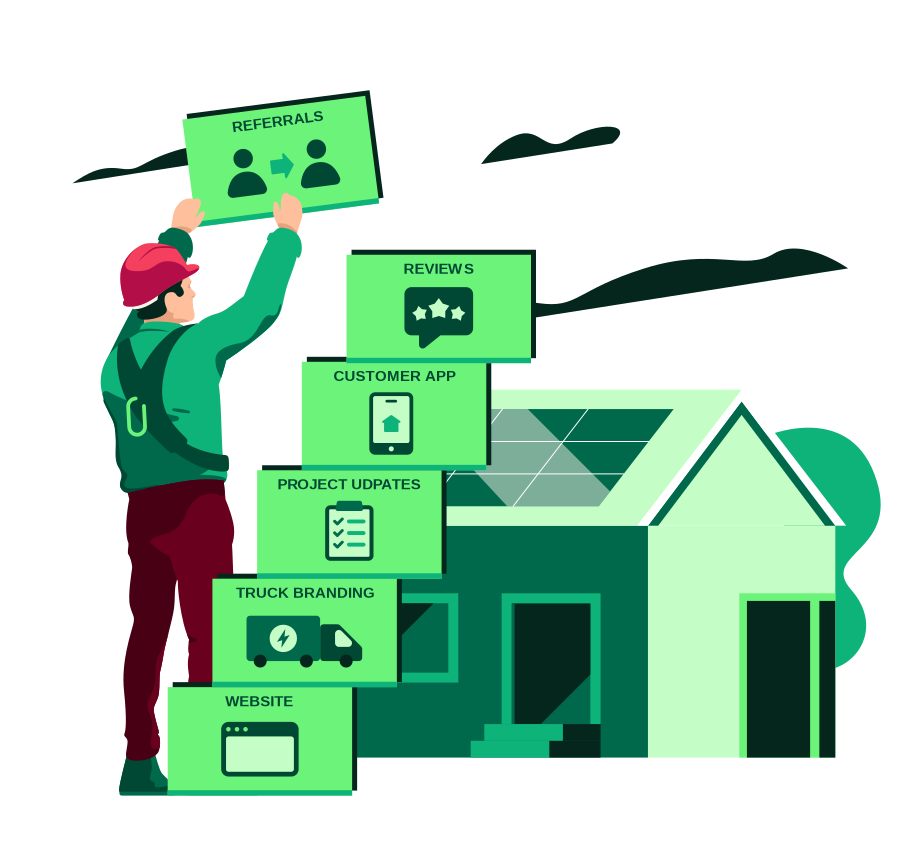
- Your company name, identity, trucks, uniforms, jobsite signs, and website
- The way leads are handled before the sale
- The clarity of your proposal and financing process
- The updates customers receive between contract and installation
- What happens when permitting or interconnection drags on
- The experience after PTO
- Where homeowners go for monitoring, documents, service, reviews, and referrals
Installers often treat these as separate operational or marketing tasks.
The homeowner does not.
To them, it is all your brand.
A gorgeous website followed by six weeks of silence is not a strong brand.
A polished proposal followed by a confused handoff to operations is not a strong brand.
A five-star installation followed by a manufacturer app filled with somebody else’s logo is an unfinished brand.
Your brand is not what you paid a designer to create.
It is what the customer learns to expect from your company.
Brand investment compounds by lowering future friction
The reason diversified investing works over long time horizons is not one spectacular day in the market.
It is accumulation.
Solar branding compounds in a similar way.
One completed installation creates a homeowner relationship.
That relationship can produce a review.
The review can improve conversion on the next lead.
A good post-PTO experience can produce a referral.
The referral can lower CAC.
A familiar app can bring the customer back when they need a battery, EV charger, service plan, system expansion, or reroof coordination.
Each customer becomes more than a closed project.
They become another small piece of the company’s distribution, reputation, and future revenue.
That is compounding.
And just like financial compounding, it looks underwhelming at the beginning.
The first truck wrap does not transform the company.
Neither does the first article, referral workflow, customer portal, or review request.
But after hundreds or thousands of projects, the gap between an installer that invested in the relationship and one that did not becomes enormous.
One company owns a recognized name and an engaged customer fleet.
The other owns a list of old addresses.
A website that converts is not the same as a splashy website
This is where the analogy can go wrong.
Spending money is not investing merely because the invoice says “marketing.”
A $60,000 website that looks expensive but produces no calls, demos, financing applications, or measurable improvement is not an index fund.
It is an expensive website.
Hiring a seasoned CMO can be a powerful investment. So can paid search, direct mail, SEO, community events, referral programs, or a branded customer app.
But only when those pieces work together.
A serious brand investment should make at least one part of the business stronger:
- More qualified homeowners recognize and trust the company
- Leads convert at a higher rate
- Customers understand what happens next
- Fewer projects are lost to confusion or silence
- More completed customers leave reviews or send referrals
- Past customers return for service and additional products
- The company depends less on buying every future opportunity
The question is not, “Did we spend more on marketing this year?”
The question is, “Did we build something that will keep producing value next year?”
Your customer app may be the closest thing to a long-term brand account
Most installers spend months earning a homeowner’s trust.
Then, after installation, they send that customer into the inverter manufacturer’s app.
Think about that.
You acquired the lead.
You sold the system.
You managed design, permitting, installation, inspection, and PTO.
Then the longest part of the customer relationship happens inside somebody else’s brand.
For a product expected to sit on the roof for decades, that is a strange place to surrender the relationship.
A branded customer app gives the homeowner a reason to keep returning to the installer’s ecosystem. They can find documents, see project information, review production, request service, refer a friend, or explore additional products without having to remember which employee texted them three years ago.
That is not just software consolidation.
It is brand infrastructure.
A customer who sees your name every time they check the system is different from one who forgets who installed it.
Brand becomes more valuable when the market gets harder
Brand investment can feel optional when leads are cheap, incentives are generous, and everyone wants solar.
That is exactly when companies tend to neglect it.
Then financing changes.
Subsidies tighten.
Paid lead costs climb.
Demand becomes less predictable.
Suddenly, the installer with strong reviews, visible local market share, a recognizable name, and thousands of reachable past customers has options.
The installer that depended on the next purchased lead has a bill.
This is why brand should not be treated as the decoration added after operations, sales, and financing are figured out.
Brand is what makes those investments accumulate instead of disappearing after each project.
The install creates proof.
The customer experience turns that proof into trust.
The brand carries that trust into the next sale.
Your brand is closer to SPY than a lottery ticket
A good brand strategy is not a viral post, one beautiful video, or a huge ad campaign that rescues the quarter.
It is closer to regularly investing in SPY.
You invest across several channels, stay consistent when one campaign underperforms, measure the returns, and give the work enough time to compound.
For a solar installer, that portfolio might include:
- A credible website built to convert local homeowners
- A clear market position instead of generic “quality and service” claims
- Consistent educational content
- Trucks and jobsites that make the company visible
- Automated project updates that reduce customer anxiety
- A review and referral system
- A branded post-PTO experience
- Ongoing communication with the installed customer fleet
No single item carries the entire portfolio.
Together, they create something difficult for a competitor to copy quickly.
Decide whether you are creating income or building an asset
There is nothing wrong with building a small solar company that supports the life you want.
Not every installer needs a CMO, a media operation, or an aggressive expansion plan.
But be honest about what you are building.
If every lead depends on your personal network, every customer relationship lives in somebody’s phone, and every project disappears from view after PTO, you may have created a good job for yourself.
You probably have not created an asset that compounds.
Start with one question:
What are we building today that will make acquiring, serving, and retaining customers easier five years from now?
The answer could be your reputation, content library, customer fleet, referral engine, website, app, or service program.
Ideally, it is all of them working together.
Cash in the wallet is useful.
But it is not a retirement plan.
And a full installation calendar, by itself, is not a brand strategy.
From "aha" to "oh crap", we're sharing everything on our journey to help install 100,000 residential solar systems per year.
We're learning a lot and so will you.
Residential solar systems installed through Sunvoy in the past year:
Real time metrics tracked bysunvoy
Before starting Sunvoy, Joe was the Co-Founder and COO of a top residential solar installer in Washington DC with 60+ employees and $12M+ in annual revenue. Now he helps solar companies scale far beyond through Sunvoy.
Next Article
Why Your Solar Tech Stack Needs a Diet