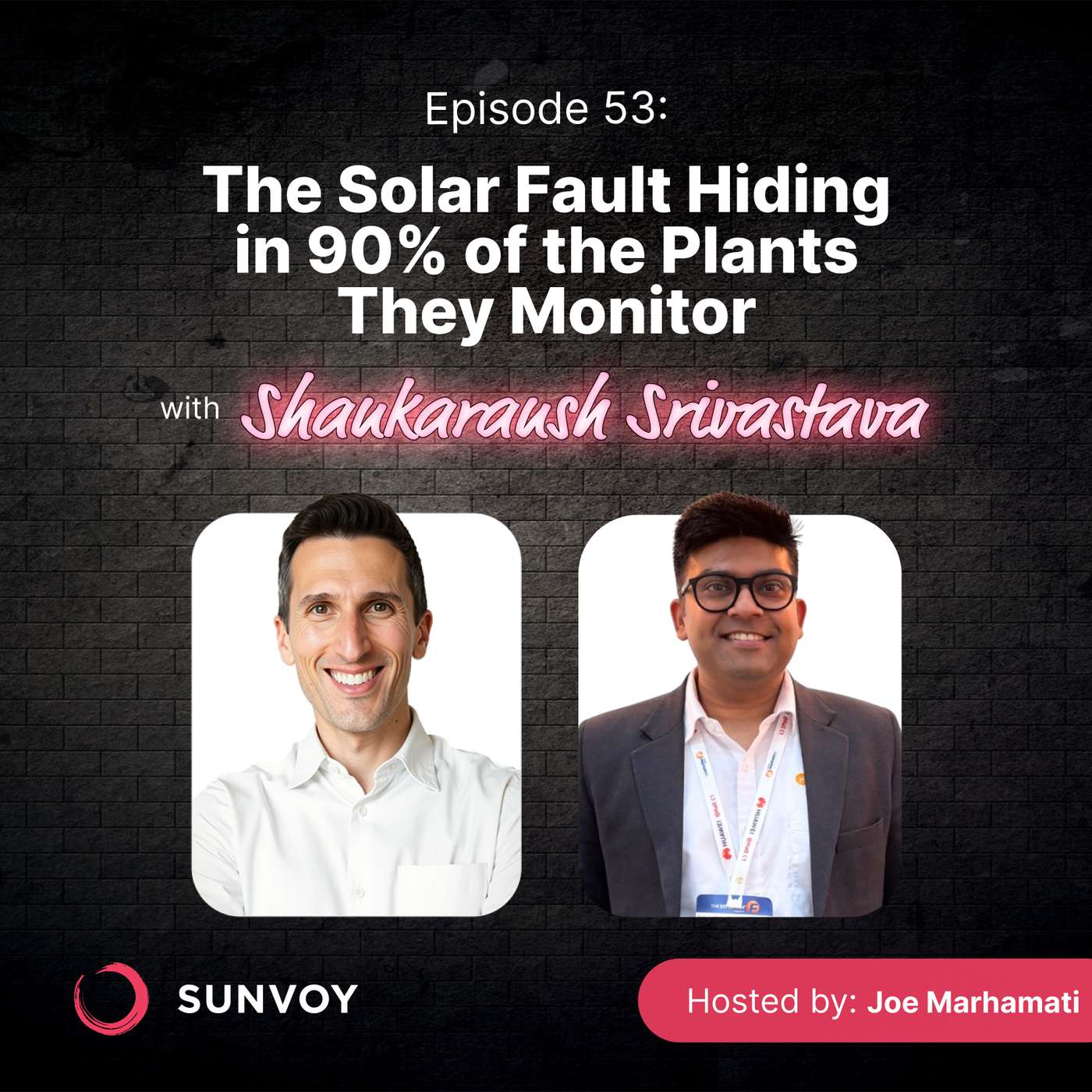
View All EpisodesEP 53
The Solar Fault Hiding in 90% of the Plants They Monitor
About this episode
Most solar O&M teams don’t have a data problem. They have a prioritization problem. In this episode, Joe talks with SmartHelio founder Shankaransh Srivastava about using AI and physics-based analytics to catch faults early, predict inverter failures, and figure out which issues are actually worth fixing first. They get into ground faults, overheating, technician response times, lost revenue, and why better monitoring only matters if your team knows what to act on.
Transcript
Joe Marhamati: I will say that our business is stronger than it has ever been. The success of growth and where I see companies growing consistently really is your people. I mean, the story is not does it make power? Because they all make power. The story is what does it power?
This is what solar installers need to know with your host Herve Billie and Joe Mahamati.
Speaker 1: Hi there. It's Herve and Joe Lourdes, Solar Installers Need to Know, where we interview solar CEOs and experts on how they run their business on the solar cluster. We ask their private revenue numbers. We give actionable advice and learn about trade secrets so you can run and grow your solar business. Joe and I built a solar company from 0 to 12,000,000 sales and got successfully acquired.
If you'd like to do the same or do better, go to sunvoy.com/blog to get actionable behind the scenes lessons on running and growing your solar business. And now without further ado, let's jump right into the next episode.
Joe Marhamati: Welcome everyone to this week's of what solar installers need to know. I am Joe Mahmadi, cofounder of Sunvoy, and I'm honored today. I have a close friend of mine, Shankar Srivastava. Did I say that right, Shankar? Almost.
Why don't you correct me?
Shankaran Srivastava: It's Shankaran Srivastava. There we go. You know,
Joe Marhamati: I've probably known you longer than just about anyone in the solar industry, but that's okay. No one can get my name right either. So nice to have you on the show.
Shankaran Srivastava: Thank you. Thank you for having me. It's a pleasure. I've been watching your podcasts, and I'm delighted to be here.
Joe Marhamati: Pleasure. And, you know, we met, gosh, well over ten years ago now when you're in The US focused on growing Green Brilliance, an installer in Northern Virginia DC area. You started your own solar business, and now you're cofounder of Smart Helio. You're NAPCEP certified. I've seen you teach students the solar industry and the technical engineering elements of solar.
You've done so much for the solar industry already in in your young career, and I'm excited to hear about what you're working on today. Tell our audience a little bit about how you got into the solar industry and why you're so passionate about it.
Shankaran Srivastava: I think why I got into it, it's it's funny because my dad worked for one of Asia's largest coal based power plant. And I was still in high school, and I remember there was some construction going on in in the power plant, and some people died. And my dad was like, you know, when you build 300, 400 feet high chimneys, people die. And this happens, and I'm like, why is this normal? And I think above all, I could see...
I I lived in the neighborhood where there were, like, you know, five, six giant power plants in India, and there was just so much pollution. Right? People getting sick because of coldness, all of that. So I think I then decided that, okay, I want to be in power generation because that's what I saw growing up. But then I was like, but definitely not cold.
And back in two thousand seven and eight, like, solar wasn't a very big thing. You know? Solar wasn't a thing where young kids pursuing engineering were like, oh, I wanna join solar industry. Right? That wasn't the thing.
But think because of my family background, I was clear that I wanna go in renewables and landed up in The US doing my master's, just specialization in renewables from Michigan, and rest is history. Solar is all I have done since 2013.
Joe Marhamati: You know, I I remember... I've been to India once. It was about exactly ten years ago. And I remember being in New Delhi, and I've never seen so much pollution in my life. I never even knew that level of pollution was physically possible.
Like, you couldn't see more than maybe a 100 feet in front of you. You know, the cars were such that you could only drive odd or even license plates on on every other day. I And remember thinking, you know, what is it this way? I know some of it's the topography. Obviously, there's a lot of people in India, and as you said, there's a lot of fossil fuel production.
And just thinking, you know, why... This seems like the number one country in the world that would benefit from solar energy. Why has it been so difficult, this transition, you know, from fossil energy to solar energy, and where does India stand today in that transition?
Shankaran Srivastava: So that's a good question. I think, of course, you were here ten years back, so the situation has become worse when it comes to pollution. But, another very interesting thing has happened, in the past ten years. The solar industry has grown more than tenfold in past ten years. Yeah.
From, I think, ten to fifteen gigawatts. Now we are close to, I believe, 140, 150. Right? So I think the need was recognized. But then there's also a need to constantly supply power to, you know, the ever increasing demand by the consumers.
Yeah. And one of the ways established technology where we already had funds and we had skilled manpower to take care of was coal. Right? So coal still exists, but not the rate of growth of solar, especially, has outpaced even coal. You know?
My dad's company, which is one of India's premium, like, thermal based power plants, they are currently heavily focused in solar. Yeah. So that transition is happening, but definitely it has to happen much faster. Yeah. It has started impacting people's health.
Joe Marhamati: And so I'm sure that was also at least part of your inspiration from, you know, getting into solar and then going from rooftop solar into what you're doing today. Tell the audience a little bit about how you made this transition from rooftop solar construction, engineering into utility scale, front of meter solar, and how you got into building Smart Helio.
Shankaran Srivastava: Yeah. I think in 2019, when I moved back to India, of course, I knew the EPC business, and that's what I started doing in India. And just very randomly, you know, through a high school friend, I got connected with this guy, Govinda, who is based out of Switzerland, and he had this idea that why don't we automate, you know, operation and maintenance. Right? And that sounded like a great idea because back in The US when we were doing rooftops, like, and maintenance was always a challenge from identifying, you know, what's going wrong to getting us...
It fixed on the site. Right? Too much back and forth. So I like that idea, and I was like, you know, let's work on this. Right?
And, we started working on it. We first targeted rooftops, and we built a software, which was just automatically diagnosing what the issue is. But then very early on, we realized that the real product market fit is, you know, in utility scale where it's a high stake gate. Right? There are large power plants.
Even if there's 1% of, under production, you are losing quite a bit of money. Right? So we started from there. But in last two years, now we have a lot of rooftop clients. But these are clients who have, you know, more than 100, you know, C and I assets spread across the country.
Joe Marhamati: Okay. Yeah. Well, it makes a lot of sense. Like, basically, any opportunity that you have to help a large solar power plant recognize an issue, particularly before it happens, is a huge ROI for that power plant. So without giving away your secret sauce, how are you able to kind of predict problems before they happen in these types of power plants?
And what... And most importantly, what kind of success have you had with getting the operators to actually take that information and do something actionable with it to save that money, that lost production?
Shankaran Srivastava: Yeah. That's... The second one is tricky. The first one is easy. So I think the best thing that happened when we started Smart Helio was getting ourselves exposed to some research grants.
And with those research grants, we started reading the electrical signals coming from solar plants. Yeah. Just the basic ones. We stuck with, you know, the first principles of physics that when a cell cracks in a module to when the MC four connectors have a loose crimp, yeah, to a bypass diode going out in a module, how is that impacting the current and voltage at a string level, at an MPPT level, at inverter level? Right?
And to to just oversimplify the findings, the finding were that each issue that's happening on the DC side is either impacting the current or voltage of both. Yeah. And we did an extensive research for a couple of years, and we took these electrical signals and converted them into into So that's how that journey started. Now there's a particular nuance to that. Multiple faults can have very similar signatures.
Yeah. So how our system would work is it would say that, look, based on the knowledge of physics that I have, I believe the highest probability why this electrical anomaly exists is because it's a disconnected string, for example. But it could also be soiling. It could also be a hot spot on a couple of modules in the string. Yeah.
So it will give a fault with highest probability, but couple of other, you know, secondary faults. Right? So that's what we do, and from there on, we realize that there are certain electrical signatures that leads to failures, you know, especially, on the inverter side. So we started tapping those electrical signatures very early on.
Joe Marhamati: And you mentioned that the second part is difficult. Why do you find it so difficult? Because you would think that if there's thousands of dollars to be saved or maybe in some case tens or hundreds of thousands of dollars to be saved and taking this advice, which I'm presuming you can show is reliable advice, seriously that all the incentive in the world would be there for the operators and the investors and the owners of these plants to do something with this intelligence. Why do you find that to be the hard part?
Shankaran Srivastava: So that's that's what we hadn't figured till we started commercially offering the solution. Right? And when we did, we realized, like, within the first year that change is something that human beings are just opposed to, you know, from from the get go. I think there's a particular way. Every every organized company has a particular way of approaching your o and m activities.
Right? You come in with a software and say something that you spend hours using your expertise to figure out there's a fault x or you send someone to the site to figure that out. My software tells that in real time. And people are like, yeah. Right.
Like, there's disbelief. There is lack of trust. I see today there are a lot of companies who are trying to build algorithms like that. But back in 2019, I hardly knew any company who was doing that. So as a solution, the concept of the solution was also pretty new.
Right? So it started with lack of trust to... Eventually, when people started going to the site, they started finding that, okay. You know? What Smart Helio is saying is making sense.
This is what I found, and I wouldn't have found it otherwise. Right? So the trust started building. It took us months. Yeah.
I mean, now it takes us a couple of months when a new client on boards. But back in 2020, you know, we were still trying to figure out our game, and I remember that it took us probably an year or more than that to really build that trust among our clients. And then, you know, they started speaking about their experience and the word spread. But... So it started with, you know, lack of trust to a prioritization problem.
Yeah. I tell you that there is a resistance isolation fault that occurs in your plant every morning, and as the sun shines, the moisture goes, and the inverter starts working. Guess what? If that inverter is a 50 kilowatt inverter and you are losing production in the first thirty minutes or first one hour of the day, does that impact you a whole lot versus you have a one megawatt or 500 kilowatt inverter that's, you know, not producing for the first one hour? You start counting your dollars.
Okay? So this was one thing. You know, depending on the size, the same problem, the financial impact, you know, that changes your prioritization. The second one was even within the same clientele, within the same 500 kilowatt inverter spread across multiple plants, you have different PPA rates. So now if there are five inverters having the same problem, your priority is to go and fix where you're losing the maximum revenue.
Yeah? So that later on became an input in the software that it's not about how much kilowatt hours you're losing. Yeah. 100 kilowatt hours being lost on two sites could have very different meaning, right, depending on your PPA rates and electricity rates. So the prioritization, the optimization of the prioritization became another problem wherein people who were using us, they were like, across my fleet of 200, 500 solar PV rooftop assets, there are so many issues that you have identified.
What do I do now? And then the following years, more than detecting the fault, being able to automatically tell that this is your priority became the bigger challenge.
Joe Marhamati: Yeah. So walk me through an example, kind of a case study where maybe you're working with an operator on a specific project, and they were unable to see some of these issues coming, maybe even after they occurred, let alone before, and how you were able to kinda save them money with the technology. Do you have an example project or customer you'd like to highlight?
Shankaran Srivastava: Give you a very simple example. You know? There was a BMW showroom, you know, and I believe it was either Germany or or France, and all of a sudden, the production drops. Yeah. Nothing had changed according to them on the roof.
Our system detects that there's shading happening bang in the middle of, you know, the day in the front row of the area, and the client was like, that's not possible. They went back to the site or maybe they called the client, whatever. I don't remember that. But it it happened to be that they put up a sign board in the front of the building right up the edge of the roof, and that was casting shad. Right?
So this is such a... You know, typically, let's say it was not for smart healer. I could go back to when I was doing EPC. Right? I would have sent someone to the site to see what's dropping the production in the middle of the ticket.
Yeah. I could have thought of multiple things, but I wouldn't have thought of shading being a reason. Yeah. Because I I know what's on the roof. Okay.
That's one example. The other one, which is also very, very subtle, is there was this new plant. It was in Spain by a company that has entered the solar market probably, like, five years back. Yeah. So not extremely well well trained staff.
But six months after the construction and the handover by the EPC, the production started to drop. And we saw that particular site had two different type of modules that they had used. And one particular make and model, the bypass diodes were going off, you know, every now and then. But how much impact was it making? We are talking about a 150 megawatt installation and 100 or 200 odd modules had their bypass diodes failed.
Not even 0.5%, you know, impact on production if you see in the entirety for a 150 megawatt plant. Now, typically, you would see that, okay, I was expecting whatever, you know, a million units. I'm making, like, you know, a few units less, so I care least. Right? But when we started reporting that, hey.
Look. This month, you had, you know, 50 bypass diodes had issues. Next month, it's 70, and six months down the line, it's already crossed 200 odd modules. That created an impact that led the site owner, the IPP, go back to the manufacturer. Yeah.
And eventually, I think after a year or so, they end up replacing most of those modules. And because this was, like, kind of, like, spreading like in cancer, could have been just a bad batch of modules. Yeah. But the point that I wanna make is the overall impact on production was so low to begin with, they would have probably caught it. I'm not saying that it was because of Smart Helio that they caught, but it was because of Smart Helio that they caught it early on.
They would have caught it when the cancer would have spread to, you know, 500 or a thousand modules, you know, because that's when you would have started seeing a good percentage of drop in production.
Joe Marhamati: So when you look across all the projects that you've worked with and all the different customers, do you see any particular trends in terms of what causes... Tends to cause issues and what you're able to spot, you know, before there's a catastrophic loss or drop in production? Is it wiring? Is it inverter faults? Is it kind of anomalous things like you just described?
Are there any sort of patterns in the data?
Shankaran Srivastava: So I'm very happy that I started off as a design engineer and ultimately, you know, doing the EPC and mentoring those construction because that's where most of the problem lies. How you're designing, are you taking care of, you know, there's enough ventilation of the inverters of the modules? You know, when you're doing industrial rooftops, are the modules closer to some exhaust or HVAC units? Right? Where are your inverters placed?
How well have you done your wiring? Did you try to save that extra $500 on a $20,000 install? That would create problems, you know, three years down the line. So design and installation, even today, are the biggest cause of, you know, production issues, performance issues in the system. So much so...
Like, I I didn't know this, Joe, but if modules have persistent shade, it takes five or six years, but those modules would start degrading faster than the non shaded modules. And we have done this study across multiple sites with more than three years of data. Yeah. So now you see, like, as an EPC or even as an IPP or whatever, I'm trying to maximize my land. I'm trying to maximize my rooftop.
But these minor issues in the long run, they are problematic. Yeah. But the long run, we are talking about, you know, after three years or five years when I have already built, you know, hundreds of other assets that I'm more concerned about and my older assets underperforming by a couple of percentage less than what I anticipated. Yeah. If you look at just the physical faults, those are causing maximum performance issues.
Most of them are related with inverters. And I don't know if if you would agree, but the data that we have processed with about eight gigawatt of assets across, like, four continents, we are talking about, like, 20 plus countries, the most recurring issue is the inverter being shut off because there was a ground. Where is the ground fault coming from? Loose connectors, cross mated m c four connectors, a loose crimp in the m c four. Your junction boxes, the weather sealing of the junction boxes going bad, moisture entering the circuits.
You used, you know, some... The wire management was a problem and the wires, eventually, there was a wear and tear. And now when a wind blows, it touches a part of the racking or module and then there's a crown fault. Yeah. So almost all of the crown faults were either installation or a lack or oversight of the regular maintenance checks that you should be doing at least once a year.
The second biggest one is inverter heating issues that has not only led to underperformance, but in some extreme cases. Yeah. And I'm talking about probably 15 odd cases that we were able to successfully predict that these heating issues are causing... Are gonna, you know, have a permanent failure in the inverters. Yeah.
So, yeah, heating issues are are the second, and I think heating issues has a little less to do with how systems are installed unless you have installed the inverter in a location where the ambient temperature is kind of, like, bound to increase. But for the most part, it was about the OEM stated operation and maintenance protocols that you should have followed to maintain the life of the inverter, and these were not
Joe Marhamati: It's super interesting to me. So how common is that? Yeah. Are we talking about 10% of plants, 50% of plants? Because you would...
On the one hand, you would think that these plants would go through an inspection process that would catch those kinds of things. But, obviously, for the larger plants, there may be thousands or millions of connection points that you can't possibly inspect all of them. So I'm curious how common is this? Ground fault.
Shankaran Srivastava: Just ground fault or resistance isolation fault. It's very difficult for me to open a site on my platform and not find a ground or a resistance isolation fault in the past six months. When I say that, I'm guessing... I don't have the exact number, but definitely over 90% of the eight gigawatt portfolio that we currently monitor, they have ground fault issue. Heating issue is not a lot, probably less than 20% of the assets that we see.
But interestingly, in the past one year, that frequency has increased. And, you know, at the end of every year, we we try to, you know, accumulate all of our data and see if we can understand any trend. And one of the things that we see that as the plants or the inverters are growing more than five years or older, the problem of inverter heating, the fans not working well or thus being accumulated or it not being wet... Ventilated better or ventilated adequately has started to, you know, come up more frequently. My guess is that probably when inverters are new, they're able to handle that additional heat or unnecessary heat a little bit better.
But if that's more persistent, again, this is just what I think is happening. I don't know the exact root cause, but even in inverters where the fans are working fine, Right? I believe the electronic components or the ears, if they are persistently under some heat, the electronic components become weak. Yeah. And then they start derating because derating of the inverters is one of the things that I have seen the most afterground fault in the portfolio that that we see.
And now the average age of the plants is a little over five years.
Joe Marhamati: But, of course, there's a opportunity cost to fixing any of these issues. Right? If it's something that's, you know, relatively minor that would cost more to go out and repair than you would save in production or is kind of a marginal decision, I'm guessing that must happen a lot. So how do you think about and how do you advise operators to look at what really constitutes a major issue that is gonna have a high ROI versus something that's maybe more noise than signal?
Shankaran Srivastava: That's correct. And that's when I said there were two adoption challenges to begin with, lack of trust, and eventually, it was an optimization problem. Honestly, Joe, we are still working on this problem, but a couple of things that we have figured out, it's basic, like you said. Yeah. We both have run EPC businesses.
And if, like... Even if in a residential install, a SolarEdge optimizer goes bad, I know I would end up paying, like, between 300 to $500 to my technician to go and even replace that one optimizer. Yeah. How much production am I losing in an year because of that one optimizer? Yeah.
It's the same problem in commercial, you know, irrespective of the size of the system. And that's where we added an optimization layer. There, again, this is what you're losing. This much energy you are projected to lose in the next one month, what's your cost of fixing a cost of site visit? Yeah.
So we have put that optimization into play, you know, when we help our clients prioritize the problems. And these are the places we are we are using the AI to help prioritize. But then when you dig down the layer... And that's why I'm I'm saying it's work in progress because if I have to fix something in an inverter, probably I am sending my master electrician or one of my more mature technicians to the site. Yeah.
If it's a known issue like a disconnected string, I know there are a couple of points to check. I might not send my best guy out. Yeah. So that... The nature of the problem.
Yeah. Whether it's so in your is your in house crew or now, you know, most of the o and m is is third party, especially in the commercial world, yeah, and utility world. The pricing also changes with the nature of the problem they need to go and solve on the site. Yeah. So having that tiered pricing approach to optimize the problem.
That's one thing currently we just go off of a flat price. But the other problem is, especially in utility scale plants, that, okay, now I'm on the site. I'm fixing an inverter. But guess what? I also know that for the past two months, there are 10 disconnected strings in some other inverter.
Yeah. And it's... The property is... The solar plant is spread across five, 10, 20 acres of land. So should I still go and fix the inverter and then drive couple of acres of land to reach to those strings that I need to fix.
Yeah? How much time that is? Right? That's another optimization problem because actually this 150 megawatt plant in Spain that I was talking about, that's the real scenario that happened. And he was like, look.
The to and fro to fix those five strings of 30 modules each is gonna cost me, like, two hours. Yeah. So I'm probably gonna fix it if for whatever reason I'm there. So when you peel the layers of the optimization problem, you know, to help prioritize as an onion, you keep peeling and there's a new layer. There's a new layer.
Joe Marhamati: It... That's so interest... It's interesting to me that the technology, which is clearly impressive that you guys have built that I haven't seen anywhere else, is easier than the human change problem. I mean, it's not uncommon, but I wonder how, you know, AI has started to inject itself into what you guys are building both on the technology side and the human side? Because it seems like it could be extraordinarily helpful to just have a smart Helio dashboard in your control room that says, okay.
Here are the issues. Here's what it might cost you, and here's what it's gonna cost you to go fix. And here's the ROI kinda triaging from highest ROI to lowest ROI. So where do you see AI coming in terms of the optimization problem, the human problem, and on the technology side? How has it changed the company?
Shankaran Srivastava: Yeah. I think I'll I'll start with the technology. So the first couple of years after our research, when we commercially launched it, for good three years after that, we did not deploy machine learning or AI on our core technology. It was purely based on physics. Now what happened in those three to four years, if I say it is fault x, but I also say it could be fault I and z.
Right? We have a complete ticketing system. So now we have data wherein the technician said, oh, we went to the site. There is a problem, but it's not x. It was either y or z.
In some cases, we have collected feedback that... And all of this is happening on our on our software. It's it's called autopilot, where they say it was neither x nor y nor z. It was problem b on the site. We have that data as well.
Now where we used technology was a localized machine learning that for each site based on the feedback that we are receiving from the technician and it was validated by the operation maintenance manager or the asset manager, we let our software learn from these feedback. The key was that the learning is happening at a site level. Just to give you an example, if the data that I'm collecting is from a combiner box, is a combination of, like, 20 strings. Yeah? And let's say I was expecting 200 amps, but I'm getting one ninety amps.
So the first thing that the system thinks, one of the strings is disconnected. Yeah? Because each string was supposed to produce 10 amps, for example. In reality, what happened, there was just soiling on the modules that reduced 0.5 amperes from all the strings. And in combination, I see 10 amperes dropping.
Right? So now the technician says, hey, it wasn't disconnected string, it was soiled. All the strings were producing. Right? So then the system in...
Now I cannot generalize that. Yeah. There could be another system absolutely clean. Yeah. And there's a 10 ampere drop.
Yeah. There could be a real disconnected string. So I think the classification of the fault is where the technology helped us. That was the first time or or the first aspect where we used, you know, AI and machine learning. The second one is is actually that that we ended up kind of, like, deep prioritizing, but I'll tell you why we started working on the second problem.
The second one was when we saw that the meantime to resolve was a few weeks even for critical faults. Yeah. So we thought that it's a incentivization problem. What's the incentive of a technician or a third party to go when they have fixed contract, fixed salaries? Yeah.
So the next problem we started working was through AI, we would generate a ranking of technicians, ranking of different third party contractors, you know, that how many issues were reported, what was the meantime, to respond, how much additional revenue they help you generate because they fixed a problem, you know, within few hours versus another contractor in few weeks. We did that, and it did impact. Yeah? For a matter of fact, there are a couple of webinars on our website where the CEO of these companies have come and say that within three months, the meantime to resolve reduced from few weeks to sometimes under seventy two hours. Yeah?
Because there was... It was more transparent to every stakeholder within the company is who is performing good, who is performing bad. So everyone was, like, image conscious, all of that. But but then we could only get to, you know, a certain client with certain clients. And then we realized after probably a year and a half that the prioritization of issues is the bigger problem.
Yeah. When we started building more relationship with the technicians, we got to hear from them directly. Yeah. We started visiting, you know, our clients in in The US, in Europe, in Africa, in Japan, and really understand from the end user, you know, who, if they do not act, there is no impact of the technology that I built. Yeah?
We were working with asset managers, o and m managers, CXOs, and we were thinking, oh, these guys will push the change to the last person in in the tree. Right? But but... No. That didn't work out as good as us directly going to the technician and talking, and that's where the entire problem of prioritization came out.
Yeah. So it's a complex problem. I wouldn't lie. I think we are, like, 60, 70, maybe. 70 could be an overkill, but 60% there with technology, with AI.
Because now with all the wide coding and all of that, if I have to, you know, write those logics of optimization myself, it's gonna take some time. So I think that's also where technologies is really helping us. You know? Just build prototypes, technologies, and go to the market and test out new features faster. Get feedback and reiterate faster.
Joe Marhamati: Yeah. Last question. You're a smart guy. I know you must think about this. Where do you see renewable energy in the year 2050?
Obviously, a lot of folks have talked in the last decade about getting net zero by 2050. Do you see that as realistic based on, you know, where you see the current landscape and current trends? And how do you see the vision and trajectory of Smart Helio tie into what that world will look like in 2050?
Shankaran Srivastava: I mean, definitely, the world is accelerating towards cleaner energy. There's there's no doubt about it. But when you talk about net zero, I haven't done my math, but I'm not convinced because even if I'm producing 100% renewable, right, I have my solar, I have some winds, I have battery. Yeah? But how much carbon did I emit in manufacturing them?
How much loss am I doing to the environment by pushing modules or batteries or whatever in landfills? Yeah. So for me, the the net zero equation is really a net zero impact on the environment based on the systems that we have in place now. And also, like, 2050 is not very far away. Yeah.
It has to be very policy driven. What do we do about discarding when these components come to end of life? Yeah. So I... We'll see where we get there, but from from just energy point of view.
Yeah. So net zero, my answer would be will become better, definitely better, but I don't see us becoming net zero unless governments have a push. Yeah. Coming to just... This is a technology or how I see the energy landscape changing and where smart helium would fit in.
See, I think the stability of the grid is already in question in in a lot of grids across the world. Yeah. There's a reason why grid curtailment is... You know, when you talk about solar now, you talk about curtailment. Yeah.
You talk about Spain. You talk about California. You talk about Australia. You know? It's everywhere.
Japan is crazy. You know? We started expanding in Japan since last year, and grid curtailment is crazy. What's the answer to curtailing? In my opinion, it's storage, you know, whether it's lithium ion or whatever, but storage would be the next big thing.
Grid stability would be the next big thing. I think one of the ways that the industry and the society would carve out of making the grid stable is really building their own grids. Yeah. Virtual power plants are bound to increase. Self sustainable communities, you know, those are not in any way interacting interacting with with the main grid.
Yeah. I think those kind of solutions would become little more mainstream. Yeah. Just decentralization of energy systems to put it that way. Yeah.
I see that happening. And in all of this, energy trading is gonna be the backbone. Yeah. Even if you're building a self sustainable community, I need to know that Joe is running low on battery. I need to be able to predict that it's a summer month, and Joe is gonna need another 20 kilowatt hours to sustain rest of the day.
But for some reason, there was some problem. His battery is not charged. I should be discharging to Joe now. Yeah. From there to, you know, even there's so much negative pricing.
Yeah. So to maximize my ROI, I need to dynamically understand, predict, act, and meet my system in a way that I am injecting to the grid when I'm able to maximize my profit. When there is negative pricing, I I play with the batteries. So I think I think, you know, long story short, energy trading would become very, very critical to the centralized and the decentralized grid. And that's where, you know, sometimes when we discuss what's in for us five years, ten years down the line, I think that's the route.
If the industry goes, we would love to.
Joe Marhamati: Well, it's always such a pleasure talking with you. Always learn something. Where can people find you, if they wanna learn more, if they wanna get a demo of the technology, they wanna see what it can do for their project or for their company?
Shankaran Srivastava: I think Linden is the first place, but, I mean, feel free to share my email. I'm fine with that. So if someone is interested, they can talk.
Joe Marhamati: And smarthelio.com, is that the company's website?
Shankaran Srivastava: That's correct.
Joe Marhamati: Shankar, thank you for joining us today. I I hope that a lot of owner operators, o and m folks got to enjoy this conversation. I learned a ton, and it's a pleasure to call you a friend. Thank you for joining us on what solar installers need to know today.
Shankaran Srivastava: Thank you, Joe, and pleasure and an honor of being on this show with you. Thank you.
Joe Marhamati: Thank you everyone for joining, and we'll see you next time.
Speaker 1: If you'd like to do the same or do better, go to sunvoy.com/blog and get actionable behind the scenes lessons on running and growing your solar business.