Voir tous les épisodesEP 52
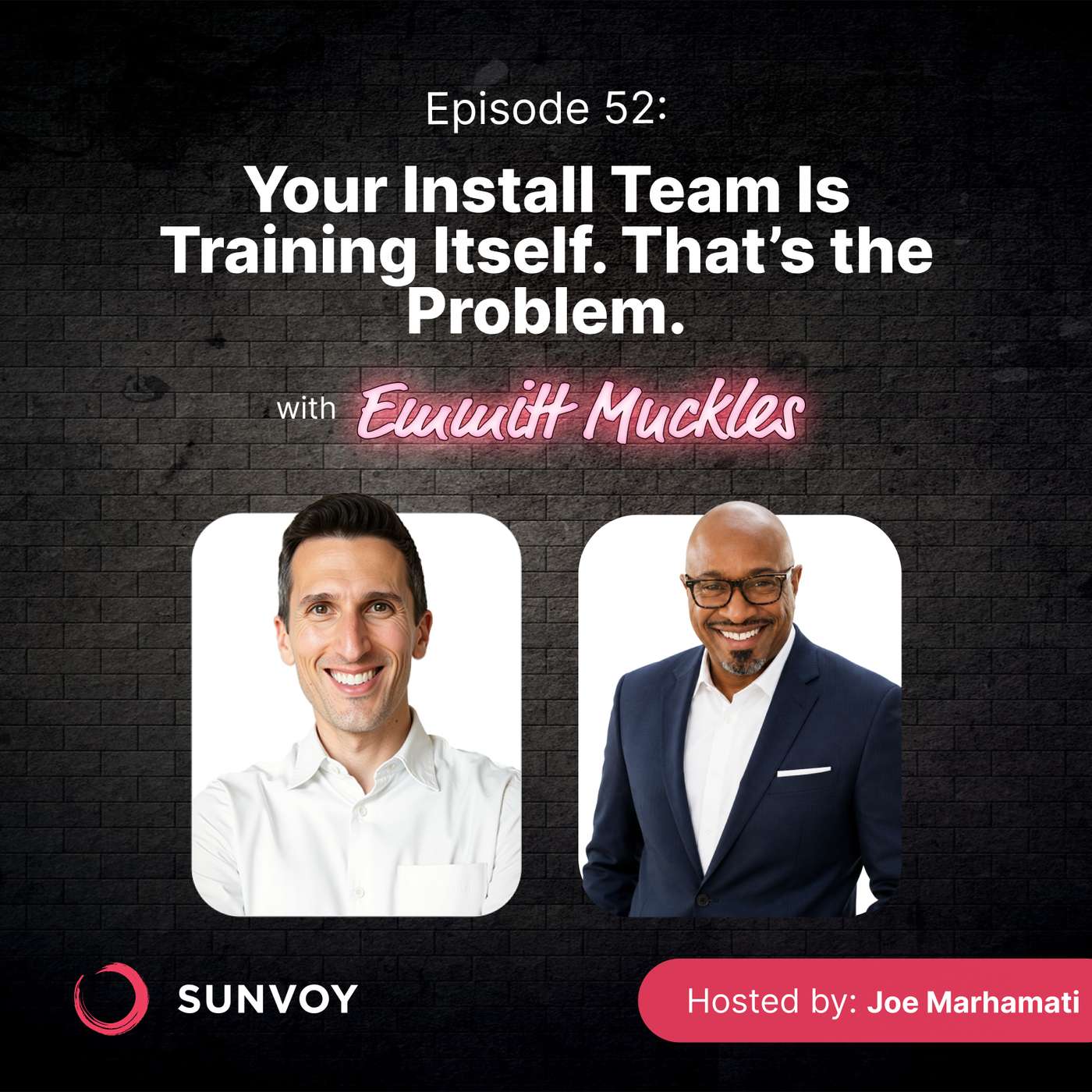
Your Install Team Is Training Itself. That’s the Problem.
À propos de cet épisode
A lot of solar companies don’t have a people problem. They have a process problem.
In this episode, Joe talks with solar trainer and industry veteran Emmett Muckles about why missing SOPs, inconsistent training, and “learn it on the job” culture quietly drive up costs. They get into commercial O&M, workforce development, distressed solar assets, real estate education, and the operational changes installers need to scale without creating more service problems later.
Transcription
Joe Marhamati (00:03.763)
Hey everybody, welcome to What Solar Installers Need to Know, brought to you by Sunvoy. My name is Joe Marhamati and I am honored to welcome Emmett Muckles to this edition of the podcast. Hey man.
Emmitt (00:15.79)
How you doing?
Joe Marhamati (00:17.543)
I'm doing great. Now that I'm with you, I'm gonna tell the same story that you told everybody on your podcast, but from my POV. So I was in San Diego. What was that? Three and a half months ago. I was walking into the convention center, and this guy turns around and says, I think I know you. And I'm like, Okay. Do I know you? Maybe I know you. and And you convinced me that we know each other. and then that was the start of a beautiful friendship. And he came over, yeah.
Emmitt (00:24.141)
Right.
Emmitt (00:45.228)
No, we we knew each we knew each other via social media. How's how's that how's that's a good way to put it?
Joe Marhamati (00:55.186)
Yeah, yeah. We're we're acquaintances via the internet. Like like everybody.
Emmitt (00:58.924)
Yeah, and I was like, that guy looked I was like, and I'm like that with faces. I may not remember your name, but I'll remember your face. And I was like, I know that dude.
Joe Marhamati (01:08.988)
You you convinced me that we were like lifelong friends, you know? And I was like now now you are. Yeah. And
Emmitt (01:12.31)
I'm like, we are.
I mean, you gotta think about life, dude. We're here for each other. It's just we've just missed each other until now.
Joe Marhamati (01:24.645)
You know you know the bet one of the best pieces of advice I ever got was from Nico Johnson and I think he got it from somebody else. And it's your network is your net worth. Have you ever heard that before?
Emmitt (01:35.337)
yeah. It is. It is so true.
Joe Marhamati (01:37.369)
Okay, well I isn't it so true? I was like, wow, that really that blew my mind. That's a great great piece of advice. Right.
Emmitt (01:43.522)
I mean your first network is your family, right? Your immediate biological family. When you need something, all you have to do is ask either your mom, your dad, your brother, sister, or your crazy uncles. You need your oil chains, your crazy uncles will show you how to do it, right? You need
Joe Marhamati (02:01.732)
Or a tire change or yeah.
Emmitt (02:03.136)
Or a tire change, your crazy uncle will show you how to do it, right? But then when you once you hit 18, you have to develop another network. And that's what carries you through life. You know, a lot of times if you go to college, you join a fraternity or sorority. That's like the quick version of the network.
Joe Marhamati (02:06.97)
True.
Joe Marhamati (02:29.505)
Right.
Emmitt (02:30.644)
Or you're on a sports team, quick version. For us nerds, we have to we have to go the slower route. I'm talking about myself as the nerd. You might not be a nerd, but I am. I am. I'm an anomaly.
Joe Marhamati (02:43.619)
You're pretty extroverted nerd. I mean, you know, just because you have na that's pe just because you're a NABCEP P V I P, you know, doesn't mean that you're a total nerd. Like, you know, you're you're you're pretty extroverted, man.
Emmitt (02:56.19)
I am pretty extra. I'm I'm an introvert extrovert, which means I'm on when I'm on, but then when I come back to the fortress of solitude, shut your pie hole. I need silence. Yeah.
Joe Marhamati (03:09.519)
You gotta recharge your battery. You need a level three charger to get back out there.
Emmitt (03:16.652)
I do, I do. I need I don't want to say any names. But you know, the biggest thing for me right now in leveraging my network is because you you know what my passion is. My passion is enabling people to do the job that they need to do, which means training, wisdom, sharing knowledge, and we got away from it, so to speak, in a certain degree, when twenty twenty happened.
Joe Marhamati (03:47.649)
Yeah. Yeah. A lot a lot happens in person that is hard to quantify, right? That's kind of what I took away from the last my God, has it been six years? Wow. It's like these hallway conversations, these water cooler conversations, these incidental interactions, there is just an enormous amount of information that's passed along incidentally that is not being passed along. And now you've got
Emmitt (04:13.196)
Yeah.
Joe Marhamati (04:16.375)
Folks who they only want to interact through text, they don't even want to hear your voice, you know, and it's like, okay, I know I sound like I'm a hundred and twenty years old, but the world has really changed a lot in these last six years. And so you're out there on the road doing in person trainings, is that what you're trying to say?
Emmitt (04:29.516)
Well yeah, I'm doing in person training. I'm doing I'm using all the methods and techniques we have available to us. So I'm gonna go back. I'm gonna make this analogy. Imagine you as a child coming into this earth and you had to learn everything that you learned, but your mom said, Hey.
I'm gonna sit you down in front of this computer every day until you're able to go to school and you're gonna learn everything you need to. You're gonna learn to walk, talk, go to the bathroom, eat, sleep from an online presentation.
Joe Marhamati (05:17.74)
I don't know. We might be about ten years away from that actually.
Emmitt (05:20.886)
I mean, but imagine how that would go. It doesn't change because we age. We still need human interaction to show us the way. We need somebody to walk us through the wilderness. I'm not saying it's necessarily me, but I think we need to have an earnest conversation to say, what do our what does our workforce need? Because we've come to this, and I don't know how. We've come to this thing like,
Hey, when I hire somebody, they should be fully formed.
Joe Marhamati (05:56.339)
Yeah, that's not happening. That's not happening.
Emmitt (05:56.399)
They're not. They don't know what you your preferences are. They may not know the particular way the job or occupation is for you and your standards. Or they maybe have another different skill set that's adaptable to what you want them to do, but you have to help them along.
Joe Marhamati (06:21.402)
It's true. And so so are you mostly working with installers now, or are you working with OEMs or you're working with with all the above?
Emmitt (06:28.642)
My man, I'm working with everybody. It it it a ma it amazes me because one one thing I have this cool ability, thanks to the universe, is to see OPP. I'm done with OPP. Yeah, you know me. Other people's problems.
Joe Marhamati (06:31.985)
Okay.
Joe Marhamati (06:43.474)
Okay, tell me more.
Joe Marhamati (06:49.709)
yeah. That's right. What year was that song?
Emmitt (06:53.068)
I was like 91, 93. I don't know. Anywho, because of training, because training solves a problem. And as a trainer, you recognize humans' problems and adapting messages. That can be brought now to a bigger scope. Okay, what's this? What problem is this company having that we need to address? Okay, training.
Joe Marhamati (06:56.051)
Man, we're really dating ourselves. Okay.
Emmitt (07:22.07)
is kind of a symptom, but what's the problem behind that symptom?
you don't have SOPs. Ooh.
Like you don't have a procedure of how to do things. You don't have anything to tell the people that are already there that know how to do it if they're doing it right. Because things change.
Joe Marhamati (07:42.526)
It's com it's so com it's so common, it's scary. Like so w when you see like a tip top solar company that has like a training program and protocol and like the the the root you know, the mock roof and the whole thing
What does that look like to you? Like what's like the best solar training program you've seen from a company that's not Sunrun? You know, that's like your median solar installer. I don't even know I don't even know if Sunrun has a good training program actually.
Emmitt (08:08.878)
Sunrun had a really good program, actually. They had they had a top notch and they were investing in people. They had, and I'm just using them as an example. They had because I was a trainer there, we had a 45 degree pitch roof. That was yeah, we had a no, that was a workup too. We had a 22 degree pitch roof.
Joe Marhamati (08:26.479)
Whoa. That was the starter roof?
Joe Marhamati (08:35.131)
Yeah.
Emmitt (08:35.638)
Had like a 15 that was on a roll cart. So you started on the 15, you moved up to the 22. Then we really got to understand how your harness and everything works because you had to tie in, you had to use a hook to get up to the top. Then you had to tie in in your harness so you could put an array on this training roof that's 45 degrees.
Joe Marhamati (09:02.599)
Wow. Okay, so this is my experience running a solar business. You install your first few projects, you hire your first few guys, and then it's on-the-job training. This is how you do it, and then they train the next guy, and then they train the next guy, and then they train the next guy, and it's all kind of ad hoc. Like you say, there's barely an SOP, any SOPs. Everyone's just training the trainer.
I'm sure that's like most of what you see. So when you come into a solar business like that, th that's kind of what's going on. Do you have something like off the shelf that you can hand them that's like, here's a training program and here's how you do it? Or okay, so what does that look like?
Emmitt (09:37.091)
Yes. Yeah, yes. So that looks like the basics. The very basics. You should know the why and understand the why and understand the how. It's not just Legos. Okay, this has six dots that protrude up, and this has six receptacles. So that goes together. Anyone can do that. If you need to troubleshoot or if you have a if you install and you're like, it's not working, you need to know the why.
So you need to start off with the math, the Ohm's law, which is very simple. And if and you make it really simple for people to understand how modules go together, how an array is built, what an inverter is for, yada, yada, yada, yada. Get the basics out the way. Then you get into, that's why we're plugging these things together. That's how the inverter works. This is why we have this many modules.
Joe Marhamati (10:28.519)
Ha
Emmitt (10:34.964)
This is why we have racking so it doesn't fly off the roof when tornado season comes or when it doesn't crash down because we got a snowload. There's just tons of stuff. But yes, there's a fundamental program that is available. But most of my work has been in commercial, believers.
Joe Marhamati (10:56.679)
Okay. Okay. But that that's really hard. Commercial stuff. When you're putting up even 500 KW, try to take try to get it as efficient as possible, right? So that you're installing and the number of days you expect and you don't have the unknown unknowns. And I mean, those projects are really challenging, especially if you're coming from residential, right?
Emmitt (11:16.44)
Yeah. No, well, not I like I said, I'm a nerd for this stuff. It it really wasn't a hard transition. But most of mine because I come from a troubleshooting background. I worked in tier three automotive and electronics where I built systems, repaired systems and things like that. And then I came into solar, it was like, this is cake, you know, compared to like some of the things you have to learn, but it's gotten more complex.
But when it comes to commercial, this is more on the distressed side or the OM side of things. Because, you know, we've we've gone through a transition. We've gone from resident, residential, residential, residential to now you have all these workers and the residential installs are are dropping. Where are they gonna go? Now's the perfect time for them to do OM. So one of the things I've been on the lookout for and it
If you have access to this, reach out to me is distressed sites so that we can get them back up to running. Because there's some sites that are owners just like, we don't want to resuscitate it. I got a deal for you. Because we need these sites going because we got data centers going in. We got more EV cars, automobiles that are on the road. So our system needs these things to keep it bolstered up and running.
And there needs to be a process of keeping them running. That's what I do, whether it's training or just take it over.
Joe Marhamati (12:54.036)
What does take it over mean?
Emmitt (12:55.522)
Give it here. I'll buy it from you.
Joe Marhamati (12:58.718)
Really? You're buying solar projects?
Joe Marhamati (13:03.514)
Okay, all right. Well, if anyone's listening out there who's trying to sell their solar project - so g give me give an example of a of a project that you're interested in.
Emmitt (13:11.992)
So there's a couple of sites in Minnesota that I'm looking at that are this distrect, they're old, you know, they're like ten years old. All the incentives have been extracted, all the PPA is still there. But it's not really worth anybody to like, it's making money. But do we want to really maybe repower this or go find these modules that are ten years old and
Really get this string back up running or this inverter, that's a central inverter, and we got one string down. It's still producing some, we're still making some money off of it. But you have to invest in these things. Not only just cutting the grass, you need to make sure that you don't have ground faults, pests that are on site. Make sure that it's an asset to the community. And if you're having problems with that, I can work out some deals from you. I don't have to own it all right.
I can work with you so that you can get these things moving back to go. Hey man, I am moving. I am very committed to this industry. So much so. You ready for it? I've been looking for the underserved communities. It's not what you think. You know what's the most underserved community in solar?
Joe Marhamati (14:24.165)
Ready.
Emmitt (14:39.158)
Real estate agents.
Joe Marhamati (14:41.8)
I know. my God. I tried so hard to tap this market in my own solar business. But it's difficult, right? Because they're like anybody, their mind is focused on selling their core product that they know, right? So trying to get anybody to sell this other thing that's not their thing, that's kind of technical, it's actually I found it really hard, but maybe maybe the industry has shifted. Tell me.
Emmitt (15:03.33)
You know why? Because I this is what I thought about. We thought about You thought about it from your point of view. You didn't think about it from their point of view. So I said, let me let me sit out here with the sun basking on my face in my morning coffee. How could I help real estate agents? And I was like, they what's their pain point? Their pain point is the fact that they don't know contracts.
Joe Marhamati (15:10.716)
Of course. Yeah.
Emmitt (15:32.472)
They don't know PPAs. They don't know leases. They don't know equipment. They don't know the red flags. So they try to avoid them when they try listing or buying a house. So I made a course that walks them through this so they can go, that's that, that, that, that, that. I need to check this. I need to check that. So when they get to their customer, they can say, we're good to go, or you need to do this so we can move forward.
Joe Marhamati (15:59.258)
Is that a heat spring course? Where do you find that?
Emmitt (16:01.794)
You can find it on R E A. It's being released this week. I know I'm dating this, but it'll be released in the month of June.
Joe Marhamati (16:09.276)
Wow.
Okay, so a real estate agent would sign up for this course and then they would understand the ins and outs of s of residential solar.
Emmitt (16:18.072)
They would understand, they would understand what a PPA is and what it does. They will understand what pace loans and how they adapt to the solar. They will understand how to talk to appraisers. They will understand how to navigate. They will understand the difference between a own system, a lease system, and a power purchase agreement. They will understand that there might they have to
roll in the EV vehicle because it may be tied to the PV system and it may be leased or loaned or something like that. These are all the things that throw the deal off when they get to the table. Like, you mean after we sell this house, after you purchase this house, somebody's going to come and tear your roof up and take off everything. Because you're because they don't want to pay. Or
You know, there there's a bunch of scenarios that can happen out there and they need to be ready for this.
Joe Marhamati (17:20.996)
So so what's your opinion on the third party own? Because I you know, I hear all sides, the companies I generally work with and and my, you know, community, the amicus kind of community, I think tends to be kind of against it, you know, pro cash and and loan and own your own system. But then with all the changes and the tax code, obviously the momentum is moving in the direction of third party owned just because of the deals that homeowners can get, the ROI relative to owning their system, but then they have the liability of this thing that they don't own on their home when they go to sell it.
And so this is this big divide in the industry about whether this should even be a thing, whether you should even be talking to customers about it. What what is your view?
Emmitt (18:01.492)
If it's a if you're gonna be in your house for 20 some odd years, I think it's like the next level, a different level of PPA. It's a different fintech, financial tech that keeps us viable. Outside of that, I am a direct proponent of ownership. That's one of the problems that we're running into, is that we haven't figured out how to structure deals so that they're affordable. Think about it like this.
Joe Marhamati (18:20.131)
Me too.
Emmitt (18:31.82)
Somebody pays sixty grand for their car, right? They pay seven, eight hundred dollars a month. I don't know because I I own my car.
Joe Marhamati (18:40.281)
That's a lot that's an expensive car, but I guess some people are paying that much. No, get out of here. Sixty thousand is the average for a car now? I haven't bought a car in a while.
Emmitt (18:44.738)
That's that that's that's average my man.
So if you go get a tr if you go get a a truck, a F one fifty, you gonna pin sixty grand easy.
Joe Marhamati (18:58.912)
Wow. Price has gone up on vehicles. Okay.
Emmitt (19:00.556)
So, plus you have insurance, but they lay you out of contract. You're gonna pay this much for this many years, which is, and then I think this is part of the problem. We look at the life expectancy of a PV system and say, we're gonna base it on that. No, base it on recoup quick. Five or ten years, you finance this system, that's how much it costs. Then the prices would start.
The labor prices and all that would start to to adjust. So if it works for you, that's great. If you, if it can lower your bill, if it can save you some money in the short and long run, great. If it's not the right financial instrument for you, I'm against it. And that's it's like the difference between, hey, and I'm gonna use the car analogy because I'm from Detroit.
Joe Marhamati (19:42.519)
Mm-hmm. Right, we're own it.
Emmitt (19:57.049)
Do you want to lease your car? Do you want to own your car? Or do you want to go to enterprise and rent one when you need one? Or do you just want to Uber?
Joe Marhamati (20:06.288)
Sure, but it but it's this is something on your house, right? So it's a little bit different because you might need to to sell your house sooner than you think, or you you might need to move for reasons that you don't understand. And so it is a little bit unique in that way.
Emmitt (20:16.6)
Yes. Yes, people aren't in their houses for 30 years anymore. People are in their houses maybe 10, 15. And then you have to think about it like this. Let's say Joe buys a house. Joe has a spouse, and Joe has two kids. They are one year old and five years old. And
Joe Marhamati (20:21.437)
No.
Emmitt (20:44.344)
15 years, they're gonna be 16 and 21. They're gonna be out of there. All of a sudden, your house is huge. You're like, why am I still in this gigundous house? Let's downsize or let's get something that fits our life. Let's get a two-bedroom instead of a four-bedroom. In 15 years. So if you got solar year two.
And it's a PPA release. Ew. You gotta you have to figure out, okay, how do we navigate this? Can we pay it off? Can we transfer it? Because just because they qualify for the home doesn't mean they're gonna qualify for the PPA.
Joe Marhamati (21:20.196)
Yeah.
Joe Marhamati (21:34.896)
Okay, but you're a self proclaimed nerd, you're the NAPSEP guy. I want to talk about how to get the price of solar down so that everybody can afford to buy a cash system at sub two dollars a watt. What is the number one way that you come in and help installers reduce their operational costs, get more efficient in the field so that they can get to two bucks a watt, so that they can sell everybody a five to ten year payback time?
Emmitt (22:00.824)
So you have to get your process down. You have to see where you can cut. Where is where are you from an operational standpoint? Where are you paying out the most? Is it labor? Is it on the roof labor? Is it pre-labor? Is it inspection labor? And if you start to nip at each one of those areas, think about the process. Or is it sales commission?
Am I or is it on the finance side? Are you having to pay fees? You have to look at every area and see where it's just like your house, your own home, your own life. You have to look at it and say, what is my budget and how can I cut these costs? I'm not just gonna look at, okay, we go to DoorDash like two times a week. Okay, that's a smidget of it. We also leave all our lights on all night long. We leave the water running. And you know.
Look at the process, and that's where you start to make incremental changes to lower your cost. Because some costs you can't really change. You can't change how much an inverter modules are gonna cost, especially now.
Joe Marhamati (23:13.614)
Yeah.
Emmitt (23:15.084)
So use those as fixed costs and then look at the variability of what you can control. Where are you wasting stuff? How much are you throwing away? Go look at go in a solar company. I dare somebody to do this. Go to the trash bin.
Joe Marhamati (23:32.722)
It's a lot of wasted wire in there, right?
Emmitt (23:35.894)
lot of ways to wire, metal. Are you converting that? Do you have somebody coming up and picking that up and paying it paying you for?
Joe Marhamati (23:38.564)
Conto it.
Joe Marhamati (23:44.433)
Should be.
Emmitt (23:45.794)
These are all little things. Or how much of how many how many of the mounting brackets can you sweep up off the floor in the warehouse?
Joe Marhamati (23:58.609)
Okay, but that's not gonna get us to two bucks a lot. I want you to tell me about a real life story where you went into a solar company and saved some like what what's the number one, two, and three things of of operationally? Okay. Okay. Yeah.
Emmitt (24:01.758)
It's it's no no no th this is
Emmitt (24:10.419)
we're gonna we're gonna go back. We're gonna go back. You ready? It's really simple. Standardized procedure.
Joe Marhamati (24:19.055)
Yeah. That's the biggest thing you see. It's e everything's ad hoc all over the place, people running around with no s SOPs.
Emmitt (24:25.774)
Standardized procedure training. Training way If you if your people aren't trained, if they don't overstand the process, they're gonna waste money. They're gonna waste time. Time is gonna cost you money. If you don't have something for them to look at, they're just gonna or something to read, something, a guidepost, they're gonna do it themselves because they're trying to impress you. Hey, we got this done and it's working.
Joe Marhamati (24:29.122)
Yeah.
Joe Marhamati (24:41.551)
Right.
Emmitt (24:54.744)
It's working right now. You know, here's a funny thing. Many large solar companies, installation companies, I'm talking about the big boys. They're not solar installer, they're service companies. You know why? Because they get it installed, then they have to send somebody back out to get it to work.
Joe Marhamati (24:57.375)
Yeah.
Joe Marhamati (25:09.818)
Okay.
Joe Marhamati (25:15.599)
that's sad. Why? Why why that that seems like that seems very ineff is inefficient. Is that have they just calculated that that actually is better for their bottom line? It's better for their bottom line.
Emmitt (25:20.536)
That's
Emmitt (25:28.662)
I mean because because they gotta get the commitment. Just think about it. If if somebody says to you, Joe, we're gonna get you this nice new dishwasher, you're like, cool. When will it be here? Tuesday. All right, well, we need you to put 50% down. Okay. Tuesday comes, you've put 50% down and you don't see your dishwasher. You don't even see the truck in the neighborhood. You're gonna be upset.
Joe Marhamati (25:32.173)
Right.
Joe Marhamati (25:56.886)
Sure.
Emmitt (25:58.135)
So if you got salesmen that are out here and they're like making these promises, those people, at least even if they've signed, they want to see their bill go down. And the promise of that is seeing people on their roof or at least a truck in the neighborhood.
Joe Marhamati (26:13.354)
It makes sense. Okay, okay. But here's here's my experience, especially in a big, expensive urbanized area, it can be really difficult to set up a truly systematized training program. You know, like building a mock roof in a in an urban area where it's just land is expensive. That can be hard to do.
Sending them to a training program like there's only a handful in the country that I know of, that can be expensive.
Emmitt (26:36.288)
Are you in New York? Are you in New York? New Jersey? Somewhere there?
Joe Marhamati (26:42.101)
My business was in Northern Virginia, D C D C area.
Emmitt (26:44.726)
Yeah. There's a warehouse somewhere that is cheap. It might be in the hood.
Joe Marhamati (26:52.205)
Were your training roof?
Emmitt (26:56.77)
That's the perfect environment. You have a bunch of young, able, willing participants who need some guidance. Here's what you do. Here's how you create an ecosystem. First of all, you create you can train on carpentry just to build the system out. You can train on electrical. You can train on organization. You can train on leadership.
Joe Marhamati (27:13.517)
Okay.
Emmitt (27:25.93)
And who do you get to do it? There's especially in urban environments, there's always workforce development places that are looking to get people who are trained or have exposure. So that could be just part one. So these mock roofs, they don't last. They need to be rebuilt.
Joe Marhamati (27:33.049)
Mm-hmm.
Joe Marhamati (27:38.92)
Mm-hmm.
Joe Marhamati (27:48.692)
Right.
Emmitt (27:50.349)
You're creating a job just for training. And those people who started the job will be training the next people to take their place because they're going to take the training for the stuff that they built. And then they're going to understand implicitly, like, I know how to hit a roof rafter because I built these. It's you see what I'm saying? It's a different, you got to think about the big picture versus.
Joe Marhamati (28:06.293)
Yeah.
Emmitt (28:17.762)
the bottom line because if you think about the big picture down the line, those costs start to take care of themselves because now you have vested people who are by efficiency and who want to go home.
Joe Marhamati (28:30.092)
I agree a hundred percent. I think the hard part is when you're a small business, it's you know, when you're a really small business, let's say you're doing ten, fifteen installs a month, which is about the median long tail installer that I talk to, it's really hard to see in front of tomorrow, right? Am I gonna survive tomorrow?
Emmitt (28:46.028)
I know.
Joe Marhamati (28:49.234)
And so to say like, hey, I'm gonna come in, put in this big thing, and we're gonna get partnered with this workforce development program, we're gonna go find a warehouse in the hood that we're gonna repurpose every quarter so you have a mockery. I mean, it's really difficult to do that until you have the scale where you can think to next quarter, right?
Emmitt (29:02.133)
I understand.
Emmitt (29:05.996)
This is where community comes into play. So this is when you, Joe, and Emmett lives in Maryland, so to speak, where you go like I got well, you and I got the same freaking problem. How can we come together to make this problem go away or make it subsist, subside, go away? It's community. Think about Amicus O and You talked about them earlier. I'm sure.
If they get together, I think once a month and talk about their problems and shared problems and come up with solutions. This is what's built America, small business, mom and pop shops, farmers. If they could do that, then we need to get away from this, hey, I got my screen, I'm divided from everybody to hey, every Saturday once a month, I meet with this other solar guy who's seven counties away.
And then like three months in, he brought this guy that he knew and I brought this other guy. Next thing you know, you have a community and you're solving problems together.
Joe Marhamati (30:13.2)
Emmitt (30:13.972)
Instead of being in think about this, man. The universe there is enough for everybody. There's no reason to to really be in this c competitive mode, especially at the levels where you don't have a monopoly.
Joe Marhamati (30:31.128)
you can say that again. But that that's that's a culture change. You're talking about a pretty profound culture change there. Change of mindset.
Emmitt (30:37.698)
I'm a profound I'm a profound guy, don't you know?
Joe Marhamati (30:40.648)
I mean I've been on a lot of the am those Amicus O&M and calls actually and and I love the I love the vibe. I love the intentionality. It's it can be difficult to to translate to some businesses. So I'm curious how how do you get into that, like culture shift within a solar business so they can think a little bit more long term?
Emmitt (31:04.002)
You have to, but it takes a long time. So a lot of my contracts are like three months, six months. They ha yeah. How do I say this? You have to I have to be what I need them to be.
Joe Marhamati (31:09.991)
Mm-hmm.
Joe Marhamati (31:17.905)
Okay. Makes sense.
Emmitt (31:19.372)
So they can go, you got that done really quick. How did you do that? I was like, remember when we worked together? Remember when we worked with Phil over there and we got this done? Remember how we did this?
Joe Marhamati (31:34.498)
Mm.
Emmitt (31:37.112)
Remember how you remember how you told me about that thing and then we did it? And they're like, Yeah. I'm like, remember, I'm supposed to be the expert, but you came up with the solution and we made it happen.
Joe Marhamati (31:50.914)
I gotcha. Sounds like you should start a solar business. Have you thought about that?
Emmitt (31:55.394)
No.
I did. There needs to be one where I live because per capita, the amount of electric vehicles, EVs, is crazy. I live in a town of 35,000 people. I see I literally see more Teslas, Rivians, and those little e scooters, the ones that are really fast that charge off electricity. More than I've seen in San Francisco or California. And I live in Indiana. I'm in Valparaiso, Indiana.
Joe Marhamati (32:18.01)
Yeah.
Joe Marhamati (32:23.77)
Where are you?
Joe Marhamati (32:28.165)
Hey, okay, okay. I I I got some installers for you in Indiana, I'll tell you after the show. Well You probably did. You probably did.
Emmitt (32:33.81)
yeah. I I probably trained him at one point or another. Cause I was with Fronius for a long time.
Joe Marhamati (32:42.625)
Okay. Tell us more about that.
Emmitt (32:44.866)
I was their master trainer for the North for the Americas. So when I came there, this is my in my inroads into the solar industry. I started working at Fronius because a friend of mine that I worked with in the casino business was like, Hey man, I need a social nerd like you. No, yeah, I'm good. I was working in cytometry, which is
you shoot blood cells through a tube, analyze them with lasers so you can see anomalies. I had done some other stuff before that. And I was like, duh. He was like, no, no, no, no, please, please, please. Took me like seven months to get me on boards. So I'm trying to learn out learn what inverters are, and I take one out of stock and I'm taking it apart, and I realized something. I'm like, this thing's a big car amplifier.
Because I used to repair those back in the day when I was like in my twenties or something like that. Because you take DC from a car battery, boost it up through high frequency switching to get your rails for your amplification, which is negative and positive. Same concept, very similar concept. And during that process, I come in to my boss and I'm like, I got a question for you. He's like, Yeah, what is it? I'm like, why do you ship out whole inverters or
partial inverters, why don't you just ship them the part? He's like, because they don't know how to put it in. I was like, why don't we just train them? He was like, and then he had a smile on his face. He was like, that's why I hired you because I knew you were going to figure out what we needed to do needed to do. And so I created the Fronius Service Partner Program where you came in, you got trained in depth on the inverter. You took it down to the frame. And then we explained every part
And then you put it back together. And then I kicked you out the room and I turned into mayhem and I would bug each inverter and they would have to fix it. And I always made sure I did this right after a heavy lunch.
Joe Marhamati (34:49.538)
Wow. So why did you that sounds like a great job. Why did you leave that job?
Emmitt (34:57.324)
Let's not go there.
Joe Marhamati (34:59.074)
How many lives have you lived?
Emmitt (35:02.944)
A lie.
Joe Marhamati (35:05.236)
Okay, but you're you're gonna stay in the solar industry, right? Because we need more people like you.
Emmitt (35:08.442)
yeah, I love this I I love this industry.
Joe Marhamati (35:12.916)
Isn't it fun? I mean, this is
Emmitt (35:14.574)
Love it. That's what that's why I'm looking for the what problem can I solve? That's what I'm looking for.
Joe Marhamati (35:21.024)
Okay. So who who are you working with now and where can people find you if they want to work with you?
Emmitt (35:29.246)
I can't disclose due to NDAs. Who am I? So I'm working with some manufacturers as a trainer on the operation and maintenance side for 250 kilowatt and up inverters, training people on how to maintain them in the field. Of course, I'm working with NAPSEP as a trainer, delivering content and
Joe Marhamati (35:32.502)
That's the types of the types of people you're working with.
Emmitt (35:57.145)
Coming up with new ideas, looking at the market. MREA, that's who we have, the real estate course that's being released this month through for real estate agents. And then there's people who just call me for, I need this and I need that and I need this. Emmett, I got this problem. That's my first question. What problem are you having? And it's either, so you might want to go see so and so. Or
I can help you with that.
Joe Marhamati (36:28.564)
Alright, well, this is a public service announcement for all solar installers. I know that you have inefficiencies and I know you don't have SOPs because I had inefficiencies and I didn't have SOPs, or at least not as many as we should have had. We had some SOPs. And so you need to call Emmett Muckles right now so that you can get your business in line, scale sustainably, get some SOPs and training in place, get more organizational efficiency.
'Cause there's really not many guys out there like you doing this, who know their stuff, who have worked for the manufacturers, who've got the kind of six sigma sense that can kind of make a business more efficient and scale sustainably. and I'll just say this as as we wrap up. I don't even think I got to any of my questions. That's how interest I that's how interesting you are. and how fun you are to talk to.
Emmitt (37:23.374)
All right, read off r really really quick, read off one of your questions.
Joe Marhamati (37:27.174)
Okay, but it's gonna be like so lame because these questions are just so boring. we're just gonna shoot it. Yeah. Okay, as host of the What's Up Solar Podcast, what is the one question about the future of renewables you're dying for someone to ask you and what is your answer?
Emmitt (37:32.494)
I told you we were just gonna we were just gonna talk.
Emmitt (37:47.404)
Ooh where will we be in three years?
Joe Marhamati (37:56.296)
Did you read did you read that AI twenty twenty seven thing that was like, you know, don't read it. Don't read it. It's gonna make you upset.
Emmitt (38:00.95)
No, I no, no, no, no, no. I no. I hey I I have a puppy. She's almost three years old, but she's about size 30 pounds. And I realized something. She lives in the now. The only thing that is relevant to her is right now. Everything else, because humans are the only ones who can speculate on the future and remember the past, like in detail. Since I've been
Joe Marhamati (38:16.43)
Mm.
Joe Marhamati (38:22.974)
Mm-hmm. Yeah.
Emmitt (38:30.762)
Ingracing that ingratiating that in my life. It's so beautiful.
Joe Marhamati (38:36.258)
Easier said than done.
Emmitt (38:39.32)
You just have to turn TV off. And and l yeah. Yeah. Yeah. Here, I'll give you a plug. I'll give you an easy win. You have a library in your town?
Joe Marhamati (38:42.008)
And your social media, and your phone, and your tablet, and all the screens, right? You gotta get rid of all the screens.
Joe Marhamati (38:54.256)
Course.
Emmitt (38:55.586)
Do you have a card?
Joe Marhamati (38:57.378)
Of course.
Emmitt (38:59.436)
That means you without tur putting your phone down or your tablet, you can use the Libby app and you can get audiobooks and books. So you can you'll find yourself, if you have an audio book on, you'll find yourself doing tasks, which is being a part of life, washing the dishes, building like what I did this weekend. I built a what are those, a rain barrel system for my wife. Because
Joe Marhamati (39:26.985)
Nice.
Emmitt (39:30.24)
I could do it because I was just listening to a book and I'm sweating like someone's chasing me, building this rain barrel system. And I was like, I did that.
Joe Marhamati (39:40.007)
I love audiobooks. I listen to audiobooks every day in the gym, walking around. I'm with you, man. Get rid of these screens. Social media is worse than cigarettes. It's killing us. We're isolated. We need to get back in real life. Get our hands dirty. Plug stuff in. Interact with people. The messiness of of the real world.
Emmitt (39:50.786)
Yes.
Emmitt (40:04.013)
Yes.
Joe Marhamati (40:04.108)
It's the 'cause it's it's it's the reason for being alive.
Emmitt (40:07.576)
Yes, it is. I I wake up every morning and greet the sun. That's why I hate winter because it comes so late. I wake up probably about four fifty in the morning because the sun is just starting to peek out around this time of the year. I pour coffee. I sit and wait for my patio door. I actually look at this tree to find out how many degrees the sun has moved. And I wait for it to come up and it hits me on the side of the head. And I just bask in it.
Joe Marhamati (40:33.239)
Mm-hmm.
Emmitt (40:36.578)
And then I think to myself, I'm really gonna teach these real estate agents how to save their deal.
Joe Marhamati (40:46.02)
Is the most solar guy story I've ever heard. I actually believe that. Okay, will you come on in three years so we can figure out what happened?
Emmitt (40:53.238)
Yes. It'd probably be it'd probably be at a show and we'll just sit down and kick it with a camera.
Joe Marhamati (40:58.778)
Let's do it. Are are you going to R E plus in November?
Emmitt (41:02.232)
Probably.
Joe Marhamati (41:04.238)
Okay. Come come to the Sunvoy booth. We got a big surprise. I'll just tell everybody right now. We're gonna do a joint booth with Brooklyn Solar Canopy. You know these guys that put the solar canopies in New York above your HVAC and all the things? 'Cause they're our friends. They're old amic amicus friends. We're gonna do like a whole setup, a joint booth with these guys and everyone's welcome, the whole s solar industry can come over and we'll have drinks and stuff.
Emmitt (41:17.23)
Yeah.
Emmitt (41:28.974)
So you gotta give me a featured walkthrough of all this stuff between both of you. So just call him up and say, Emmet's coming by the booth. He's gonna have cameras and sister.
Joe Marhamati (41:38.084)
I will do that. I will do that. Have you seen their canopy, the Brooklyn Solar Canopy?
Emmitt (41:41.954)
Probably. I've seen everything I've seen so much that I forget.
Joe Marhamati (41:43.619)
man, it's so cool.
That's when you know you've been around the block, huh?
Emmitt (41:49.324)
That I've been around. Yeah. I'm like old shoes. I've just been around the block and around the block.
Joe Marhamati (41:53.03)
Yeah.
Well, I'm I'm glad that we reconnected or connected in real life in San Diego. and I'm looking forward to seeing ya in Vegas, man, in November.
Emmitt (42:04.46)
Yes, sir. Hey, thank you so much for having me on. I appreciate this so much.
Joe Marhamati (42:09.772)
This is super fun. I'll see you in three years. Well, on the podcast. I'll see you in Vegas in in November. But thank you everyone for joining this very loose episode of What Solar Installers Need to Know with Emmett Muckles. We'll see you next time.
Emmitt (42:16.206)
Yeah.