Transcription
Herve Billiet (00:00)
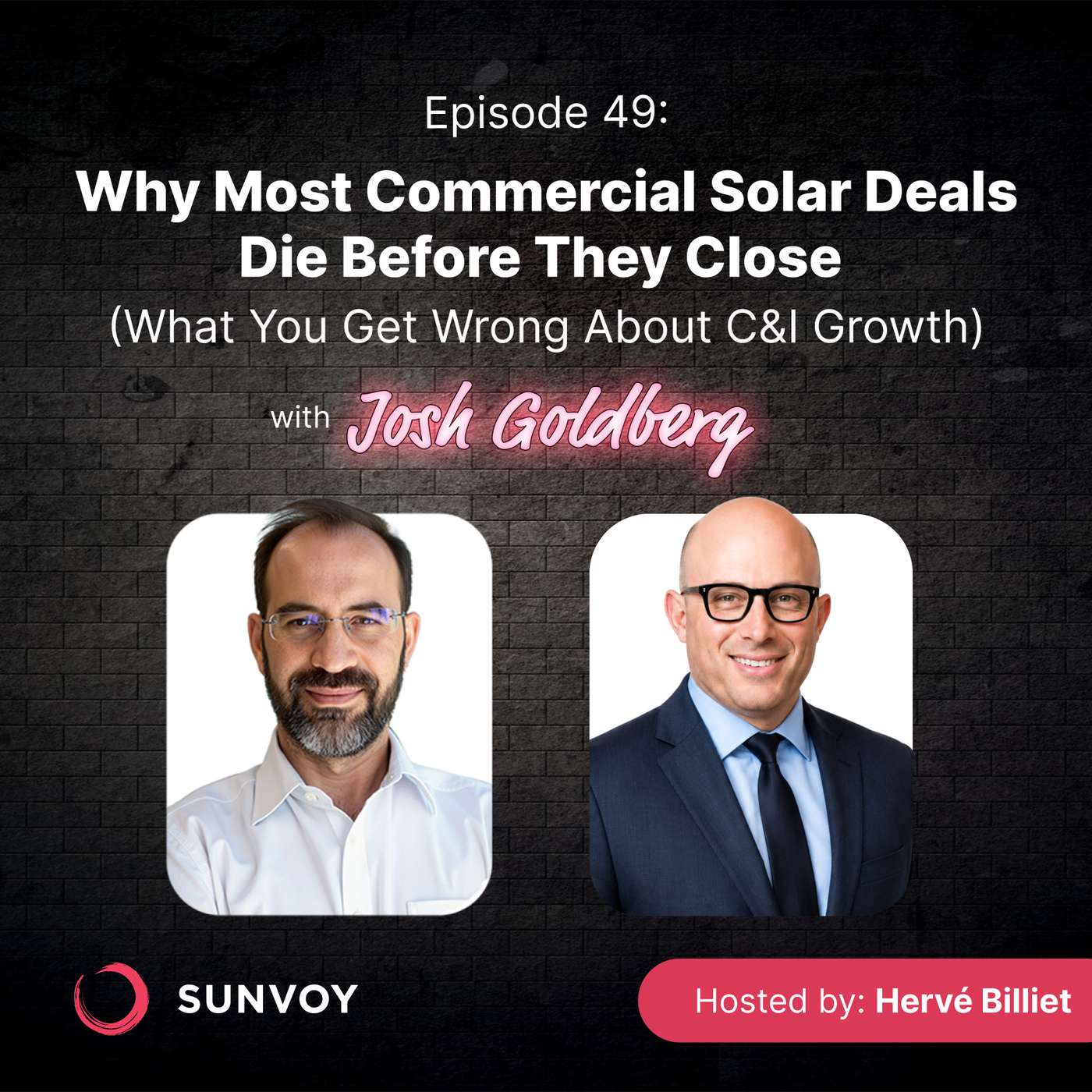
Hey everyone, welcome to another episode of What Solar Installers Need To Know. My guest today has founded three solar companies. He started Astrum Solar, solid to direct energy. Congratulations. He co-founded Sunlight Financial, took it public via SPAC and now he's running Sunstone Credit, a commercial solar loan platform that has crossed a billion in loan applications. Again, congrats. Works with 500 plus installer partners across
Josh Goldberg (00:10)
Thank you.
Herve Billiet (00:23)
30 states and in full circle move Sunstone credit is now also co-owner of Sunlight Financial which he'd help secure out of bankruptcy in 2023. Josh Goldberg, welcome to the show.
Josh Goldberg (00:34)
Thank you so much for having me. Looking forward to talking about all things solar.
Herve Billiet (00:37)
All Things Solar. Yeah, maybe that would be another name of a podcast. A few days ago, somebody's like, so what's the podcast? You basically ask all the solar celebrities to talk to you. It's like, yeah, maybe should make that another podcast title.
Josh Goldberg (00:50)
All of the solar celebrities, it's a very small pond.
Herve Billiet (00:53)
But it's growing, I mean it's growing definitely sir.
Josh Goldberg (00:54)
Right.
Growing some quarters shrinking others, you know.
Herve Billiet (00:58)
That's a painful comment, but yes. Well, I'm in the DMV area, I'm outside of Washington DC, and so I've known about Astrum Solar. And so you found three solar companies. What made you keep coming back? And what did each one of those items teach you that we wouldn't have learned any other way?
Josh Goldberg (01:17)
Really bad judgment. I guess maybe just sort of like the quickly the arc of the three companies. So one of my good friends growing up, Vadim Polikov, we went to Hebrew school together, went to high school together, wrestling team across all this other stuff. He had sold a prior business and in 2007 said, Hey, Josh,
Herve Billiet (01:19)
No!
Josh Goldberg (01:40)
I think residential solar, was a corporate lawyer at a law firm doing M&A work. Didn't know a kilowatt hour from a solar panel. If you asked me what an inverter was, I would realize that kind of transformer character. And I said, hey, I think residential solar is going to be big. I was sort of looking to do something more entrepreneurial. I said, I have an idea. And I did a little research and I said, hey, think residential solar will be big too. Let's do Astrum Solar. And there was three founders, Ben Davis, Vadim Polakov and myself.
And really the theory was we got started on the East coast in 2008. At the time, SolarCity, company called Sinjevity, which is long since dead a couple of times, Sunrun were getting going on California. There wasn't much going on in the East coast. And we said, Hey, there's an opportunity to put a professional solar installer that actually looks like a brand to the customer that delivers a good customer experience. That isn't like a science project. A lot of the folks in the business at the time were like true believers. You know, they wanted everything to like little engineering project, which is great as a hobby,
but you can't build a business that way. And so that was the origin of Astrum. My parents were our first customer. The system was free. My mom, I'm Jewish, so my mom was very happy that I was a lawyer. When I told her what I was doing, she said, so you went to law school to become a door-to-door salesperson? And I didn't actually sell door-to-door, but she was pretty spot on. I was like, hey, you kind of nailed it. And they got a free system. It was the hardest sale of my life. And when it actually turned real, they were like,
Herve Billiet (02:55)
Hahaha
Josh Goldberg (02:57)
Surprise, it actually works. Who would thought, right? And so, know, Astrum was a nice success. was residential solar was very different 2008 to 2014 than it is today. We had a nice exit to direct energy. A couple of things along the way that I learned was, you know, financing was really key to the customer. So we started selling cash deals. Everybody did. And then Solar City came to the East Coast in 2000, maybe late 10 or 11. I don't remember exactly.
And it is lease, right? And we were aware of it. Okay, well, they have a lease and we need to have one too. And I sort of said, Hey, it doesn't really make sense for us to also be a leasing company. Like one of the things I've learned in entrepreneurship, it's very hard to be good at one thing, let alone three or five or 10 things. Right. And so if you're a solar installation business, you got to generate leads, you got to hire salespeople, you got to have installers, electricians, designers of warehouse. That's a lot of things to be good at to then also be a specialty finance company.
Kind of crazy, right? But that's what SolarCity and Sinsegevity and others, some of them were doing. And so our competitive response was, hey, let's partner with Constellation Energy. We got them to invest in the company. And we originated ashtrom solar leases, but sold them all to Constellation. But I actually spent two years selling solar in the home. And what I concluded, and it sort of still colors my opinion today, is that third party ownership lease TPA, I think is a
Herve Billiet (04:03)
Mm.
Josh Goldberg (04:16)
Pretty stupid way for homeowner to go solar. It was stupid then and I think it's stupid now, even though it's tax advantaged. If you think about it, at the end of the day, yeah, so you own your house, right? You go solar to save money and get away from the utility. If you lease a system, you've just created a second utility on your roof, right? Now, what it solved initially was,
Herve Billiet (04:24)
you say that, I want to go deeper than I put it. Yes.
Josh Goldberg (04:42)
The upfront capital cost is high, right? And so the average American can't afford $40,000 to pay cash to save over time, right? So yes, matching payments with expenses, which makes a lot of sense. But what I saw, and we were selling these lists, but it wasn't really what the customer wanted. It made a lot of sense for the finance company. And I think in solar in general, whether it's commercial or consumer,
There's a lot of things that make a lot of sense for the finance company that don't make a lot of sense for the end user. We have drastically overcomplicated this industry in ways that I think hurt us all the time. And so in 2013, was in 2012 when I was introduced to guy named Wilson Chang, who was at Hudson Renewable Energy, a private equity firm. And they had some infrastructure capital. And I convinced them to do to solar loans for Ashtrom's customers. So rather than just offering a lease or a cash Deal,
We now offered a lease, a 20 year loan and a cash deal. And almost instantly, all the lease customers moved to loan. Cause they wanted to own the system. They own their house, right? But they needed financing. And so that program worked really well. If you fast forward like six months, we sold Astrum Solar to Direct Energy. You could do a whole different podcast on Direct Energy, but they paid for this house. So thank you.
Herve Billiet (05:34)
Mm-hmm.
Josh Goldberg (05:55)
And I did not have much desire to stick around for a variety of reasons. And so I went to the folks at Hudson and said, hey, like, I've seen how this movie plays out. Right. Like we piloted this loan product. was just them to us. It took off. Why don't we build a business that does this for every other solar company? And that was the origin of my financial. We sort of spun it out. I joined, got the business going. Astrum was our first customer. Yay.
I went to some of my friends who I really respect, Matt Rasmussen of IOWN Solar. I know if you've had him on your show at all. Fantastic operator, the best in the business. A bunch of other folks, on board with him as partners. And they went through that same experiment that I did of, we were doing lease on cash, let's throw a loan in there, right? And I think from 2014 through just last year, or through the IRA, loans dominated the market, right?
It was very clear that all else equal, Ceteris Paribus, the customer preferred to own the system, the loan was a better option for them. Now, the IRA and the Make America adders and those things, they started distorting the economics. And then today there is no tax credit for purchase. There is one for lease. So I get when people do leases, but it's not a better product for the customer. So that was sort of the origin of Sunlight. I was there for a few years. I'm an entrepreneur at heart.
Herve Billiet (07:00)
Mm-hmm.
Josh Goldberg (07:10)
I had disagreements with some of the investors at the business about its direction. I ultimately left in 2017. The company did fine without me and went public in a SPAC deal in 2021. So Sunstone. So I was sort of out of solar for a little while. I had some former colleagues of mine who started a company called Lumina Solar in the Mid-Atlantic. They used to work at Astrum, a little minor involvement there, nothing day to day.
Herve Billiet (07:36)
I didn't know that link. All right.
Josh Goldberg (07:37)
Yeah, a
big thing of mine is encouraging entrepreneurship. So I love when people who used to work for me start their own business and hopefully they'll be a lot more successful than I was. So that's really cool. And I've helped people here and there, but I was my sort of, love complaining. If you follow me on LinkedIn, I complain all the time and I like solving my own complaints. And so if you think about Sunlight, was, Hey, I have a solar business. We're selling TPO. It's better than nothing, but it's a
it's not the best option, how can we get a better product? Lone, start sunlight, right? And so, you know, one thing when I was at Astrum was commercial solar. So when we got started, my partner, Vadim, he's like, laser focus is a big thing of his. Batteries, no thank you. Too complicated back then, right? Like he wouldn't even, there was no price, which if God, if Muhammad, Jesus, and God, Abraham came down and said, want a battery, and Mount Olympus, he would have said, no thank you.
Herve Billiet (08:20)
At that
you
Josh Goldberg (08:30)
Like no
interest, right? And commercial solar was that way at first. We did residential. About three or four years in, we sort of figured out residential. It was still great. And we kept getting increased more residential customers. Hey, you installed my house. You guys did a fantastic job. And you think about who owns commercial property, it's all owned by homeowners. They have two lives, right?
They are a dentist and a homeowner. They are the CFO of a public company and a homeowner, right? We get all these requests and we say, you know what? Time to build a commercial division, right? So around 20, late 2012, 2013, we built the commercial division. But one thing that sort of always vexed us a little bit in commercial is if you, if Walmart wanted to go solar, there's a whole world of developers out there who own assets on the power, right? If.
Herve Billiet (09:12)
Yeah. Yeah.
Josh Goldberg (09:15)
Your locally owned grocery center wants to go solar, there's just no financing. And so so many times we would talk to a commercial property owner and then say, hey, like, you know, can I go solar? said, absolutely, we'd love to help you. Is it a good deal? Absolutely. It's an even better deal than residential solar because the system prices are maybe even cheaper. Power rates for most commercial are about the same as residential. Tax credit is the same. Oh, by the way, this magical thing called depreciation exists, which is a homeowner you can't use, right?
And they'd be like, well, what's the catch? And the catch was always like, whether it's $100,000 or $3 million, I don't have financing for you. So you have to either pay cash, which most businesses don't wanna do. If you look at equipment broadly, businesses finance about 90% of their equipment. From forklifts, solar, they don't pay cash for stuff, right? So asking them to do it is very unnatural. And if you have to go to your local bank, they're gonna offer you a really crappy product, and it's gonna take a really long time to get
Right.
Herve Billiet (10:06)
It's interesting that you say that because when I was selling solar commercial, I tried to come up with like, oh, a developer can own it or some other things. And the answer was like, I had so many times the same answer and the business entity like we already have our own ways to access capital.
Josh Goldberg (10:23)
Some of them do, some of them don't.
Herve Billiet (10:24)
My problem was that as soon as you go to your local bank, you already a client then explain solar well they don't know solar so that's where things go to die but then
Josh Goldberg (10:32)
Yeah,
or exactly. Or the CFO thinks, I've got this. I got my bank and they go to the first one takes a while to do it. And then they go to the bank and the bank offers them a five year loan. Well, then you're you're upside down for five years. And even if the long term payback is good, no business owner is going to be like, yes, let me approve this deal where for five years I'm hemorrhaging money. That in year seven, I make money. That's an insane business proposition, right?
And so I think if you think about like solar broadly, I put it into four buckets. Residential, residential has grown because of financing, right? Utility scale, all financed. In the middle, I put commercial and mosh and I put two buckets. One is like the fortune 500, right? They don't usually want to own the asset, third party owner that's grown. And then I put the everything else commercial. And that part of the market has been like a cash business really. And it's never kept up with the growth of the other three.
And so the question is, this was a problem for me in 2012, was a problem in 2015, and I'm sitting at home during COVID thinking about it, and it was still a problem. And so like, why? And it wasn't a supply or demand problem, right? There's plenty of people that want to sell into this space and have tried. It makes sense for the business owner. So what was the friction? It was my conclusion that the friction was the lack of financing. And so if I pivot from my Ostrom Solar to my Sunstone Credit,
Herve Billiet (11:47)
Is that?
Josh Goldberg (11:47)
You know, you it was our belief that this middle market commercial that the vast majority of property out there that's not investment rated, that isn't publicly traded property. Those folks want to own their own solar system like they own the property. They have their own tax liability. They don't want somebody else on the roof. Right. But there's no financing for them. And so we said, hey, if we could build a business at Sunstone that looks at a high level like some of the Rezzi finance companies. So on the one hand,
We partner with capital markets and providers to build products. We don't sell solar. We go to market through contractors. We have about 1100 partners today in 50 states now who offer financing to business borrowers. And for us, business is anything non-consumer. It could be an HOA, it could be a nonprofit, it could be retail manufacturing, industrial storage. We don't care. So, you know, we'll plan. Oh yeah. I mean, we underwrite them if they qualify. Yes. I mean, we do plenty of them.
Herve Billiet (12:32)
You mentioned churches here, religious buildings. Is that also part of it?
Josh Goldberg (12:38)
If their credit is good, we'll take anyone whose credit is good. And we do financing from five to 20 years and the long term of our financing makes it able to save money on day one. We're very fast and efficient. We don't take forever to underwrite deals. And we've been growing pretty nicely for the last few years. And so I keep getting sort of like dragged back to solar. I mean, I have a love-hate relationship with it. Like most people have with the sort of the industries they serve.
And so now I'm solving that problem of I think this market is really interesting one. It never had the right tools to grow in. And I think, you know, we're at some point we're helping kind of build that market. And that's what we do today. So we finance solar, we finance storage, and we'll find we'll do solar plus storage. We launched a standalone storage loan in Q4 of last year. So we'll just finance storage and we'll also finance a new roof in conjunction with solar. And it hasn't been announced yet, but I'll say it here.
As of June 1st, we're launching what we call our flex loan or we will finance non-solar things. So you need HVAC, commercial HVAC. You need a chilling tower. You want to do a standalone roof. You want to put in a large generator. We'll finance all that for you. We want to finance anything energy related that touches a commercial property. We want to finance. And so we'll we're just starting pilots in that soon. We'll probably do a press release in a few months.
But that product is going out June 1st.
Herve Billiet (13:57)
Congrats, congrats
when you say energy related where is there? Where's the the hard stop? For example, I'm a manufacturer I have four clips that are electric and I can charge them like financing those for lifts
Josh Goldberg (14:08)
So
for now we won't do like mobile equipment. So that would be like part of the property, but we'll do EV charging. So if you want to put EV charging into your facility, we'll do that. At some point in time, we will continue to do more stuff, but for now it needs to be a physical improvement to the property that is sort of equipment based. So again, generators, cogen, roof, chilling towers, EV charging, other things that we would do as well.
Herve Billiet (14:10)
Okay.
And again, the key is to have a long time financed over like 20 years, said.
Josh Goldberg (14:37)
We won't go for solar read in 20 years. We won't do solar for HVAC because the unit doesn't last 20 years. But we want to have as long as reasonably possible given the estimated performance of the asset so that it smooths it out for the borrower. Businesses in general don't like big lumpy payments.
Herve Billiet (14:51)
Okay.
I'd like to have two questions about Sunstone specifically. If you go back in the early, early days, you you thought about doing COVID. How exactly in the very early days you go from an idea, maybe you talk to your wife about it and your wife maybe said like, okay, one more idea. There we go again, if you're anything like me. And then what are the first people that you called or kind kind of got really started? Now you what you had like experiencing in a previous financial company, but
Josh Goldberg (14:58)
Sure.
Herve Billiet (15:20)
How do you get started with something like that?
Josh Goldberg (15:22)
It's a great question because I think I have a lot of ideas and many of them I don't. don't. Well, a lot of them get started at some level and then die in process. Right. So I spent I have a picture of it somewhere. There's a whiteboard right over there. And I started sort of drawing out on a whiteboard like here's the opportunity. Here's I think the problems. Here's what we'd have to solve to make it work. And so a great example is like there's a lot of good ideas that someone might have that they're not the right person to do. I think mining an asteroid would be a great idea.
Herve Billiet (15:36)
Mm.
You
Josh Goldberg (15:50)
But I have no
expertise at all in that. like, like how am going to solve that problem? Right. And so it's like, Hey, like, you know, could I actually, you know, the things that I would need to do to get going, building a channel of installers, getting a bank to provide funding, all these things like, could I realistically do those things? Right. That's not how I think about it first. And so I called, again, I mentioned Wilson Chang at Sunlight. So he's sort of like my partner in a lot of these different, different businesses. call partner in crime. Yes. Um,
Herve Billiet (16:13)
crime.
Josh Goldberg (16:16)
I called him up and said, hey, here's an idea, like beat it up. And, you know, he beat it up and said, this is kind interesting. And so I just talked to a few more people that weren't so, hey, like, here's my idea, like beat it up. And a lot of people said, hey, like, we've been trying to target the sector for a long time. Here's why we haven't been able to do it. And so I sort of added things to my list of like things you'd have to be able to do, like underwrite these deals quickly. Right. For example. And I looked at it and said, hey, like I.
I think that we could do this. I would say the biggest blocker to get going in a financing business like this is you can't raise equity to make loans. So if you have a good idea, you can go raise some equity to do something for operating expenses. to actually remember the loan, a million dollar loan, that has a 20-year payback, that's very hard to do with it. You can't really do it that
Herve Billiet (16:55)
Hmm.
Josh Goldberg (17:04)
And so you need to get a financing source that tends to be usually be more risk averse to actually be like, hey, Josh, like what you're doing actually makes sense. And I'm actually willing to give you capital to do it, right? Like debt capital, not equity capital. And so I've had a good relationship with Cross River Bank for a very long time going back to Sunlight. And I came to them and said, hey, here's something that I've been working on. You know, I got Wilson involved. Like, here's what we think it will work.
This is is late 20 early 21. You know, would you be willing to try it? And you know, they said, look, like we don't. We're not experts in this space, but we've worked with you, worked with you at Sunlight and saw how that worked out. So, yeah, at a reasonable level, like we'll take a flyer, right? Or not on you as an operator, not necessarily our origin. And, you know, and that was how it got started. And so we got it. We got a term sheet from them for financing.
And I said, OK, like the hardest thing on my list of things I have to do that I have no control over. Check, right? So now let's build a team. Let's hire someone who actually knows commercial underwriting. Let's find it as CTO with an amazing CTO who's been listening since the beginning. Some of it's got a CTO on board who can build us the technology. Let me bring on my co-founder, Duncan Hinkle, who was with me at Astrum and at Sunlight to build the channel. That's sort of build the team, right?
off to the races. And so here we are almost five years later and do.
Herve Billiet (18:24)
So
you build a lot of the infrastructure before you got a first deal? You didn't go some installers you knew like, hey, like give me a few deals, demo deals to kind of get through and figure out the pipeline and build everything around it.
Josh Goldberg (18:29)
Yeah, it's actually.
It's
it's actually very un Josh like right. So like in solar at Astrum, we sold sold before we had any idea how to install it. We'll figure that out later, right? And we did. Maybe it wasn't the best idea at the time. But when you're dealing with the banks, right, they're heavily regulated. And so this like I joke like move fast and break things is a really good idea. But like you can't break a regulated entities things. They don't appreciate that. And so we had to spend the first like eight months of the business.
before we could even offer a loan, getting all of our compliance policies set up and getting our technology set up so that we could comply with KYC and anti-money laundering laws. the joke was keep Josh out of an orange jumpsuit, right? So yeah, you have to be a little bit more careful when you're sort of dealing with a regulated entity, because at the end of the day, we were responsible for all the banking laws that our bank partner was responsible for as well. And so I think we we got started in like March, February, March of 21.
Herve Billiet (19:15)
you
Josh Goldberg (19:28)
And we didn't underwrite and approve our first loan until later that calendar year. Now, during that process, we were talking to installers and saying, hey, we're going to be coming to market. We're doing what went to folks like Lumenasolar where I knew the folks and went to people that I knew very well and said, hey, like you might have tried to target the segment before. You everyone has you failed. Here's why you should charge up that hill one more time, please. Right. And do it with us and we'll be ready to launch in X number.
So.
Herve Billiet (19:56)
During that period where you didn't have like, deplorative capital, you had to find your own business. That is where you did sell some equity or got partners in home or...
Josh Goldberg (20:04)
Yeah, so we did
we did our friends and family round largely founded capital at first because I didn't until we actually closed that bank deal. I thought I thought it was pretty risky. And so I didn't want to like lose someone else's money. Once we closed that deal, like fall of 21, we actually did like a traditional seed round that had external investors come in. that first like million plus dollars, we just sort of ourselves.
Because there was a chance in which we worked on it and they just said, hey, we can't get there. And we had no plan B. And then plan B would have been trying to find another bank. But there was no like, if this doesn't work, we'll just do that.
Herve Billiet (20:43)
As a Bollingwood family or friends money, maybe easier to get but the strings attached when things go wrong are pretty heavy.
Josh Goldberg (20:49)
Yeah,
I you you I actually have raised a lot of money and I absolutely hate doing it. I think when you go to friends and family, you to be very careful. Like you go to people who, you know, I want to say like they won't care if you lose the money, but like they have enough money such that like doesn't affect like it doesn't affect a lot. never taken money from my parents, for example, I don't want their money like so. Yeah.
Herve Billiet (21:10)
Yeah. Now you mentioned also underwriting a commercial loan, doing it quickly. mean, those two things are very like, I've never seen that happen quickly. So how did you figure that one out? Exactly. So the reasoning or the logic behind being able to do it quickly?
Josh Goldberg (21:20)
And provide for a long time.
Yeah.
So the reason why is you don't need solar. Solar is not a problem solution product. Not like, know, if you're a homeowner or a business and your HVAC unit is broken, you need to replace the media light. So if you have to go through a lot of hoops at a bank to do it, maybe you'll do it because you just need it. If you're selling to a business or even in the home and the financing is complicated, what's a homeowner? Oh, you know what? I'll get to it next week.
Herve Billiet (21:43)
Yeah.
Mm-hmm.
Josh Goldberg (21:51)
And what does that code for? It's good for I'll never get to it, right? Cause it just never rises. You know, we all have to-do lists and there's always things that I've been trying to get to next week for five years, right? And it just never really gets up to the top of that list, right? And so I think that's where a lot of deals went south. this is great. I'll go to my bank and then the CFO gets busy or the owner gets busy or they go to the bank and the banks like, here's 8,000 questions for you. They're like, my God.
Right. Like, and then, you know, I just, I don't, I don't need that. I have time for it. Right. Or there, you know, somebody happens in their business, things that these things happen. And so we said, like, you got to strike while the iron's hot. Right. In order to do that, we can't have like, back then we didn't have like instant approvals for large deals, but it has to be efficient. It just has to be quick. Cause like when the CFO meets a solar company, he's thinking about solar. Maybe he has for the next few days. I can get him the application and I can review the materials. I can ask my questions in that window.
Herve Billiet (22:38)
Mm-hmm.
Josh Goldberg (22:43)
And get him a decision, he's so focused on it. At some point you kind of lose your time. And so he said, hey, you're really efficient, but like commercial underwriting is a lot more complex than consumer. And so how do you be fast and efficient? Initially, you just do it manually. It's like, I don't know if you've seen Ben Hur or like Ramming Speed or the people in the galleys are just rolling really fast, right? That's what you have to do. But then over time you say, hey, how can we automate these pieces? As we learn what we want to do.
Herve Billiet (23:00)
You
Josh Goldberg (23:07)
How can we automate more and more of it? And so my view is I want to continually increase my rigor, but at the same time, decrease my time to decision, which two-pointer are usually like opposing forces. And so we invest a lot in AI, AI-driven automation, and we get a lot of data from different places. We now have lots of proprietary data about what we do. And our goal is to be as fast as possible. We have pretty much automated underwriting for smaller deals.
And that's, mean, we really want to reduce friction in the process. So I would hope that our partners say, hey, Sunston, you helped me close this deal because you are fast. We only win when everyone in our ecosystem wins, right? So we only make money when one of our contractors has sold a deal, when our borrowers has had a system installed and is happy, that's when we get paid. And so our whole existence is to make that process faster.
Herve Billiet (23:53)
I assume the commercial no writing. I every time we apply for loans or lines of credits, I mean, the amount of questions you receive as a business is massive. You have to show your P &L for the last two years and this and that. And so I assume I'm not making an assumption here that your team, the ones rolling really hard in the basement, at first, they just looked at, oh wait, this business owns their own building and it's valued at half a million. We just need like a small loan for sort of 50,000 or a hundred thousand dollars more than the equity in the building, like automatically approved.
What's this?
Josh Goldberg (24:22)
That is part of the process. Yes, how much equity is in the properties, right? So like if you in an extreme, if you have a $10 million property with no debt, I don't need to do very much work to give you $500,000. Right? Because even in a downside scenario, there's a lot of equity there. And so we've tried to think about like, you know, there are a lot of banks that are good at underwriting. They're just slow. And so we figured out, how can we do some of the things that they do, but how can we do them much faster?
You know, how can we take a tax return and auto read it? You know, now, as opposed to a human being reading these documents and agents doing it, right? How can we just make this process not reduce rigor, but just increase speed? And again, like if you look at our data, like every year we get a little bit better. It just keeps, we keep getting more and more. There's no silver bullet here. It's not like, oh my God, in 24 we did this. It's taking all, it's like a very complex watch. All these little pieces, we just make each movement always a little bit faster.
And any individual change you don't really notice, then you look back after six months, you're man, like we've run a lot faster, why? Oh, like these 30 different things, right? And that's what we're sort of constantly trying to do is to remove pieces and make pieces more efficient.
Herve Billiet (25:24)
Now you work with a lot of different installers. You first went to the ones you know and then spread the word. Do you see a trend about like the installers that don't just come back with you with like one deal, let's try to sell one, but like the ones that continuously come to you, I guess your biggest, best clients for you too. Do you see a trend what they do well that you want other installers to like, why don't you do this?
Josh Goldberg (25:39)
Yeah.
Yeah,
it's a good one. So I think this industry segment grew up cash, right? And so I think there's there's a whole segment of people out there who are like, oh, like cash is great. I've been selling cash for five years. Why do I want to introduce finance? And the same thing in residential solar in 2010. Right. And I think those people just they just missed the boat. Like the cash market for stuff is this. And you can sell cash. Sure. The rest of the market.
Herve Billiet (26:08)
Hmm.
Josh Goldberg (26:12)
Is this. And if you don't offer financing in every deal, you don't know why you don't close deals. A lot of times people just don't buy and they don't, they don't tell you, I didn't feel like paying for it. They just don't decide. And 90 % of commercial equipment is financed. like solar is not special. It's not like, oh, and for just for solar, everybody wants to pay cash. And so I think the businesses that are good, they offer financing in every deal. And if a buyer wants to pay cash, fine, great. But
Herve Billiet (26:22)
Yeah.
Josh Goldberg (26:37)
Offer financing in every deal. Let the buyer said if you only offer financing when someone says, hey, I can't afford this. Well, it often times is that the credit of that person isn't very good. There's a good joke and credit like you don't let the people who need your money right. And so if you just offer it to like save the deal to kind of kind of like Rezzi back in the day, if you don't offer only only was once I can't afford it, well, they're probably going to get declined for financing.
Herve Billiet (26:51)
Of course.
Josh Goldberg (27:01)
And so I think the more forward thinking businesses say, hey, I'm not selling a solar system. I'm selling savings. But I didn't realize I was saving that I actually provide the cash to pay for it. And so I think like, especially today in 2026, funky economy, gas prices through the roof, business confidence down. You don't want a business to be thinking, how am I paying for this capital expenditure? Am I buying solar or am I investing in my core business? You will always lose.
Herve Billiet (27:23)
Mm-hmm.
Josh Goldberg (27:28)
But if you come to the table with financing, whether it's me or somebody else, it's not your business or solar. It's, hey, I want to sell you solar. I want to sell you savings. And by the way, I'm going to give you the financing you need to buy. It packaged up in a nice bell. It's all to me. It's all about reducing friction for folks. People are just so busy. They don't want to go to the bank and answer 800 questions. Just make it as easy as possible.
Herve Billiet (27:49)
Yeah, it's inertia. It's one of the greatest forces in nature,
Josh Goldberg (27:52)
It
hits me all the time. There's so many things I don't do because just one more thing to do is more work, right? But it's all makes it easy for me. I get it done.
Herve Billiet (27:59)
Well, talking about inertia, a lot of solar residential installers are trying to do commercial, which is of a push into diversification in HVAC and a lot of different stuff, including commercial. So even installer has done zero commercial so far, what would they have to do for you to be a customer in 90 days or something? What do they have to do?
Josh Goldberg (28:20)
I mean, to be honest,
we only offer loans to approved installers. So we'll be pretty skeptical of a resi guy who hasn't done commercial before, especially if their first deal is a large one. Right now, if their first deal is a 50 kilowatt dentist office that looks like a residential, that's a great place to start. I think that some of the engineering work is different. Some of it's more complicated. You have to price it more carefully. If you're doing residential and you do 10 deals a day,
and one deal you priced terribly and one deal you made extra margin, it kind of evens out the wash. If you're doing $2 million projects and you mess up your pricing on a deal, like it's a big problem, right? And so it's just, it's a different system and process. I actually think that residents, the more sophisticated residential folks should get into commercial. Cause if you think about who owns most commercial property, it's owned locally. Who owns it? Your solar customers. Right? So
if you can figure out that cross sale, that's really powerful. But I think like what we've seen best in class is residential commercial business, different divisions, they share information. Like the crews are often different. The engineering is different. The procurement is different. Residential is a constant stream of same, same things, right? Commercial is bigger project, different inverter, different wiring. Maybe you're, you're, you need like a lift to get to the roof. Like it's just a little bit different process.
But we actually have a series going on right now with, I can't remember who's in it, I think Enphase and REC and Enstall and some other folks aimed at how to help the residential installer get into small commercial. But I would say like, start small, the sales cycles are you're not gonna one call close, million dollar deals, it doesn't exist.
Herve Billiet (29:56)
Ha ha ha.
Josh Goldberg (29:58)
It's just a little bit different process. So know that. I think also like don't have back at Astrum, every residential salesperson wanted to get into commercial because they see the dollar, you add a zero, right?
Herve Billiet (30:09)
Yeah, and then you tell them how long it took for that deal and then they're out.
Josh Goldberg (30:11)
And the deals,
You know, we had this great guy, Mark Manthing, love Mark. And he did it. And he ultimately moved into commercial sales. And be like, Mark, when's that deal closing? Next week. Next week. When's that deal closing? Next week, right? These deals, they just take forever. And so you really can't kind of do both, right? Residential is all about getting to the appointment process, closing then or the night of. Commercial is all about building leads. How do you get leads, right? They're harder.
Herve Billiet (30:17)
yeah, for sure.
Josh Goldberg (30:37)
You got a network in your community. How do you have a meeting? Can you actually talk to a CFO? Can you sit with a prospect for six, nine, 12, 24 months, building that pipeline of deals? And it also takes a while. So I think like in resi, you can get started and go, right? You have to be willing to commit to, I'm building a commercial business. I know I'm not going to sell very much for a while. If you're three months in, you're like, haven't sold anything, I'm shutting it down. Well, like don't ever start it.
Herve Billiet (31:01)
Don't start. Yeah, it's very, very different time. There was one really good thing about selling commercials. Like you can still doing your business hours because those people make business decisions and that's their job.
Josh Goldberg (31:12)
Yeah, you're
Not going to the business at 9 p.m. on a Saturday night, right? They're doing business hours, you know, they're usually pretty responsive. They're usually pretty direct. You know, if you do it right, they can be less competitive because I think if you generate a unique lead source. So we've seen people who figure out, hey, like I'm an expert in car dealerships and they go deep into car
dealerships or I'm an expert in hotels or whatever like they figure out their area of expertise and they go deep and actually like you know one thing that that I think like referral networks work in commercial just as well as they do in residential like in residential when I sold you get one home in like a Howard County Maryland Subdivision and then you get three you know gross same thing in commercial, right? If you do it right-
Herve Billiet (31:54)
It's true,
I would say it's more competitive. I mean, the amount of times I received a call like, I already got a quote from Lumina and from, what is the company in DC?
Josh Goldberg (32:06)
Solar solutions or green brilliance or the whole.
Herve Billiet (32:09)
You know, like the New Columbia solar and like,
okay, I already have two quotes, I need a third one. Like, all right. I mean, that happened a lot. And so
Josh Goldberg (32:16)
Yeah,
so like those deals, I'd be like, no, thank you. Don't get it somewhere else. If I was doing it, I would want to build relationships with property owners where you offer a fair price and you can get more for all these business. They're not always as competitive.
Herve Billiet (32:28)
Yeah, but
I mean, companies have rules in place. If you make a purchase of a certain amount, you need three quotes no matter what. So yeah. Yeah. I remember like banks that I tried to put solar on that I initiated the deal and then they went to new Columbia solar. And then after months of negotiation, I remember I lost that one. but yeah, it's so, so I wouldn't say necessarily. Well, there's a few that we generate. You're right. Like it's really relationship based. Um,
Josh Goldberg (32:34)
Some of the really big ones certainly don't. Yeah.
Herve Billiet (32:53)
MPR for example, they heard us on MPR and because we did advertising on MPR, we were the one. We have a few of those deals that we got.
Josh Goldberg (32:59)
Nice!
Nice. Yeah, I would be less interested in responding to like RFPs than like building a relationship with a property owner who owns multiple properties and or, know, if you're residential business, you have residential customers where you already did a good job on their house.
Herve Billiet (33:13)
That's true,
but RFPs are annoying, but now you can use AI to start answering all your questions. So it's to answer. We've not spoken about batteries. So you also do fund batteries. That's new in commercial.
Josh Goldberg (33:18)
Yeah, then everybody has the same answers, right?
Yeah,
so we've done solar plus storage for a while. And interesting fact, so in 2022, our storage attachment rate, you the number of deals that were solar plus storage was literally a 0%. In 2023, it was 5%. In 2024, it was 12%. And in 2025, it was 31%. Now that's, you know, there's definitely some some state concentrations, you know, California in the Northeast more than other places.
Herve Billiet (33:48)
wow.
Josh Goldberg (33:54)
But we're seeing a fair amount of attachment. think that will continue to go up. And we're starting to see some standalone storage. there are some markets where some of the storage incentive programs, maybe you're building that doesn't have enough space for solar office building, tower building, roof is funky, lots of stuff on the roof, whatever it is. But storage actually pencils and you have a big parking lot. Right. And so I think storage is a nice compliment to solar. It's also, think, a market in and of itself where it actually can increase the TAM because there's
Some buildings, you know, when you're in Seoul, you drive around in like a home and oh, shaded. No good. Right. It's like a disease. Right. Oh, you're up in the airport. Oh, that roof is terrible. Too many too many units on the roof. Right. Well, you know, maybe they could go storage and they don't need so. And so I think it's early innings. I would kind of equate it to like to me, the storage market today is like solar in 2010. Right. It's it's very immature. It's funky. No one really knows how it's going to play out. But like, I think, well, I think it's going to play out in a very positive way.
Just no one exactly knows like all the different use cases. But I think it will be quite big. And, you know, we want to we want to finance it. And if businesses want to adopt it, fantastic. So we're very bullish on it. I think in general, one big shift that I've seen that's really new for my career that I've been in this mess in 2007 is people always went solar to make money. Right. The homeowner, a business, businesses were like IRR and a spreadsheet. Right.
Nobody was like, oh my God, I have this big problem. But now, because if you think about early adopter curves, was like early adopters doing stuff. So now, because power prices have risen so much in the past three or four years, and it's all over the news, like every election is about it, it's all over the place. Every article you read is about power prices. And so it's in the minds of every homeowner, every business owner. Oh, power prices are a problem.
Herve Billiet (35:27)
I miss it.
Josh Goldberg (35:36)
And what's the solution to that problem? Solar, storage, a new HVAC unit, new windows in your house. You're actively looking at ways to reduce your bill, not just to make money. And that shift in the mindset of the buyer, I think is really profound and I think really important because when you're just looking to make money, your return hurdles as a homeowner or business are just higher, right? When you're solving a problem, then your return hurdles are lower and your urgency level is higher.
Herve Billiet (35:57)
Mm-hmm.
Josh Goldberg (36:03)
So if you're a nursing home and you're like, man, last year was my worst year in a long time. Why? My utility rates went up. Nothing I did. I treated my patients. I got new residents. I did a great job. My profitability got crushed because my utility sucks. Now that's a problem. How do I solve it? So I think that mindset I think is really interesting. And I think that to me is more important than the ITC, whether it's here or gone.
How much do people actually care about doing this kind of stuff? And that's probably the most interesting thing I've seen in the past 15 years.
Herve Billiet (36:33)
We have to do some growth in the industry.
Josh Goldberg (36:36)
I always joke like I don't I know where solar and surge will be in 2040. It's but I don't know what's in that line plot right. Yeah and look and like any industry there's there's plenty of you know you're joking before the call started about residential solar there's plenty of garbage out there and business models that are terrible for the consumer and sock that kind of played the industry and eventually those will sort of sift.
Herve Billiet (36:40)
Hahaha!
Yeah.
Josh Goldberg (36:57)
And then they have largely already have, but I think that's just the maturation of any industry. We're not even 20, and I don't think there's like a single PPA that's even reached its 20 year life yet, right? And this is kind of a funky phenomenon.
Herve Billiet (37:08)
Yeah. Josh, thank you very much for sharing your points of view and your many years in the solar industry experience and knowledge. So very much appreciate Thank you.
Josh Goldberg (37:17)
If anyone
listening loved my complaining check out check me on a LinkedIn. I talk about TV shows, fast foods. I generally complain about all kinds of
Herve Billiet (37:24)
Absolutely.
I follow you on LinkedIn too. So go to LinkedIn on Josh Goldberg. You'll find his profile pretty easily and click follow.
Josh Goldberg (37:32)
It was an absolute pleasure joining you. Always happy to talk. Thanks so much.
Herve Billiet (37:35)
Thank you.