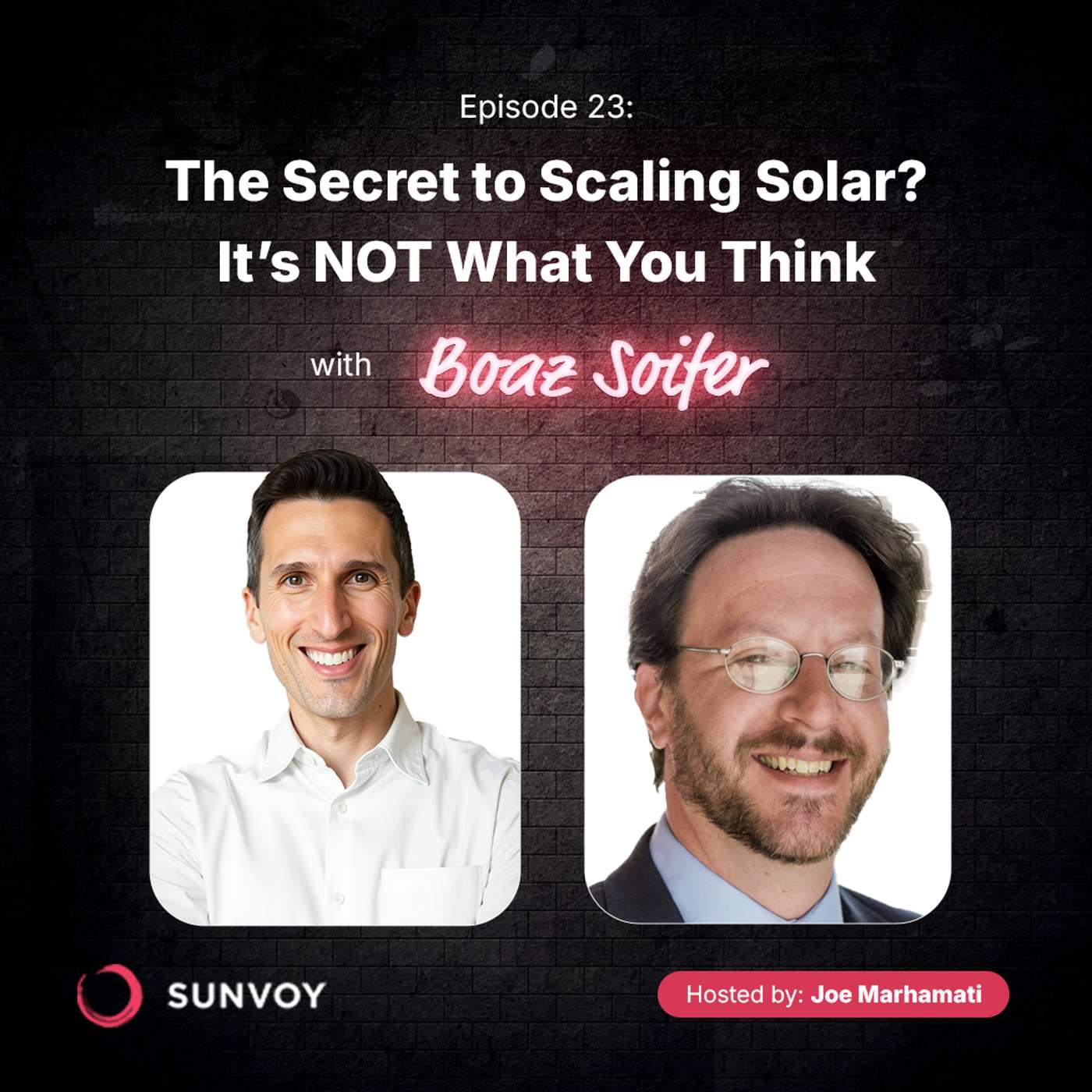
View All EpisodesEP 23
The Secret to Scaling Solar? It’s NOT What You Think
About this episode
In this standout episode, Joe Marhamati sits down with Boaz Sofier (one of the real veterans of the solar industry) for a conversation every solar CEO should hear. Boaz walks through his path from the wild Y2K days to running major solar organizations, and why he ultimately shifted his focus to fixing the one thing that makes or breaks an installation company: culture. What follows is part solar origin story, part executive masterclass, and a surprisingly honest look at how leaders, teams, and companies actually grow — and why the hardest work in solar has nothing to do with the hardware.
Transcript
Intro: I will say that our business is stronger than it has ever been.
The success of growth and where I see companies growing consistently really is your people.
I mean, the story is not does it make power? Because they all make power. The story is what does it power?
This is what solar installers need to know with your host Herve Billie and Joe Marhamati.
Hervé: Hi there. It's Herve and Joe Lourdes, Solar Installers Need to Know, where we interview solar CEOs and experts on how they run their business on the solar cluster. We ask their private revenue numbers. We give actionable advice and learn about trade secrets so you can run and grow your solar business. Joe and I built a solar company from 0 to 12,000,000 sales and got successfully acquired.
If you'd like to do the same or do better, go to sunburn.com/blog to get actionable behind the scenes lessons on running and growing your solar business. And now without further ado, let's jump right into the next episode.
Joe: Welcome back to you. And, for the first time, for the listeners, probably for their benefit, I'm sure they would love to hear a bit about your background and, you know, how you got into the solar industry and what you're up to today.
Boaz: Sure. So so I got into solar back in 1999 during the y two k boom. I had just bought a piece of off grid land, and I needed a power system for my little cabin. And I went to Positive Energy, which was the the local solar installer in Santa Fe. And they're still around.
Great company. And they helped me with a power system. I think I had $500 to spend on my first power system. Maybe it was 250. I don't remember.
They almost laughed me out of the office when I went in, but then they took pity on me and helped me out with some with, like, a used charge controller, a used panel, and a couple of golf cart batteries, and a DC light. I think that was my first system. And then Alan Sindilar came out and helped me install it. And I needed more steady work too. We're about to have our first kid, and I'd been working construction, and it was kind of stop and start.
And y two k meant there were a lot of backup power systems getting installed in the Santa Fe area, especially in the in the rural areas around Santa Fe. So I stayed really busy and learned a ton working with Positive Energy for about a year. After y two k, things slowed down, and I went to work for our distributor, which was Dankov Solar Products, and that's how I got into distribution. And my career has mostly been in distribution. I took a break to start up a couple of companies.
I had a mechanical contracting company doing kind of complex radiant heating systems with solar and backup heat, and we're heating not just radiant, but also domestic hot water and often other things, ice melt, pool, spa, etcetera. And then we spun off from that a design and controls company for solar heating systems, which was super interesting. But then I ended coming ended up coming back to distribution, I think, in 2010 with Focused Energy, stayed on through Baywise acquisition of Focused Energy and ended up running Baywise distribution business in The US and then for The Americas. So I got involved in m and a activity and post merger integration. We expanded into Canada and Mexico.
We expanded into the EPC business in small utility scale construction. And then I ran the The US business for a company called Amara and Xero for about a year kind of as a transition, CEO, helping Amara, with its acquisition of a distribution business in The States and then integrating that business with a wind component distribution business and a services and logistics business. So kind of like building up a corporate structure, hiring the executive team, forming the strategy, etcetera. And before I started at Amara and then since I left Amara, I've been running a consulting practice called PebbleToast or PebbleToast Consulting. And in PebbleToast, I'm focused on organizational development, not just with renewable energy companies, but in general, working on organizational culture and strategy.
And I became really interested in and passionate about those topics back when I was BAWA when I was at BAWA. Excuse me. And when I was CEO, there there was one point where, you might remember this, SolarCity and Sunrun and the other TPO companies had just taken tremendous market share, and distribution looked like it was having a more and more limited role. And we decided at Baywa that that meant it was a good time to focus on ourselves and build the most resilient and healthy culture that we could, and that that would serve us kind of regardless of what's going on in the market. And that ended up being a fascinating project.
And as the company grew, all kinds of new elements became introduced into that. And it wasn't like a project with a beginning and an end. It was just an ongoing continual improvement and innovation process relating to culture. And I got to apply a lot of frameworks. I got to learn a lot, read a lot, work with some amazing people.
And culture fascinates me because it's kind of in this nexus between philosophy and psychology and organizational elements. Like, it's kind of making philosophy real in the real world and psychology. And you you kind of find out if your philosophy and psychology work if your organization is successful. So it really put those pieces to together for me in a fun way. And when I'm not doing consulting work, there are a couple of things that that are keeping me busy.
One is the fools and sages podcast, where I talk with my old friend and mentor, Brian Lee, about psychology and philosophy. And we try to do that in a really practical way. So we end up using some technical terminology. Lately, it's been hermeneutics and phenomenology and things like that. But the idea is making it about answering the question, how do we live?
What do we do? And so that's been fun. Right? We wanna we wanna help describe describe a model of how the world works and and what being a successful human being in that world can look like. And we've had some great guests, mostly philosophy professors, but also some luminaries, like Jeffrey Moore, who wrote Crossing the Chasm and has recently gotten into writing about philosophy.
He was a surprise guest. I just hit him up on LinkedIn, and he said, yes. I couldn't believe it. And we had a great conversation. And then, you know, there's some kind of social topics that are super interesting to me that I'm trying to figure out how to work on more.
And I mean, particular, the political fragmentation and ideological fragmentation that we see in our country and, I think, in Western civilization in general. I think that's related to a 700% rise in antisemitism over the last couple of years, and I'm trying to figure out how to put those topics together and work on them more directly also. And I think that all interrelates with organizational culture, philosophy, psychology, all of these pieces somehow cohere. I'm not sure exactly how yet, but we're finding out. So that's me.
Joe: Sounds like a fun life after Baywa and being at the top of large organizations. When did you realize that culture matters? Is this something that you've always known, or is it something that you learned the hard way through failure? Was it from reading books? Like, when when did it hit you that this is the core of success?
Boaz: I think when that idea came up, and I think it was around 2011, it when SolarCity and Sunrun I I think there there were a couple of others at the time. I don't remember exactly who, but they were up to, like, 65% of the residential market, something like that, maybe 70. And and distribution didn't serve those companies or at least not much. So we were just constrained. And when when we were talking as a leadership team about what can we do, there were there were a fair number of ideas about what we could do externally with marketing and our sales approach and our positioning, but we had some strong voices in the organization saying, we we need to think long term, and we need to look at at root causes.
Like, if if we're going to transform in any way, or maybe let's make the distinction between change and transformation. So if we're going to change our activities, that might mean that we also need to transform ourselves. It might mean we need to have different beliefs. It might mean we need to have new perspectives about our challenges and our opportunities, and that means we have to think differently. And I related to that idea, I think, because of of my own background.
I've always been interested in psychology and philosophy. And and I like thinking, and and I believe that we can always level up our thinking. And when it comes to how organizations function, there's a collective reality. It's not just a bunch of individuals doing things. There's a collective shared understanding, a collective set of beliefs and values that represent a different environment than a bunch of individual things.
We're part of a society. We're part of an organization, and that has different meaning than our existence as individuals. And so so I don't know if it was an individual moment of realization, but but there is definitely a moment when the opportunity opened up to align my strong interest in how human systems work with actually boots on the ground operations. That coalescence was at that moment in the evolution of the industry.
Joe: What you said reminds me of something my favorite philosopher wrote about recently. If you know Slavoj Zizek, he has a fantastic substack. If you have a chance to read a substack, it's really good. And he had a piece a couple of months ago where he was talking about how we are neither particles, individuals, nor are we waves, just kind of one collective consciousness, but we're sort of this quantum thing in between. Sort of what I I hear you saying is that we're not just all a bunch of individual particles existing in this organization bouncing off one another.
We're also not one cohesive collective consciousness. We're something kind of both. And so that was a big realization for me too. And and I went through a period in during my first business of having a lot of self limiting beliefs and and also realizing that culture was something bigger than one person or even founders or even a leadership team. What does someone do if they realize they have a self limiting belief that may be holding them back or their organization back, but that it's so ingrained in them from their parents or their mentors or their first job?
Here's one that comes to mind, a self limiting belief like, everyone should listen to me because I know everything. There are definitely some executives like that, and there was a time where, you know, maybe I was a little bit like that, and and learned like, oh, this isn't helpful. And so when someone recognizes like, hey, this this isn't working, and maybe it's because of something I believe, how can they shift?
Boaz: I wanna react to a couple of things that you said. Zizek is brilliant. I wouldn't wanna be standing within 10 feet of him while he's talking, but I've watched a bunch of his talks on YouTube, and I've seen him debate also. He's a fun thinker. I think he's he's wrong in the end about what political and economic systems we should be gravitating toward, but he's way smarter than than I am.
So I do enjoy listening to him. The example that you gave about recognizing that we have a self limiting belief isn't really the problem. When we recognize we have a self limiting belief, we've basically won. We still have to do the work of catching ourselves being ourselves as my friend Hirsch Wilson likes to say. If we think that everyone should listen to us because we're always right and we recognize that's kind of how we're going about our lives, then we just have to notice when we're doing that so that we can have a choice.
The problem happens when we don't recognize and we have a self limiting belief. And what becomes fascinating about culture is might it be possible to create an environment in which people are more likely to recognize their self limiting beliefs, and what are the factors that might make that more possible? And that's where culture design starts to get really interesting. So if you surround individuals with other individuals who are also invested in recognizing their self limiting beliefs as opposed to putting an individual in an environment where people are not invested in that, then maybe it's more likely that these beliefs will be recognized and integrated. And there there's kind of a tension between the safety that we need to create in order for people to be willing to be vulnerable enough to recognize their self limiting beliefs and that they're challenged.
So their ideas in business literature like constructive conflict that imply that there are ways in which we can disagree that help us surface the biases and assumptions and judgments that we might have that get in the way of us having a more coherent perspective of whatever the challenge or opportunity is that we're facing. And and one of his core ideas is that we can divide our understanding of evolution into four quadrants, a two by two matrix. And on one axis of the matrix is the continuum from individual to collective, and on the other axis of the matrix is the continuum from internal to external. And culture lives in the internal collective quadrant, and that's the most mysterious quadrant by far. When we say external, we're referring to things that we can see or measure.
When we say internal, we're referring basically to the subjective, to our beliefs, our feelings, the things that can't really be measured. And the internal collective is really hard to get at without fragmenting it accidentally into a bunch of individual internal universes. So your feelings and your beliefs, my feelings and my beliefs, person x feelings and beliefs. The I I was incredibly lucky a couple of years ago to discover BOEM dialogue, which is the first kind of intervention I've come across that works directly on the collective internal quadrant. Other that that might be palatable for businesses and organizations.
Shamanism works on the collective internal quadrant too, but you can't really do that in a company, at least most companies. But but dialogue, you can. And David Bohm was a physicist regarded as one of the most important physicists of the twentieth century, worked on quantum theory, developed the theory of quantum potential. And he got super interested in consciousness and ended up working with Krishnamurti and writing several books that were philosophy books about one is called Wholeness and the Implicate Order, and one is called On Dialogue. And I was introduced to somebody that worked directly with David Baum.
Her name's Glennon Girard. She showed up on the Fools and Sages podcast if you wanna go check out that episode. And I studied dialogue with her formally for probably about six months, and I've remained in a dialogue practice group with her and several other students of hers. And dialogue is a method of surfacing our collective judgments, assumptions, perspectives, biases, feelings, all of that stuff so we can all look at them. And that's based on David Baum's idea that the way we're taught to think and communicate comes from fragmentation and creates fragmentation.
We think in terms of discrete things. You, me, this computer, this microphone, and that's useful for building stuff. But it's not useful for understanding stuff like what do we do? What is the best way to live? And Bohm wanted to help people create coherence, and he thought working on things like the climate problem and political polarization and things like that would benefit from a practice where we resolve fragmentation into coherence a little bit at a time.
In my experience with dialogue, it's possible to think very differently about something at the end of a session than you do at the beginning, and and that comes from tapping into collective intelligence, the intelligence of the the group that's in the dialogue practice. So so, yeah, that's been that's been an important part of how I want to work on culture and how I have been in a couple of consulting engagements over the last couple of years. Can you
Joe: give a concrete example of how dialogue might go from what you describe as language of existing discrete objects to something more holistic and how that could shift a culture from one that might be stifled or not as successful as it as it could be to one that manifests a greater level of success, coherence, etcetera?
Boaz: One company that I I do consulting work with brought an issue up that they referred to as we in our culture, we don't have an adequate sense of ownership amongst individuals. And so we don't see, like, the level of initiative and ideation and taking an idea all the way to the ground and making sure it works as we'd like to see. And they called they were calling that ownership. And we've we've got some perspectives about that topic from the individuals on the leadership team. And then we actually brought the leadership team into a dialogue session with the dialogue group that I practice with.
And we went through three stages of a dialogue practice. One was the client's leadership team and the dialogue group all having a dialogue together about this topic of ownership. And then the dialogue group continued with the topic while the client team became observers. And then we all came back together again for another dialogue and then reflection on what what we learned. And the first section with everybody was really useful in in terms of kind of inquiry into the topic.
Like, what do we really mean by ownership, and how would we know when we saw it, and what do we not mean by ownership, and, you know, those kinds of questions and answers. When the client team went into observer mode, a question that came up and a topic that came up in the dialogue group was notice there were a lot of feelings in the room, and this leadership team had gone through really difficult transitions in the prior year or two, and there was, like, emotional residue from going through those difficult transitions. And so the the dialogue practice group was was able to surface kind of its perception of the emotional plane content of this topic. When the client team came back into the dialogue after observing, right, they weren't absent. They were just they were there as observers and listening intently.
They came back and said, you know, you're right. We actually have a lot of feelings. And one of the connections that came out of that was the relationship between belonging and ownership. And if we want ownership, maybe instead of asking for ownership again and again and telling people they're not demonstrating it, maybe we need to cultivate an environment in which people feel strong sense of belonging and connection to one another. And then maybe ownership follows.
And that's kind of like a really common move that that I like to make in my consulting practice, and I think a lot of good consultants make. I'm not I'm not saying I'm a good consultant, but other good consultants that I've seen make this move, which is to look at the the yin response instead of the yang response. And even the word response is yang. So let's say the yin perspective instead of a yang response. And what I mean by that is a lot of times when we wanna create change, we try to take action directly on the thing that we want to change.
But when it comes to culture, a more yin response might be asking ourselves what is the container or the environment that out of which what we want will flourish. And let's focus on building the container, not on trying to make the flourishing happen. And it's very much like growing a garden. Right? You can't try to get your your squash plants to grow by telling them to grow, and you can't even control the outcome of whether they grow and whether they fruit.
But you can contribute by having good soil and having good sun and watering at the right times and adding nutrients and harvesting and, you know, tending and weeding and all this stuff. Right? You can work on the container and on the environment so that the probability of a good outcome is enhanced. And so so when it comes to to culture, I kind of threw everything out the window except for what does a healthy culture look like. What is the health how do we how do we cultivate a a grow bed for our culture that's going to have the highest probability of yielding the best fruits and vegetables for ourselves, for our clients, for our suppliers, for our communities, for our society, whatever that looks like.
And the the perspective that the client and the example that I gave, the perspective shift that happened as a result of dialogue came from the collective intelligence of the team and the dialogue group, came from creating the space to notice the emotional content of the conversation, which got the team thinking about the emotional requirements of their culture so that their team could thrive, and then help the team make choices about what they wanna do in their business to optimize for better outcomes.
Joe: It it leads me to wanna ask you what's gonna sound like a very dumb question. So I'm gonna ask you the question, and I'm gonna tell you why I'm asking this question. What is the point of business? And the reason I ask is because I used to think the point of business was to make a profit, was to make money, maybe when I was at a slightly low lower level of consciousness. And then I thought that business was to produce and innovate and add value for society.
And then after COVID, I came to to wonder, maybe believe, that the point of business was to belong in the way that our ancestors belonged to a tribe, belonged to a group of people with a set of values or beliefs that made them feel like they were bigger than themselves. So what do you think the point of business is? And does building a good culture necessarily perfectly correlate with profitability, and does it matter?
Boaz: I like your answers. I mean, the the first one obviously is is, like, the, let's say, unenlightened answer. A business is to make profit, but then you have to ask, but why? Your second answer about being a contributor to society, I think, is the best mainstream answer. What I mean by that is, you know, when you say what is the point of business, the question immediately arises to whom.
Right? What is the point to whom? One founder might have a very different idea about that than another. And and your question implies that there's, like, a meta point to business. Like, because we do this as humans, then it must have some logical like, it's pointing us towards some developmental outcome.
Like, there's a north star that is calling us. Right? So that has a lot of implications. I think not all people and not all founders would agree that that's the case, and they also if they if they do think there's a north star, they might disagree about what that north star is. And then I think belonging as your third answer is one of a universe of north stars that are valuable.
So, you know, I guess I think about business in the context of what is the market, and I and I like the idea of a free market. I mean, I think regulation is important, unfortunately, because the the kind of utopian idea of a free market is that people will want things, businesses will produce those things that will make people's lives better because they have what they want. The problem, of course, is people want things that are not in alignment with what's best for them and best for society. Right? That's, like, the human problem.
And virtue is, like, the unpredictable thing that if we have it, and if all systems work. With virtue, Zizek is right about communism. With virtue, capitalism doesn't meet regulation. But without virtue, business is is a potentially hollow vessel, morally hollow vessel. And you're you're interjecting a morality into it, which I think is great and necessary.
I mean, I think virtue can look like a lot of different things. I think creating belonging is is high up there. Once belonging exists, there's yet new potential. Right? There's potential for, let's say, for example, self actualization.
Right? So for the individuals and groups that a business touches internally and externally, right, its own people and teams and the communities that it serves and the communities in which it exists and all all of those things benefit from everybody involved becoming more whole versions of themselves. And it kinda goes back to your earlier question about self limiting beliefs. Like, a lot of the work that we're doing here as human beings is recognizing our self limiting beliefs and integrating them so they don't govern our choices. The in the phrase less limiting beliefs, there's the implication that, well, if we didn't have them, we would be less limited, and we could do more stuff.
And we could do better stuff and add virtue to that. We could do more virtuous stuff. And so I think belonging is, like, foundational for that to happen. And in my my examples earlier about what healthy culture fundamentally means, I think an environment in which people self actualize is a great north star. And the assumption in there is that the more people self actualize, the more open minded and therefore innovative and creative and effective they are, which means the organization that they're part of might be more adaptable, more resilient, more creative, more able to define and meet its goals successfully.
So there's, like, a virtuous cycle there where or at least that was my premise working in organizations. And and it remains my premise that that the more self awareness we have, the better our communication is, the the better our thinking is, and there's no end to that developmental process. Some people, some solar executives, if anyone's listening to this, are gonna listen to this and say to themselves, hey. My business seems to
Joe: be running well. We're profitable. We're growing steadily. Why does any of this matter to me? My team members seem happy enough.
Is this something that you've seen larger companies do, publicly owned companies or companies with thousands of people, what you kind of described, where you take stock of your current situation maybe because of a market force or maybe just just because of a moment of self reflection where you want your colleagues to be happier and more open and more creative. Is it something you've seen at large companies, maybe publicly traded companies, or is it something that is really relegated to smaller businesses? And why should any solar executive listening to this want to take stock of this approach to culture and consideration why philosophy might ever matter to their business?
Boaz: Well, if everything is going well, there's not much reason to change, and that's fair enough. I certainly wouldn't want to try to sell coal in Newcastle. If people have a formula that's that's working, that's great. I think as we mature as human beings, our understanding of working also develops. I just heard a story from a consultant who's a friend of mine who's working with a company in which a top executive has decided that his legacy, his past 50, that his legacy is actually to increase the quality of consciousness in his organization.
And by doing that, he's also going to contribute to the consciousness of his clients and, you know, the the external stakeholders that his organization touches. I happen to think that that can result in some interesting business outcomes and and even positive ones, but that's not the primary motivator. I think that's, like, a nice to have. But the but the must have is I have a limited time on this planet. I wanna make a difference.
Basically, it's the same thing David Bone was saying that I wanna create more coherence. I want society to be better at understanding and solving its problems, and that starts with me. And I have influence in this organization, so that's where it starts. I don't know about culture in big publicly traded companies, because I think what we read in business books is often idealized. But I do know that there are some really interesting approaches to organizational design in good sized companies, you know, with thousands of employees.
And one that I'm thinking of is the Morningstar Corporation, which is a tomato processing company that I believe is headquartered in California, and they're famous for being self managed. Their founder from the very beginning developed a sort of charter that laid out how the company can do everything it needs to do without formal hierarchy. So for example, one thing that I think they do at Morningstar, I've read about a few self managed companies, so I might be getting them confused. But setting your own salary is something that happens in self managed companies. But you do that in front of a committee of your peers, so there's transparency around it.
And you justify what your salary should be. Hiring and firing happens through committees of peers. There's hierarchy within projects, but not within an org chart. So somebody has to be responsible for getting something across the finish line, and and they get to make decisions about that. But that doesn't mean that they are also responsible for hiring and firing the other people involved in that project.
So so by kind of creating organizational structures that are peer led, they've stepped out of hierarchy. And I don't know how much they would share my perspective on the relationship between healthy culture, self actualization, and being virtuous, benefiting society. But I assume that they have some reasons that are in the realm of morality for experimenting in this way. And I think, if I remember correctly, it's that people feel they belong. They have a sense of ownership.
They take more initiative. They're more creative. They're more collaborative when they work in a self governed system. And I think other their ideas, like the book Small is Beautiful, talks about how these kinds of structures have limitations of scale, and that our cities are too big, our organizations are too big, our institutions are too big. And that contributes to bureaucratic drift, scope drift, a tendency towards the consciousness of the lowest common denominator in the institution.
And and, yeah, there are just some issues of scale that seem to be a factor here that that might preclude organizations of a 100,000 people being able to do that kind of work. Another self managed company is Semco, which is a, I believe it's a Brazilian energy company. Steam, the gaming platform, or maybe the platform is the company is Valve and the platform is Steam or the other way around, but they have, like, this 50 page charter, like, employee handbook that says how we operate without hierarchical structure. And those exist. And, actually, building on the work of Ken Wilbur, people like Frederick Laloux, he took Ken Wilbur's ideas about of integral theory, which are about there being higher and higher states of collective consciousness that we're moving through, and applied them to business and developed a a framework that talks about the teal organization.
Right? These different levels of relationship to hierarchy and authority are associated with different colors, red being, you know, command and control, and the opposite end of the spectrum being teal, which is shared ownership, shared leadership. And my understanding is that there are a growing number of companies, mostly small companies, taking these principles of tier organizations and applying them. I do think a key is applying it from the start. I think it's really hard to back into a nonhierarchical structure after you have hierarchy in place.
I don't think it's impossible, but I think it's harder. So I I think that the best chances reside with founders who have this kind of mindset from the beginning. Companies with thousands of people are doing this and winning. As far as I know, Morningstar and Semco and some of these other companies are very successful market leaders.
Joe: How do you think about ego? What is a healthy ego? And have you seen a founder or an executive who gains self awareness that maybe their ego is getting in the way of the business culture moving forward or going to a higher level of consciousness or success? And what can somebody do in that moment of self reflection? Do they need to climb the zap of a mountain, take a sabbatical, work with a consultant?
How do you think about ego in business, and what can somebody do to overcome their ego if it's an impediment to building the culture they they
Boaz: Ego is a tricky topic. Maybe let's start with definitions. So when you say well, when people say ego generically, they're usually referring to an out of balance ego. A big ego means that somebody wants to control a situation or or define a situation or be seen and recognized as important somehow. Right?
That's what we mean by big ego. A more elaborate understanding of ego is the the sum of our defense mechanisms and narratives that help us make sense of the world. And in that sense, an ego is extremely necessary. Being without ego or experiencing what people call ego death is a state of union with everything. And if somebody can remain in that state, they are not in business anymore.
They're in a transcendental place, which is great for them, but not really what we're talking about. So when we say healthy ego, I think what we mean is that the beliefs and narratives and defense mechanisms that we have are continually becoming more conscious to us and that we're able to evaluate them and update them so that they're more an accurate reflection of the universe, and they will never be a fully accurate reflection. Right? Our our worldview will never be complete, but we can be continually updating it and informing it with other perspectives. And and if we do that well, it becomes more useful, more resilient.
We become more virtuous, more happy, more compassionate, more more balanced, less less prone to acting on our compulsions, and more prone to making thoughtful, mindful choices that account for more complexity. And so so let's say ego is not a bad thing, and and a healthy ego is in a mode of continual updating. And so to your question about what does somebody do when they kind of bump up against limitations, I mean, climbing a mountain and taking a sabbatical and talking to a consultant or a coach or a therapist are all useful. But the reason they're useful is because they're interventions. They're disruptions of the norm.
And I think I think the universe does a pretty good job of disrupting us. But if we're somehow immune to the slings and arrows and we need more disruption, or maybe this is more the case, the universe is disrupting us, and our ego structures no longer serve. And so we need to process that, and we need other people and other experiences to help us understand that. That's where climbing a mountain and taking a sabbatical and talking to a coach or a consultant or a therapist or whatever help us make sense in new ways. And I think that's I think for a lot of people, that's like a lifetime process.
I've heard people say, I you know, I've integrated all my shadow stuff. I'm not really doing development work anymore. And I don't have any reason to not believe them except that that's not my experience. And I have some heavy trauma in my background, so maybe I have to do more of this than other people. I don't know.
Or maybe my karma is just that I'm on this path of continual development and assume that I will be for the remainder of my life. And maybe other people just aren't, and that's okay. But I think that I'm better for it, and I think that a lot of people that I see who relate to development as a continual process make better and better choices about their lives when it comes to their relationship to meaning, and they find ways to build life structures that are more and more meaningful to them and meaningful to the the people. And I wanna say, like, groups and and communities, but also environments that surround them.
Joe: A summary of recently called the denial of death, which is a thesis, as I understand it, that we are meaning making creatures that need to make sense of our lives. I think it was written by a Holocaust survivor. And it makes me wonder if we're better off for being meaning making machines. And so when you when you talk about Wilbur and the higher levels of consciousness, is that do you think that that is a kind of god? Is that a kind of teleology?
Is it intentional? Is it helpful to us, or would we all be better off as dogs who don't have to make sense of anything?
Boaz: I heard in a sermon recently a a retelling of a debate that's documented in the Talmud, which is kind of like the Jewish book of moral debate. And and the debate I think the the sermon at the sermon was by a rabbi, and and I think he said it went on for, like, forty years. The topic was, are we better off for being alive by being conscious? Are we or, you know, are we better off for being here? And the answer after forty years of debate was it would be easier if we weren't.
It would. But since we're here, right, and and I I think that's right on. And it and it kind of it reminds me of the there's kind of, like, this this duality that we experience around the pain and tragedy of life, and and you said this was written by a Holocaust survivor. Well, who would know better? How painful and tragic life is.
And yet what a miracle it is to be alive every day and have this outrageous experience of reality. Like, who would have predicted? I saw something There is a mathematician who calculated the probability of this universe existing as something like one in 10 to the one zero two zero three place or or something like, you know, exponent. So so, like, an incredibly infinitesimal chance that this universe could even exist, and here we are getting to experience it, right, with all of its pain and suffering and tragedy and attachment and all of our human frailty and all of the mistakes that we make and all of the ways we get in our way and hurt each other and hurt ourselves, it's overwhelming. And yet, since we're here, what is making the best of it look like becomes a really important question.
And I think teleology kind of comes out of that question. Like, since we're here, what are we gonna do? And because human beings, generation after generation, ask that question, that implies to me that there's an overarching trajectory. Because there's development in technology and because there's development in in in philosophy and in our understanding of the world, I I tend to think that there's some trajectory to that, that that's going someplace. And I tend to think that that that's going to a place of integration, that as we continually become aware of our ego structures and how they get in our way so that we can update them, that continual updating brings us closer and closer and closer, never all the way to, but closer and closer to an understanding of what's really going on here and who we really are and what a miracle this this actually is.
And you asked about God, and God is a really difficult subject because even in the same breath, it can mean different things to us. But I tend to think of it well, I think of it in several ways. One is the potential force behind that trajectory, that developmental agenda that humans seem to be on, and by implication, consciousness seems to be on. And I think of we did an episode with on the Fools and Sages podcast with professor Stephen Nadler, who's an expert on Spinoza, who was a nineteenth century Jewish philosopher, who was kicked out of the the Jewish community, the religious community for his heretical views, which basically were that god is nature, not separate from nature. And and I believe he meant nature writ large, like the universe is itself God.
And each of us is a fragment of that. And our experience of a self and a desire to actualize that self is unfolding of nature and god itself. And so we're kind of, like, compelled to do this, at least some of us are, unfold ourselves towards wholeness, towards coherence, away from this fragmentation that that physical reality represents where you're you and I'm me, but we're both nature. We're both god. Right?
We're both fragments of this whole that I think consciousness is maybe most fundamental to.
Joe: And yet the scientists tell us that entropy is increasing. Chaos is increasing. Do you see this higher level of consciousness, this trajectory, if there is one, as a counterweight to increasing physical entropy in the universe?
Boaz: One way I think about that is the more tension exists in a system, the more opportunity there is for phase change. And so if you think of entropy increasing as, let's say, analogous to the molecules in water getting more excited as the water heats up, At some point, the water flashes to steam, and the molecules are in a new phase. So so I don't think the idea of entropy is necessarily in conflict with with the evolution of consciousness. And then I also think there's kind of a duality where where I don't know. I'm I'm not a physicist, not even remotely, and I have no idea whether physicists would say that the increase in entropy applies to anything other than matter.
But to me, that brings up this kind of duality that that matter and consciousness are interrelated perhaps, but are but are not the same thing. And it might be that as entropy increases in the material world, coherence or the potential for it is actually increasing in consciousness. That's even probably too simplistic a description. And I think I'd have to think about that a little more and come back to you with how I think those topics might interrelate. But but I don't I don't see it as disqualifying.
Right? That in fact, I'm I'm thinking about, like, chaos and order being the primary duality that pre Socratic philosophers talked about. Like, is the universe fundamentally chaos or order? And I think the conclusion to that, to the extent that one exists, is both. And and that that may be another way of saying is is the universe fundamentally material or of consciousness?
And, well, probably both.
Joe: I wanna bring it back down to earth just a little bit, not too much, and talk about values. And I'll admit that I I didn't fully follow your answer because probably because I have a bias toward understanding that values matter in business and in life and relationships, and knowing your values matters in business and in life and relationships. And you had a different answer. It was something like there there's a universal value or infinite points of light, and I wanted to understand that better. How do you think about the relevance and the importance of an individual or a business defining its values, ensuring that the people in that organization understand with, agree with, and live those values?
Is that important for business and life?
Boaz: If you go back to our conversation about the ego, where where we said that that the ego is basically the most updated set we currently have of beliefs about how the world works so we can make sense of it. Values exist at the level of ego. Values are amongst those beliefs that we have about how the world works and how we wanna play in it. And if you agree with my premise that we're never gonna fully understand how the world works and our place in it, but we can participate in a continual updating of our beliefs, then it follows that we might also continually update our values. And we don't we aren't served by adopting values with with the idea that they alone are our timeless guideposts to living a good life.
It's not to say that they aren't perpetually valuable. Right? Real values are timeless. But if I choose these three values as how I define meaning and how I derive meaning, well, then you come along and give me an experience that makes me see that differently. I would be foolish not to update my mental model, including what values I consider most important to me.
And I think this happens as we age specifically. So for example, you know, at at 50 years old, we have a consistent experience that we call the midlife transition, or in some cases, the midlife crisis. It's well documented. I think that very generically, what's happening there is we realize we passed the halfway mark, and we ask ourselves what's really important. And we might realize that a lot of the things we've been investing a lot of time in have not checked that box.
And we might react by doubling down on those things because it's too scary to try to change lanes, or we might react by having a second career and transitioning, say, from corporate life to working in nonprofits on the topics that really matter to us most, let's say, hypothetically. So so it's not that I think values aren't important, but I think all of the values, however you describe that set, can all be seen as the names of God or the faces of God and all represent fragmentation when value itself might represent the whole. Right? You can take something like we were talking about earlier, virtue. I think I said something along the lines of with virtue, communism works, capitalism works, everything works if people are virtuous.
But you can break virtue down into a lot of other words. Right? It can be compassion. It can be hard work. It can be caring for the less fortunate, whatever.
And you can call any of those fragments of virtue your values. Or if your mental model gets updated and you think virtue comprises all of these other valuable things, you might say virtue is my value. And then you might realize that virtue is a component in coherence, and then you would say coherence is my value. And then you realize twenty years later that coherence is really a component of merging, and you you decide merging is my value. Whatever.
Right? At some point, it's whatever. Like, they're all good words. They're all good things. By all means, talk about them, explore them, but don't be too attached to the specific words because they're all fragments of the good by what Plato called the good.
And the benefits to an organization of naming values become eroded by the organization's subsequent close mindedness and attachment around those values. Like, they're only as good as as the point in time in which they serve us and have to be open minded. I think that's what I was saying, that, like, at least in The US company, we've we defined core values, and then a couple of and and they were good. They were, like, honesty and integrity and good stuff, reliability, quality. And then we threw them all out and said, fundamentally, we want health, and we're we're calling that the sum of these values and the other good ones.
And we're gonna develop our culture to be as healthy as possible, and we're going to be willing to update our understanding of health as new awareness becomes available to us. I don't know what what PayWise is doing today, but I thought that was a really useful move for us because it helped people stop focusing on these words that are hanging on the boardroom wall and got them thinking more about what health means to them. When they wake up in the morning, how they approach the integration of their work life and their personal life and the choices that they make and how they relate to their team and their customers all from a perspective of health, meaning physical health, emotional health, spiritual health, intellectual health. We we my colleague and friend, Jody White, ran a program in Baywa called Learning is Fund that was a great contributor to our culture of health. And sometimes it was like a weekly meeting that was totally voluntary, and sometimes it was discussing topics that were closely related to what was going on in the business.
But at one point, we did a debate, and and there were several sessions. I mean, there were people that took opposing positions on a topic and debated, and all of that practice was to make real our awareness of fallacies and cognitive bias. Because the quality of an argument depends on the ability to recognize and remove all of the cognitive fallacies that might creep in there, and the fallacies are the result of lower quality thinking that we have. So just to give people, like, an example in case they're not familiar with cognitive biases, When we're arguing with somebody, we have a temptation to make what's called a straw man of our opponent's argument. And a straw man means we make the weakest version of their argument that we can so that we can dismantle it.
And instead, good argument steelmans our opponent's argument, helps their argument be as strong as possible so that when we counter it, we're really engaging with the fundamental merit of that argument, not a straw man of you know, that we make of it. So we did that, and what we found is that it contributed directly to the quality of decisions that people were making in the organization because they were thinking about, you know, differentiating their assumptions from the facts. They were thinking about whether they the scenarios that they envisioned resulting from their decisions were thoroughly thought about. They they looked at whether they were approaching risk in these decisions more rationally as opposed to emotionally. All of those things emerged from driving up the quality of our thinking through debate.
That came out of health as our unifying core value. And I didn't miss talking about honesty and integrity and all those other things as our core values. They're still good things, but I felt like we didn't need it anymore. It's obvious. Of course, we're gonna be honest.
This is a healthy organization. What else are
Joe: we gonna do? You know? Maria Kingery refers to those as table stakes, which I think is true. But sometimes we make our core values nebulous concepts that we ought to all believe to be in relationship in the first place. And I think you're right.
And sometimes they do become a poster on a wall rather than something that informs our behavior. But when you're when you're making a change like that, whether it's culture or core values, and you've got an organization of hundreds or maybe thousands of people, how do you go about even beginning to do that? And how do you do that in a way that makes people feel like they were part of the decision and not just being told one day when when they get up, they get an email saying, hey. Our core values changed. And I'm asking with genuine curiosity because because I I haven't seen that really for a chance, certainly in a private organization.
Boaz: Well, I I think that the part of your question that is how do you make people feel dot dot dot has some clues. You don't. You can't make people feel anything. And if you want them to have had the experience of being part of the decision, they have to be part of the decision. That doesn't mean the decision is gonna be a consensus based decision or they're gonna vote or anything like that.
But if you want people to feel like they were involved, you actually have to involve them. And and I think the the the low watermark for that is just getting input. I think using the input in your decision process. And if you already know what the answer is, don't bother getting input because people will smell that. They'll recognize that you never really wanted their input in the first place.
So you have to genuinely want input, and then you you have to ask for it, and then you have to read it or listen to it or or, you know, take it in. Then you have to think about it and and maybe talk to them about it. And the input that might be surprising, you need to dig into. You know, you really have to have a a real process there. Obviously, sending an email saying we changed our core values is people might be fine with it, but that doesn't mean they're gonna feel involved.
And not everybody needs to feel involved in everything. They might they might need to have some sense of belonging, which will vary from person to person, but belonging doesn't mean involved in the decision and or nor involved in the execution. That also varies. So I I don't I don't think everybody has to be a key stakeholder in everything in order for there to be cultural integrity. Or by integrity, I mean, like, we're all reading off the same page.
Joe: But if you've got 5,000 people in an organization, is it just a matter of genuinely and sincerely asking for feedback about what they think the the core values ought to be or what the core value ought to be? Or is it that there there's some level of middle management that confers about that question and maybe asks the relevant people, like, is the actual process of making a change like that so that you get input from all 5,000 people?
Boaz: I I don't know if I would ask, what do you think our core values should be? To to my my earlier comments about core values, you should get a thousand answers or 5,000 answers to that because there are plenty of good core values. And how are you possibly gonna choose between them? You know, if you're kinda putting that out to everybody. But you might ask, who are we really?
And you might get some interesting answers to that that make you think differently about that. And then middle managers are not a proxy for individual contributors. I would not assume that that middle manager will tell you what the sum of their direct reports would have told you. You. That's there's no reason to believe that.
And you can design a process in any number of ways, but if you want input from representatives across the organization, then you might have some individual contributors and some managers and some directors and some, you know, every level of the organization contributing, or you might have everybody in the organization contributing and come up with a way to process that information. You might have a series of dialogue sessions that bring different stakeholders together. So I think it might be an interesting experiment to take, you know, let's say, five individual contributors, two managers, and a director, and do a dialogue session with them and duplicate that with different people representing different levels of organizational hierarchy and duplicate it again. And as a CEO, I would want to observe and not participate, and I would wanna create a context in which my authority as CEO is left at the door. So me observing is not as an evaluator, but as a listener.
And I would want to have already created the culture so that the people participating in the dialogue with me as an observer and not an authority figure would trust that I'm not there evaluating them. Right? Like, that's the real culture. It it brings to mind a a question I've
Joe: been wrestling with in the the last month, which is thinking versus feeling and analysis versus intuition. Seems like a lot of the civilization we've built and business culture we've built and institutions we've built have been built on reason and thought and hierarchy and rules based order, and that there's been a kind of movement maybe against that or counterbalancing that in favor of feeling, intuition, collaboration. Do you sense that, and is that either good or bad? And how do you think about balancing thinking versus feeling, analysis versus intuition?
Boaz: I think that's totally right, and I think it's totally good, but it's not the end of the story. I think that rationalism and materialism and a belief in the possibility that we can think our way through everything, did a lot of great things for us or or continues to do a lot of great things for us, and also divorced us from the rest of reality that is not rational. Then along came so so call that modernism. And then along came postmodernism and said, well, what underlies all of this so called rationality is a belief in power or or a desire for power. And so, really, all of these rational things that we're doing are only rational superficially, but serve the movement of power, the holding of power, the expansion of power, the taking of power from from one party to another.
And that's valuable in that it made us more aware of the role that the rest of consciousness plays in the rational. I think it's a mistake to think of it as just power, but that how we use rational information is not necessarily a rational process. It also made us more aware of how different perspectives can be useful and relevant in ways that a rational worldview figure out which is right. And the baby went out with the bathwater, as far as I can tell with postmodernism, because rationalism is not inherently bad. It does not solely serve power.
Hierarchy is important and exists in the natural world, including in the subjective world. Some ideas are better than others. I think what's happening next is an integration of the modern and postmodern, or you can call it thinking and feeling. Postmodern is not just feeling. It's also it's got some other components to it.
It's maybe, let's say, sensing or or I think of feelings as as emotions, but it's not just emotions. And I think that integration is an opportunity for the intellectual realm to get reunited with the psychological realm, the spiritual realm, the emotional realm, the physical realm even, so that we approach problems and opportunities with both, with all of our faculties online or or at least more than they have been in the past. So in dialogue, the example that we talked about earlier, first, we had all this conversation about what does ownership really mean and what does it look like. That was a pretty rational approach. And then what came out was about people's desire or need to have a sense of belonging in order for ownership to manifest.
And that was very much at the at the emotional level and maybe also had components at the at the spiritual level. And so so with a tool like dialogue, by slowing down our processing, we can access more of the ways in which we make sense. And we do make sense in a variety of ways. And I think maybe the the last thing I'll say about rationalism is Yep. That that is much good stuff has come out of it.
You know, cures and ridges and self driving cars and AI and you name it. Quantum computing, which I have no idea what that is. Nuclear fusion is, you know, showing more promise. So, I mean, rationalism obviously is has done incredible things for the quality of life globally. We've lost community, and we've lost rates of depression and obesity are incredibly high in the Western world, and ideological fragmentation and polarization is incredibly high.
We some of us live in areas where we don't know our neighbors, and there's strip malls everywhere with chain restaurants that have poor quality food in them. I mean, on and on. Right? That's the world that we've that we've built with all this rationality. Why?
Right? I think part of why is because we don't know everything we think we know. The way we have tried to understand how nature works, by definition, requires us to take small samples of nature and analyze them. But nature is a living system. All of nature is a living system.
And so whenever we look at a limited piece of it, we're missing or risking missing a forest for the trees. I get these headlines every morning from a non biased headline aggregator, and often there's, like, science and health news, and it often reads something like, this new section of this monkey's genome was mapped. That has promising implications for cancer treatments. Great. But what?
There's obviously like, the reason that this genome was mapped was for a particular direction in medical research. But where is that knowledge, that new knowledge that was gained getting integrated with all the new knowledge that's been gained? And even for the question to be asked, what does this new knowledge make possible? And it seems like what this new knowledge makes possible is potentially a cancer therapy, which is great, but I imagine there's a million things this knowledge makes possible. But but we're we're thinking about it as cause effect instead of in a a web of interconnectedness, and that's not bad.
It's necessary. We have to think in this fragmented way. That's what human beings do. I want us to add more of the whole as context for that so that when we're making choices or that seem like cause effect choices, we do it with more context and greater understanding, and ideally greater shared understanding so that we can even be aligned in in how we're making choices.
Joe: You said want, and you said that you, I think, hope there's an integration of modernism and and postmodernism or thinking and feeling and rationalism and whatever you wanna call the complement to that. Do you have evidence that that might be coming? Because right now, to a lot of people, it feels like there's a backlash going back to kinda where your original comments about social and political division, a lot of which I think is caused by social media and technology and what we used to call progress. Is there any reason to think that this is actually coming, or is it what it feels like to a lot of people, this kind of cosmic battle between rationalism and civilization and progress on the one side and feeling and integration and love and collaboration on the other side?
Boaz: I don't have evidence, meaning meaning I don't have statistics. I don't have data. I have anecdotal evidence like this conversation. There are a lot of people having this conversation or a version of it right now. I suspect it's more than fifty years ago.
I think there are some polarizations that that, like, you mentioned the polarization between, like, rationality slash civilization, and I assume love and compassion were the slashes with disorder, right, or not civilization. And I don't think that polarity is necessarily sustainable. I think plenty of the people who promote rationalism as how to make progress and define progress in terms of rational outcomes, go home to their families, and find meaning in plenty of ways that are not rational. So I think that conflict, if it is a conflict, is within each of us, and that's why it gets projected and manifests at a societal level. And I don't agree that social media creates polarization.
I think that social media is also a projection and then a reflection back of polarization that exists in each of us and between us. And so it amplifies it, but it's not the source. And so I do think the evolution of human consciousness has a trajectory. I think Ken Wilbur is right that in each phase in the evolution of human consciousness, there's a reaction to the prior phase and then an integration of those together. I couldn't give you evidence for that.
It's a belief that I have. And that because we're having this conversation about how we take the very valuable capacity that we have as human beings to fragment the world and build things with this very valuable capacity we have as human beings to make meaning, to care, and to be virtuous? How do we put those together, for example, in organizational culture or in the relationship between organization and society? I don't think we'd be having this conversation if it weren't evolutionarily emergent. I think this conversation is an attempt to synthesize those, and I think there are a lot of conversations like this happening that that I take as evidence that we're in process with that.
And postmodernism, I think, maxed out. I think there are still people saying things like, you can replace scientific knowing with other ways of knowing and get better outcomes. But the mistake that they make is that that's not true for science. You can't come up with a genetic intervention for cancer with other ways of knowing. You do that with science.
Other ways of knowing have relevance in other ways of being. And I think there are still people saying, no. Other ways of knowing are better than science. Right? There are still people saying all hierarchy is bad, and that's gonna continue.
There's a long tail on that. But there are more and more people saying that our job in in stewarding or midwifing the evolution of consciousness is figuring out how to take the subjective and the objective and integrate them. I think that I think that's happening. I think this conversation and and many others like it are are showing us that that's in play. This conversation wouldn't be happening if that weren't the case.
We're we're just expressing consciousness. This isn't just here's what I think and here's what you think. We're also part of a whole. Right? This is what the whole is thinking through us.
Joe: It reminds me of another piece recently talking about how reality never exists in any given perspective, but only in the space between all perspectives. A parallax view, I believe you called it. And I loved that because going back to your conversation about dialogue, it seems like and it feels like reality only manifests itself as we talk, and particularly as we talk with empathy in person, ideally. And it seems sure and sure to me every day that reality only manifests itself as we empathize with one another's perspectives, but not in any given perspective. Do you agree with that?
Boaz: Yeah. I mean, it ties back to the leveling up we talked about with the ego structures always needing to be updated. So I don't think you can suspend perspective. I think you have a perspective whether we admit it or not. We have a perspective or an ecosystem of perspectives about how the world works.
Otherwise, we couldn't make any sense of it. We couldn't tie our shoes in the morning. And talking to one another is what phenomenologists like Levinas refer to. That's the opportunity for us to merge horizons. I'm encountering the infinite in you, and you're encountering the infinite in me, and that makes my worldview potentially much greater.
By trying to understand your depth and the depth of your experience, I enhance my own experience and can have some taste of the infinite. And I think, in that in that quote, you referred to to reality being the sum of all the fragments of reality, basically. And and I think that's that's, you can replace the word reality with god, I think, with some function, without without getting too esoteric. I mean, that's, I think, what Spinosa was saying about nature. I mean, that's what Kurt Vonnegut was saying about the at a chronos ynclastic infundibulum.
We just did an episode on that, on fools and sages podcast. And Vonnegut describes a place in the universe where all truths can coexist. And the the anti postmodernists will hate that quote because they will think it implies that there is no hierarchy amongst truths, but there is.
Joe: So I'm gonna ask you one more question and then the last question. What is sophistry then if not part of what you're describing? Because a lot a lot of the anti postmodernists would call postmodernism just a rehash of sophistry. So what is sophistry to you if if not that?
Boaz: How are you using sophistry? Just just in terms of, like, deceiving ourselves? Delusions, circular beliefs, sort of
Joe: the idea that language and reason and logic are are not the be all and all.
Boaz: So so anything that's not rational is delusion, and promoting it is sophistry.
Joe: And very much related to your idea that power is is the fundamental And that therefore, anything anyone says is just a behavioral mechanism for them to gain more power, that there's no universal truth and or meaning to anything anyone says.
Boaz: And, okay, and I just wanna clarify. I think you know this, but just in case the listeners just got confused, I don't believe that power is the fundamental thing we're trying to achieve as human beings. I don't know how I would try to convince someone heavily invested in in a modernist worldview that the subjective also matters. I guess it's obvious to me that the subjective matters because the way this hypermodern person, this this hypermodernist person derives meaning is from the subjective realm. Right?
They they might have they might have a peak experience of solving a mathematical equation. Right? I'm just trying to think of what what's a good example of something that happens kind of purely in the rational space. But the feeling of happiness that they have when they solve that equation and the meaning that they derive from that feeling of happiness is entirely subjective. So, I mean, I might try to make that that from a from a Darwinian standpoint, meaning is an evolutionary accident.
Right? It's something that we experience because it theoretically makes us more likely to survive or for our progeny to occur, meaning that we'll be sexually selected for because we experience meaning. Well, I don't know that that's the case at all. Even even take taking that that argument, the counterargument is that the meaning that we experience is not an accident. It's not a random occurrence, and therefore, meaning has a fundamental source.
If it's not an accident, we're tapping into a universal meaning. And that goes to if the universe is fundamentally material, then consciousness is kind of a a happy accident or an unhappy accident depending on how you look at it. It's just like an outcome of all these material billiard balls knocking into each other, and consciousness just happened to happen. Right? There's a mutation, and here we are experiencing it.
Or consciousness is actually central to to what the universe is doing, and our experience of it and participation in it matters, right, and is a source of meaning. So I think with with a rationalist, those kinds of conversations can happen, and I think are valid. And think I mean, I've had conversations with people that consider themselves to have a very rationalist worldview, and they've paused and thought about it. And then there are plenty of people that are not gonna have that conversation, and that's okay. I still think it's happening.
I still think, like, the evolution of consciousness is in play, and I'm curious to see how it continues to unfold. Me too. And I'm realizing that if anyone's made it this far, they might be the type of person who is thinking about their legacy, what they wanna leave behind when they leave this earth, when
Joe: they leave their company. What do you want your legacy to be with the work that you've done today and the work to come, and where can people find you if they wanna listen to your podcast or work with you?
Boaz: Well, I turned 50 this year, and legacy is a loaded term for me. I think the most important component of legacy for me is connection to people. That's more important to me than than the outcome of any thinking and working that I have done. Foremost in that is my relationship to my kids and to my wife, and I hope that I will have left them with the sense that I did my best to be the most authentic version of myself that I could be. And then and that I love them as well as I could.
Work and in kind of the external realm, I would like to have contributed individuals and teams actually experiencing a leveling up of their consciousness and for individuals and teams to value that, to to think that that's something that we ought to aspire to, and that organizations can be virtuous, and that going through the process of psychology and philosophy and meaning making is something that that our lives reflect, and our lives include our working lives. Very importantly include our working lives. So our organizations, as far as I'm concerned, must be not solely, but must be environments in which actualization occurs. And and if if I've helped one person experience that or even see that that might be the case, then then that will have been a meaningful legacy for me. And my answer might change because, hopefully, I'm updating my mental models.
Joe: Well, you've certainly given that to me. Know we've been working together for many years in a individual leadership capacity, in multiple businesses when you were at Baywalk. I'll let your name precedes you, I think, because you want that to be your legacy. I appreciate you doing this after we did this for two hours because I know your time is valuable, and I hope it was enjoyable enough as enjoyable to you as it was for me so much to to come back in the future.
Boaz: I I had a great time. I thought you did an amazing job asking different questions, and we had a quite different conversation than we did the first time. Some similar themes, but, yeah, I really enjoyed it. I hope you did too. I hope your listeners do.
You can find me at pebbletossed.consulting or at the fools and sages podcast, which is on all the main platforms, YouTube and Apple and Spotify and wherever good podcasts are found. And, yeah, if you're interested in organizational development, conversations, coaching, that sort of thing, I would welcome a contact.
Joe: Thank you, Boaz, for taking the time, and thank you everybody for listening to what solar installers need to know. We'll see you next time.
Hervé: If you'd like to do the same or do better, go to Sunroy Dot Com Slash Blog and get actionable behind the scenes lessons on running and growing your solar business.