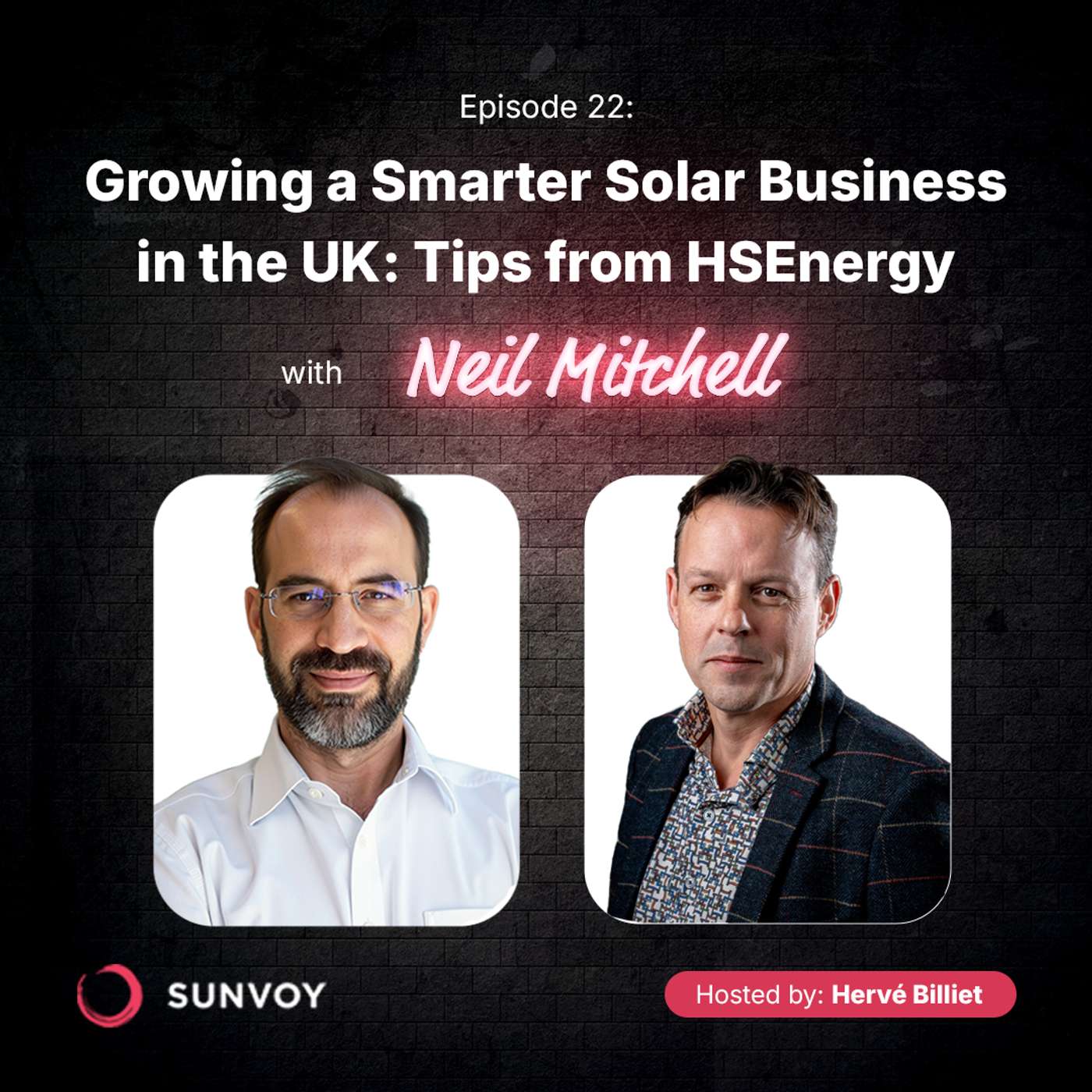
View All EpisodesEP 22
Growing a Smarter Solar Business in the UK: Tips from HSEnergy
About this episode
Neil Mitchell, Managing Director at HSEnergy, jumps on to chat about what it’s really like building a solar company in the UK right now. He talks about why accurate surveys and staying close to your customers make all the difference (and how battery tech is evolving fast). They also get into energy trading, market shifts, and how changing government policies are shaping what’s next for UK solar.
Transcript
Intro: I will say that our business is stronger than it has ever been.
The success of growth and where I see companies growing consistently really is your people.
I mean, the story is not does it make power? Because they all make power. The story is what does it power?
This is what solar installers need to know with your host Herve Billie and Joe Marhamati.
Hervé: Hi there. It's Herve and Joe Lourdes, Solar Installers Need to Know, where we interview solar CEOs and experts on how they run their business on the solar cluster. We ask their private revenue numbers. We give actionable advice and learn about trade secrets so you can run and grow your solar business. Joe and I built a solar company from 0 to 12,000,000 sales and got successfully acquired.
If you'd like to do the same or do better, go to sunvoy.com/blog to get actionable behind the scenes lessons on running and growing your solar business. And now without further ado, let's jump right into the next episode.
Hervé: Welcome, Neil, the to podcast about what saw installers need to know.
Neil: Oh, I heard. Thanks for having me.
Hervé: And you hear about the accents. I'm originally from from Belgium, and you're from The UK. Right?
Neil: Yes. Yeah. Down in the South.
Hervé: Where exactly are you located?
Neil: We're located in a place called Burgess Hill in West Sussex. So for people who don't know, sort about an hour south of London.
Hervé: Alright. Alright. And you're part of the HS Energy, which stands for home services home smart energy. Sorry. And you have a revenue of 32,000,000.
You operate all across The UK, national player, and you also are recently in Romania. You have about a 100 employees, just shy of a 100 employees, and you install four fifty systems a month. You were mainly residential with some commercial, and that is shifting by now fifty fifty and going to more like 80% commercial and 20% residential. We'll talk about the the the dynamics there. You have about 12 crews, and you both have your internal crews and subcontractors external crews.
So all of that information, Neil, give us a little about little information about, like, the the the change in name of your called HomeSmart Energy. I just switched to HS Energy, and what's happening there?
Neil: Well, we've been trading ten years, and since we started, we've grown. We've had rapid growth since COVID, and with energy prices in The UK shooting up, we were in the right position and established at the time. But it was important to sort of rebrand after ten years, and recognize the fact that actually we were doing a lot more commercial work and we weren't just residential. So we actually split the company into several entities. We've got HS Residential, HS Commercial, HS Educational, and a wholesale alarm called Smart for Solar where we'd develop direct links and not using wholesalers.
We also were helping smaller installers sort of get started.
Hervé: By wholesale, you mean being a distributor? You buy the hardware? The
Neil: Yeah. We're a little bit unique in that we've managed to get direct relationships with panel manufacturers, inverter batteries, and mountings is a key one. I mean, I don't know about America, in The UK, the wholesalers do make a a lot of money out of mountings, and installers don't really think about that element when they're buying so much. They think about the pat there's three key components, and then find out that they're they're happily pay, say, 60p on a screw, which might be a a lot less direct.
Hervé: Oh, interesting. So is the strategy there too since you do 450 installs a month, you buy directly from manufacturers, you put already in your warehouse, so now you buy maybe a little bit more at the same price, but then you resell that to to the the local installers.
Neil: Absolutely. We've always wanted to be value for money. So part of that is actually where you can drive costs down, and it's not this bit of battery is a bit cheaper. Now it's actually let's get that quality battery, but get it at the right price. Yep.
Buying power is key to that.
Hervé: That's brilliant. And that's for a lot of large installers in The US could do the same. Once you have a certain volume, you could make your prices basically available to to other installers. Now do you have your own warehouse, and are those other installers that just drive up to you and just take the the hardware in the morning, or do you ship things to their warehouse?
Neil: We've got warehouses at the moment, and, we do have a couple of sort of smaller containerized storage facilities. We will ship or guys can collect. You know, we're open to both. We I mean, we even supply stuff to other distributors. So geographically, ones that are sort of convenient.
Hervé: The people working there, are are they part of, like, you you mentioned your 100 employees? Is that all the different HS divisions together? Or Yeah. We we
Neil: tend to keep the employees within Asia's energy so so that they can they can work for for the other other entities as needed. So, I mean, the group really only sort of twelve months ago. So it's easier to keep a sort of one main hub employing people and then utilize the the other channels. And as they grow, then maybe some will sort of move into more managerial roles in other parts of the group.
Hervé: Alright. Alright. Now a quick calculation. You do 450 installs a month, and you have around 12 crews. That's about twenty days in a month, so that'll run roughly 22 installs a day roughly.
With 12 crews, that means that each crew needs to do at least two projects a day.
Neil: I mean, we do have a lot of guys who do like to do a bit of overtime on Saturday. But, yeah, the aim is two projects a day, which means that, yeah, the projects has to be managed very well. We have a a very large CRM and an IT team Mhmm. Making sure and then we have a scheduling team that are making sure everything's slowing, so scaffolding. And then guys, you know, they're not you know, they're doing two jobs, but those two jobs are close together.
Right? So we don't want, yeah, we don't want guys traveling more than sort of half an hour between jobs.
Hervé: Alright. A lot of traffic in larger cities has always a challenge. So so what's the average size? How many kilowatts do
Neil: you install now? Typically, on a domestic install, you're probably looking at sort of six six kilowatts. We're trying to get, I'd say sort of 10 kilowatts of battery, but that should be doubling with grid trading revenues coming through and and and AI. So that should your typical domestic. I'd say your your commercials, which obviously can take a little bit more time.
Neil: I think
Neil: will will range, I mean, drastically, from 20 kilowatts. We've now got sort of a pipeline developing, which is I think from sort of a 100 to, I think, our largest one that she's been planning right now is, like, 1.1 megawatts on the ground mount, which is obviously a very different sort of setup and dynamic. That's a yeah. That's that's a few weeks' worth of work there. Yeah.
Hervé: At least. At least. Yeah. Although, I'm surprised by the speed.
Neil: Yeah. I've been there also. I've been in that mix, you've got some very straightforward battery only. You know, we're dropping sort of c and I batteries now, which, you know, don't you know, have have four cables. So four cables and a comms thing.
So you might have a a team of three guys going in there and and hooking it up in the morning, and then one guy will be popping around commissioning these batteries over time. So, there's different teams, and and as we're growing commercially and the batteries coming, we're needing sort of different skill sets as well. So, you know, we're generally doing bases with ground screws for for batteries. So you got after after very different areas. And then you got your EV jobs as well.
You know, there's potential, guys can do three or four EV charges in a day. There's a mix.
Hervé: Okay. Well, let's go back to to the solar part. So you do around six kilowatts. Do you have panels of 250 watts, 400 watts? What would you currently have?
Neil: No. No. I'm a little more sort of at four fifty to four six five now, all blacks. Yep. Mhmm.
Yeah. As a a main sort of panel. If if you're doing commercial on commercials, you can be up to sort of six eight five now.
Hervé: Yeah. Yeah. Yeah. Yep. Yep.
So you you you have roughly 13 panels or something like that to to go install. And you do that in two two two systems a day. So to get to an installation, do you also have to pull permits to design work to make for interconnection request?
Neil: Yeah. It it it does. I mean, we're in The UK, we have what we call district network operators, and that's sort of split into regions. So some are really easy to work with and ones we've we've got sort of good relationships with. So we'll we've got portals and quick.
Others are a little more difficult, should we say. So some of the operations see the benefits of what we're doing, and it's helping in locations. Others are a little more resistant perhaps because it's reducing their transmission fees they can earn and their asset values as well now when you're talking large scale batteries. You know? So you have to it's nicer to work in the good areas, but you have to to work with them all.
But in the fortunate position with scale, we're getting to actually talk to government now and sort of try and push different solutions because that they have to happen. You know? In The UK, we spent a billion pounds switching off wind farms last year. They need our battery solutions particularly.
Hervé: Yeah. Yeah. Yeah. True. I asked I read that too.
Let's go back to, like, the mechanics of how you install two projects in a single day because that blows my mind. For us, it's impossible. It never really crossed my mind you could do that. So if you arrive on the morning of, you put scaffolding up first.
Neil: Yeah. So the scaffolding would have gone in the day before or or within the week before. So the scaffolding is all scheduling. So that we know that's gone in. The scaffolding's put pictures of that in our CRM.
The installer's seen that. Installer knows that the the job's good to go. All the design work, all the parts, they've got a picking list. The kit's been there and ready. They'll have a big enough van to take two jobs.
You'll have at least two roofers, maybe three, and you'll have two in the electrician's team. So those guys work together. Generally, we keep the same teams together so they know how they work with each other. Most of the most of the the the equipment now has to go on the outside in The UK. They sort of stopped us putting batteries in loss, so they tend to
Hervé: be Mhmm.
Neil: Fairly large units. And and the equipment's got a lot easier to commission nowadays, you know, with apps and so forth. There's not a lot in it. All the firmware updates are done from the office. So we and we've really made it kind of easier.
So all the guys have got tablets. They know what photos they need to take. They know what information we need. So just tried to streamline, and that's part of having an in house IT team.
Neil: I think I I think
Neil: I And it took me a while to realize because I was always kind of resist resistant in IT guys.
Neil: I think I I think I
Neil: But, actually, CRM is key. Now I think that sausage When you're making a sausage, you can't have anything that can potentially split that skin. It goes through very routine. Everyone knows their job. If somebody's ill, there's somebody who can come in and do their job.
So every part is in there, and, you know, we've inventory got systems now and that so that we know. Mean, I think the biggest mistakes made by firms as a group in The UK was just not being in control of their inventory. So guys were getting frustrated because they turn up, and they wouldn't get the the right part or enough parts.
Hervé: So so scaffolding, that's not something I see a lot in the in The US, but I've seen it at Belgium companies, French and and and in The UK. So I think it's more more common over there. A scaffold goes in the day before. You arrive with a team of, like you said, around four people, and they clear the job. And then do they have to go inside to do some of the electrical work, or is it all out
Neil: there? Yeah. Yeah. That's it. The consumer unit will normally be inside, so they've they've gotta run a cable into that with a couple of Henley blocks.
But, again, we would have sent all that information and collected all that information so they will know from looking at the photos what they're gonna need. Do they need conduit? Are they gonna be able to run through a loft? How long is that run? Do they need a six mil cable, a four mil cable?
So, you know, they're they're turning up there with everything they need. In the old days, it used to be they'd turn up, have a look around, pop down to the the local electrical contractors, and say, I'll have that, that, that, a cup of coffee, and come back a while later. But now, you know, they've they've got all that together, so they're turning up, and very rarely would they get called out.
Hervé: Is it also preapproved by the homeowner? So, like, we're gonna run it over here with this and then with a picture,
Neil: like Absolutely. Yeah. That's part of that surveyor's job is to make sure the the homeowner and, again, because this is cost us really. You know, you you learn most of your mess mistakes that you cost. You know, we've we've done that before.
We scaffolded a building. We turned up. Can't quite run that cable there. I don't wanna see a cable there. You know?
I don't wanna see and, you know, ended up actually not doing it. So everything has to be covered before. You know? Where is that cable gonna go? Is any of it visible?
You know? If it's a white rendered house, we're gonna have some white conduit. We're we're not gonna have black cables going down that. So, yeah, the information is gonna if we haven't got that information from the surveyor, they're going back before we even book the scaffold. So
Hervé: Yeah. I I remember in the beginning with we started doing a survey. Everybody can do it. You take some pictures. Super simple.
But the beginning of the entire solar company project, if the survey is very accurate, everything can happen after that. A detailed design approved by the client with the correct bill of material. But if the survey is not really done right, then the rest will just everybody's gonna struggle on the team to get a project done. You see the sense?
Neil: Yeah. Absolutely. And there's like, we don't have sales guys. We have guys who can survive. If you can't go out there and work out how that solar system should fit the house, how can you be good enough to go out and sell a solar system?
You know, the guy has set a dream and going about some financials and all that, actually, if you can't measure it right and say, it's gonna take 12 panels, and, yes, we need to run a cable here, you should understand. I started out as an electrical engineer and went into sales, and then sort of solar was everything put together. But it's it's more about bothering. So for me I think I really have sales guys. We have guys who can who know what they're talking about for the whole thing.
So once we so we only have to do one visit to get it right the first time, you know, as opposed to having one guy go and sell it and then another guy go back. Oh, well, perhaps we have to take one panel off less and yeah. No. And and suddenly, you you wasted the whole process because you you lose maybe 15% of your sales.
Hervé: Don't have, like, pure salespeople that love all the sender, installers, electricians. Yeah.
Neil: It's the transition sales. They they could be salespeople, but they have to learn how to do the job right as far as I'm concerned. That that, you know, it's part of their job to to to show a customer, you know, where that that cable is gonna go, and that that kind of elevates us a little bit. You know? The ones who are actually going and, you know, they they have to measure for us between the the rafters and the gaps so that we know that the we can work out the wind loading and so forth.
They can't just go, yeah. This is gonna be fantastic. You're gonna have 12 panels. You're you're gonna make a 150 a month or whatever. No.
That's to go in there and actually show them what's complete the job. So that way, we we get, like, zero cancellations between order. You know? It's all part of the the sausage machine. And I don't wanna be thinking, oh, you know, we wanna book this job, but, oh, there's a chance we might turn up, and they got the hump, and they're gonna cancel.
So, again, then that that that fit history to the team. So the teams know they're not gonna get messed around when they turn up, so they're happier. And, you know, you you want happy happy teams. They get on, and they get the two jobs done a day. You know?
They don't have to face problems.
Hervé: About your sausage machine, we integrated SunVo to your Zoho like it was two years ago, and then you redid the entire Zoho a lot more structure than even than than than before. Are you you still on Zoho?
Neil: We are. Yeah. I think we've rebuilt it, like, three times. But, yeah, we seem to have it sort of mastered now. And then we've we've brought the inventory in, built a whole inventory system, you know, that's kind of necessary if you want the scale.
And then that that also links to our distributor side. It's a little bit I'm not an IT guy, so it's a little bit over my head. But I know I know it functions and does what we need.
Hervé: Yeah. Yeah. Yeah. No. It's a good investment.
I mean, some people don't make the investment in IT, but, like, if you wanna scale, if you wanna grow, it's a good place to spend time. And a lot of installers also build their own serial versions. I've I've seen that quite a bit, but we have a lot of soy style ones available across the world. So ZOE is definitely yeah. Seems to be a good CRM.
I wanna go back to your your spoke about salespeople. In The US, salespeople run on commissions. They get a commission of whatever they sell. Is that the same in The UK or no?
Neil: Yeah. Generally, guys, we're one on commission. I mean, we we do have a couple hours of run the payroll, and we'll earn a bit of commission and maybe we function have some other functions in the business. But, yeah, commissions are the same way. Right?
Hervé: Well, let's speak more about sales and marketing, and what's related to that is policy. So you you mentioned that you're going from maybe more residential going to more commercial because policy changes. So what's going on in The UK, and what's the typical payback time? Why do people go solar in the first place?
Neil: Well, I mean, solar got huge in The UK. We had a bit of a when prices electric electrical prices went through the roof after COVID, but then we did have a bit of a supply crisis. And literally overnight, the the industry grew. Unfortunately, with that, we've jumped in the ten years I've been in it, we jumped from 300 installers to 4,000 installers, and you kind of have the perpetual thousand of those going bust a year and restarting. And consequently squeezes margins down because people are fighting for jobs.
And then more suppliers came into The UK market, so you got a lot of cheap products. I'd say people tend to look battery as just something you're adding on to a solar system, so they're not looking at the quality side of that. And it's vastly different qualities of batteries in terms of life. I don't know if you have it in The US, but, you when there's too much wind or too much solar, we have what's called negative priced energy. So Mhmm.
We can buy energy in it and and get paid 50p a unit, put that in a battery, and sell it later for maybe you know, if it if it's half time in a big football match, it might be a pound. So the the I mean, the energy trading market is huge in The UK. Whereas the Europeans are far more used to doing this. Their their energy gap or energy arbitrage gap is about a third of the size of The UK, so we're now bringing lot of funding from Europe. So by bringing the funding, it means we can take that to commercial and educational and even social landlords and say, right.
We can install all this for free. You can bring the money to pay for all the equipment, lower their bills. They hit their their targets, and when the funders pay back, they also then get revenue streams themselves. Need to to you need to do it at scale. So that also pushes us away from doing sort of domestic customers.
I think I mean, on the domestic front, we wanna install 5,000 social houses at once and, you know, a 100 schools, and that gives us a huge wealth of battery power, which we can then put into what's called capacity auctions and so forth. So just to explain a little bit more, battery revenues in The UK jumped last year from, like, 24,000 a megawatt to 92,000 a megawatt. So that's sort of the money that that that is available in grid trading and capacity. I think
Hervé: Let's speak a bit about about pricing. When you install residential, like, a six kilowatt system on, like, regular house. I guess it's all a clay roofs, tile roofs.
Neil: Yeah. I've found most of the concrete. We do have clay and slate slate, especially when you get into different parts of the country. Yeah. I mean, cost wise, if I was putting a six kilowatt in with, say, 20 kilowatt hours of battery, we're probably looking at around sort of eleven, twelve thousand pounds.
I gather in The US, it's far, far more. So the thing I when I visit The US, I the prices, I I I I don't quite understand why they're so much higher.
Hervé: Yeah. I'm converting right now 11,000 pounds is around 14,000 US dollars. So 14,000 for 14,000 US dollars. For a six kilowatts, that's $2.3 a watt. So it's not too different, actually.
Neil: You keep it you got the battery in there as well. So that's got a that'll have
Hervé: a Okay.
Neil: 20 kilowatt hour battery. Yeah. So I was zeroing people worth paying sort of $50,000 for a solar system in The US. I don't know what the Yeah.
Hervé: Yeah. But things are changing. I see with with Tesla where you put the string inverters and then the battery kind of comes for free with it. And that's a major game changer. But, yeah, before that, that those were the prices.
Everything was kind of not really stand alone, but you had, like, a end phase or solar edge or or AP system inverters, and then you did, like, a a battery kind of on the side, so to speak, and now all of that becomes integrated. So the price there is a lot of price pressure on batteries.
Neil: Yeah. So so so the tester's sort of almost putting the battery in for free. So he's he's grid trading, and that's why he was dropping his mega packs all over the place because he saw the negative energy. So, yeah, he hasn't actually he hasn't been able to get his license over here. So we're trying to suck up most of that energy before he gets it.
Hervé: Yeah. Exactly. Exactly.
Neil: It was you know, I know he's probably like Marmite over there, but, I mean, on the energy trading and that, you know, he saw the opportunity a long time before anybody else, and that's where you've gotta be. You gotta be aggregating that negative energy. It's it's huge. I think over there, he's got a energy license, isn't he? Certainly in Texas.
Hervé: In Texas. Yeah. Yeah. And so what what what do you call negative prices? I don't see a lot of negative prices in The US, but by moments, the price to to push power on the grid is really high.
There is a need for more power. We don't have the situation of too much power here, where I think it's a lot more penetration of renewable energy in Europe, where by moments, there'll be so much solar production that you need an off takers, not just not enough off takers. That's why suddenly it's negative prices. I don't I haven't stopped seeing that a lot in The US. But by moment, there is too much demand, and then you need extra power.
So in The US, you have, like, those speaker plans that turn on. And instead of so when you install a battery and you wanna push power to the grid to make some money, you are competing with the the speaker plans, basically. If you can be cheaper than the the gas speaker plan you need to turn on, then then your battery is is is about off. So they're aggregated in virtual power plants. So that that's what's going on in the in The US.
Although it's kind of and what kind of say in its infancy because virtual power plants like an energy hub and then so on, they've been around for a long time. But for the common people, it's still kind of a new thing.
Neil: Yeah. So we had a regulation change last November, which basically allowed us to access the wholesale market without going through your energy supplier. So then we've we've got a a VPP in Romania that I'm involved with, and we're bringing that to The UK. And it's really I mean, there's a lot of people that sort of try to do it, but they tend to overengineer the solutions. So you end up with a very expensive box with an extra meter in there and so forth.
And, actually, if you look at the markets and which of the flex or grid flex markets actually produce money, you're getting 80% of your revenue from a very small part. So we've actually got it down to a board that's the size of your hand. And then have coincidentally, they bought in another regulation just a couple of months ago where we they said we could use virtual metering. So all the revenues are kind of sort of accessible to us. But we'll be in The UK.
I mean, I've actually got it on my house as a bit of a demo, but our first batch of boxes called yellow grid boxes arrive should be in the next couple of weeks. So we'll be putting those out on both large and sort of domestic batteries and seeing the results over the winter.
Hervé: Wow. So you you have access directly to the market. You can discharge. And, well, how how does the money flow? I understand you discharged the battery.
Okay. Fine. But where is the money coming from? Who's Right. You.
Neil: Okay. So we well, we we're effectively get paid by currently through another supplier's tariff. We're bringing our own tariff
Neil: to market.
Neil: The whole idea is basically just like your you would on your energy bill, say you're getting paid $20.20 pence per unit, but at that half hour when it say minus 50p, then that comes through as a credit. So it's just a, you know, a basic energy supplier. Also, then we get paid directly by the grid for having spare capacity on the market when the grid needs it. And this is all done by AI. The AI is talking to the grid.
The AI knows what power you need. It knows the weather tomorrow. It knows when key events are. So, I mean, it's it's better at doing the job than five guys sitting in front of a computer.
Hervé: Yeah. Yeah. There's too much variables at that point. Yeah. Absolutely.
And so HS Energy, when you when the salesperson in the house selling PV and battery, do you add, like, the the future revenue of the battery in the sales, or is that too volatile and then skip the site?
Neil: What we've actually done over the summer is just create a little bit of a a waiting list. We said, like, basically, a 100 customers could have a a free box when they're available in October as a trial. We kind of underestimated it at £500 a year extra savings. We kind of knew by then what it would do because we've had some systems testing in The UK. So the idea was to sort of under promise and over deliver.
So what they will see when the boxes go in is they're gonna actually see a revenue. So we're creating an app, and that'll actually tell them, you know, congratulations. You've made £5 in the last hours because prices went negative or because your battery discharged to the grid and so forth. But realistically, what we'd expect is is well, actually, to give you an idea of a trial we've done at Yorkshire, the lady has a £900 bill. She's now got zero bill and a thousand pounds worth of revenue a year.
So Nice. Yeah. So that is that is where we sort of expect to get to with with the trading. Now then you scale that up and put a six megawatt battery on, know, on a, I think, a 1.7 megawatt supply because that that incoming pipe is key because how much of energy you can take and discharge. Suddenly, this six megawatt battery is paying for itself in, two and a half years, which is insane, and and that's got a twenty year life.
So you you can really change commercials. You can really change their energy. And I don't know if in The US, you have the same thing. In The UK, we've got sort of caps on domestic prices, but the commercial pricing is a little bit wild west. So people are getting charged horrendous prices, commercial electric.
So it's it's it's probably every business in The UK right now. Their biggest concern is their energy. Interesting.
Hervé: Oh, it's a major opportunity for for for you then. I've seen The US, though, that there is a price increase in general, but on on a commercial level, you have all those different price rates. But I do see that the problem I've I think it's that it's like, we have, like, retail price of 8¢, 7¢. So that was that was pretty low. It's hard to beat and and get solar that low.
So you you need to do, like, large projects to make it pencil out, but then there is a price increase in in general terms. So
Neil: I think that
Neil: Yeah.
Hervé: That's good for the soy industry because people wanna save money, and and and it's a solution there.
Neil: Yeah. I mean, our electricity over here is 30 to 40p per unit and going up all the time. So if you can do power purchase agreements between, say, 12 and 18 and half pence, people are are are more than happy.
Hervé: Wow. Yeah. Yeah. In in commercial, there's sometimes demand charges. So you chop the entire amount in, like, fifteen minutes increment, and when you have the highest demand, that is like an initial charge.
The demand charge are also difficult to to eliminate because you need a lot of hack to to make sure that in that fifteen period of time where where you have high demand, then your battery of PV really kind of lower it down. So the sales force is is hard because you you know what you need to hit, but that doesn't mean to imagine that you're gonna consume a lot, but at the same time, your battery is actually, is not full, so you cannot lower that demand charge. So that's, always a tricky part in the C and I thing to do.
Neil: Yeah. I mean, we've got a similar thing, so because the transmission charges, and they will charge you more at peak time. So that's where, again, your AI is coming in and making sure you've got enough power in that battery to get through that peak time and not pay that additional cost. Yeah. Yeah.
Commercially, they can get transmission charges, And those can range from 0.6p per kilowatt to 16p per kilowatt. You know? So it's a there's a huge saving to be made if you can miss those peak times. Yeah. Yeah.
Hervé: Yeah. Well, Neil, the idea was to share what's going on in The UK through our friends all over the world. We have audience. We have solo CEOs and managers all over the world, mainly US still, but we are in so many different countries now. So, hopefully, that sparked some ideas.
We spoke about having your own warehouse and resell to auto service dollars if you do high volume and pricing. And I think that's a good idea. Hopefully, others start doing it more. So, Neil, it's really real pleasure. Thank you.
Neil: Thanks, Urs. Thank you.
Hervé: If you'd like to do the same or do better, go to sunvoy.com/blog and get actionable behind the scenes lessons on running and growing your solo business.