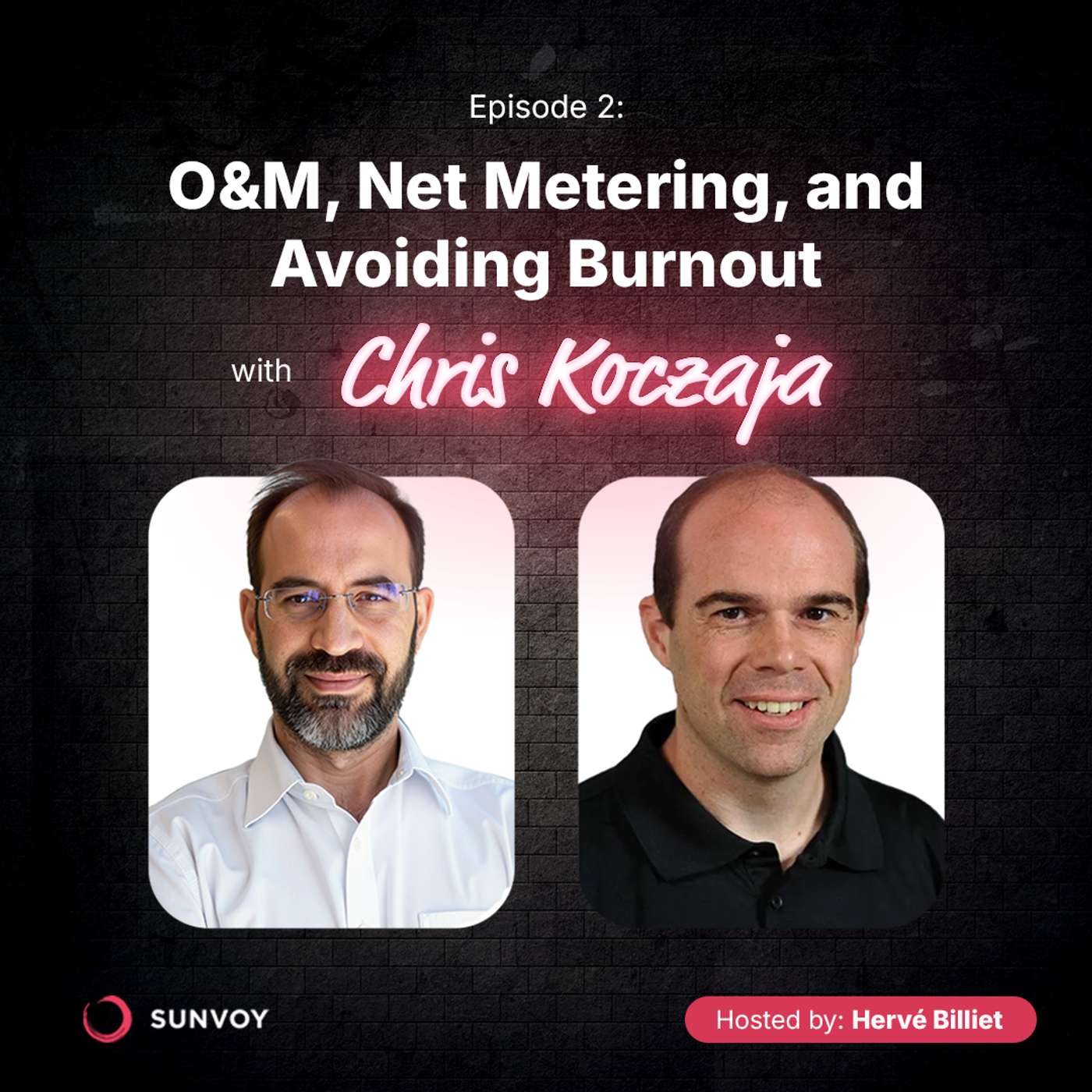
View All EpisodesEP 2
The Evolution of Solar: Insights from Lightwave Solar
About this episode
Chris Koczaja from Lightwave Solar has seen it all—and in this episode, he breaks down what’s changing in solar and how smart companies are staying ahead. From moving into commercial work to taking O&M seriously, he makes a strong case for diversifying your model and keeping your team sharp by managing time better. Oh, and if you're not thinking about storage yet? You will be after this.
Transcript
Chris: I will say that our business is stronger than it has ever been. The success of growth and where I see companies growing consistently really is your people. I mean, the story is not does it make power? Because they all make power. The story is what does it power?
This is what solar installers need to know with your host Herve Billie and Joe Mahamati.
Herve: Hi there. It's Herve and Joe in what Solar Installers Need to Know, where we interview solar CEOs and experts on how they run their business on the solar cluster. We ask their private revenue numbers. We give actionable advice and learn about trade secrets so you can run and grow your solar business. Joe and I built a solar company from 0 to 12,000,000 sales and got successfully acquired.
If you'd like to do the same or do better, go to sunvoy dot com slash blog to get actionable behind the scenes lessons on running and growing your solar business. And now without further ado, let's jump right into the next episode. Hey, Chris. Welcome to our podcast, What Solar Installers Need to Know, where we learn from other solar installers about what works and what doesn't. We help you run your solar business, innovate, and discuss the future of solar.
Chris, welcome to the podcast.
Chris: Thank you. I'm happy to be here.
Herve: Chris, we know each other for many years, but not everybody in America knows you yet. So why don't I, tell them a little bit about what you've done in your entire career starting in the year 2000 in early two thousand, you worked at Caterpillar where you started in marketing and then became the regional sales manager. And then you progressed to working more with your Sigma Black Belt certification where you worked on pricing and business planning. Right?
Chris: Exactly. Lots of lots of lessons learned there that that's a whole another podcast.
Herve: Well, we'll try to keep it in thirty minutes for people because they have busy lives. But then you also were the CEO of PHG Energy, now called Airways Clean Energy, dealing with gasification and sustainable waste disposal. But then more in the solar industry, you are the CEO of Lightwave Solar. You're also on the Amicus board for about six years. You're also on the board of TANACEA, and we'll speak about that.
Why don't you talk about Lightwave Solar? What's the typical revenue each year? Something like that.
Chris: Well, as you know, in the solar business, it varies. So we can have vastly different years year over year, but we're generally about a $25,000,000 company. That's where we we kinda land just depending on how projects are executed. Okay. And we've got we've got about eighty eighty employees, 80 full time employees that we employ to do that business.
Herve: Right. And you're only in Tennessee or also somewhere else?
Chris: We so we work in the Tennessee Valley. So we have our utility here is is the Tennessee Valley Authority. So we tend to work basically with the local power companies and in what they call the seven state region, which is most of Tennessee and then six of the surrounding states. But we're also doing projects in Illinois. We've done projects out west.
We we tended to focus not really on geographies, but more with customers. So sometimes we'll have a customer that wants projects somewhere else. So we're kind of flexible on how we try to meet their needs on that.
Herve: Alright. And Lightwave, mainly resi with some batteries, also some commercial?
Chris: Predominantly commercial, but we also have resi and we also have o and m Alright. Which is becoming a much larger portion of our business.
Herve: And how many installs or kilowatt megawatts do you install?
Chris: Again, that varies, and I think we'll get into it when we talk about, you know, the business and how it's split up. But we don't have net metering in our predominant region here where we we live. So everything we do on the residential side has storage incorporated with it. So the the projects look very different than what a traditional, hey, how many panels are you installing type project as we're we're doing all these microgrids. And then on the commercial side, it just it just varies.
So, you know, I think the in general, about 75% of our business is commercial, and then 25 would be resi.
Herve: Has that changed over the years that you were mainly doing resi and then more and more commercial? Did that shift?
Chris: Or Yeah. I think the progression for many installers is to start with residential just because the projects are smaller. It's easy to to go up the food chain there, as you get into bigger projects. But, you know, we've been around since 2006 and that's what there was to install in 2006 when everything was really expensive and, you know, finding those first early adopters were mostly residential. There were some commercial projects back then as well, but we focused on, again, segmenting through the customer groups and diversifying the business.
Herve: I feel like at the beginning, you had to find like a rich hippie.
Chris: It was willing victims, rich hippies, all the all the above at the beginning because there was just a lot that wasn't known. And, you know, especially in our region here is not necessarily where people think is, well, that's where solar started or anything like that. So the fact that we were doing solar back in 2006 in this region was very unique and we're one of the first companies really getting it started over here. So we've kind of lived through a lot of the trials and tribulations that many of the other solar companies have or are going through.
Herve: Yeah. I remember in that I started a solar company in Alabama in the South. And I had to explain to utility, like, hey. No. You need to provide me a net metering application and interconnection application, all that.
Like, it was new to them. They were not used to that. It was hard business. Few more questions about how many crews do you have and other crews, in house or or do you outsource that?
Chris: So we, for our commercial, business and commercial small utility industrial, that is basically project managed. So we sub out majority of the work over 300 k w, three to 400 k w. We'll use subcontractors to to do our design, our procurement, and, you know, we manage it, but outside labor to do that. And then everything below that will generally self perform. So the smaller commercial projects and all the residential projects will self perform.
And so number of crews is tough because those can be, you know, a three or four person crew or it can be a 12 person Yeah. Crew that's there. But we have, you know, also the whole o and m side is really growing and, you know, we have almost as many or actually more people doing o and m than we have doing installs now just a lot of the solar's getting old and it needs maintenance. And I know that's one of the things that we fought and and you fought specifically is, you know, the the adage solar doesn't need any maintenance. It does.
It's like any machine or anything. You have to still maintain it. You have to take care of it. So we're seeing more opportunities there to ensure that these systems are operating the thirty, forty years that people hope to get out. Well,
Herve: maybe it's a good segue to the first question about, like, all it's like every other machine or machinery, but you well, you worked at Caterpillar for many years. And so can you had, like, a full career outside of solar. What did you see in other industries that they learned well that people in the solar industry still need to understand better? You see something that we all should know?
Chris: The I think the big thing, you know, this is gonna be a long answer to the question. So I apologize. I apologize to listeners if it's not as as delicate an answer, but I think it's relevant to really what what your listeners and what you wanna wanna hear here is that solar is at an interesting point for me because I think as of maybe three, four years ago, it's become more mainstream.
Herve: Mhmm.
Chris: And I think us in the solar industry that have been in it forever, had always like, know, go solar, go solar, are having a hard time making the transition. It's like, no, no, everyone kinda knows what solar is now. You know, I don't have to to go, you know, yell from the rooftops literally anymore. It's it's kind of a known entity, and more people are starting to do it, not just the typical solar clients. So we're seeing more and more general contractors, general electric or regular electrical contractors start to get in the business, which is great.
But we can help them with the DC, the direct current side of things as they they see it. But I think one of the the the big things to, you know, directly to the question is, you know, accepting that it is becoming more mainstream, accepting that, you know, we're gonna have to start fitting into more of the the normal mode modes of how these things are built. There is gonna be important. The other side of it is, it it's just become the, you know, kind of the the energy of choice. And Mhmm.
I know there's a lot of concern, especially right now in the last few weeks, a month. And, you know, our team, you know, specifically keeps asking, oh my gosh. What's going on? How do we handle this? And my comment to them is, hey, we're still racing.
Cars are still running around the track. We're still racing. Our customers still need things installed. People are still calling 1800. Yes.
There's a lot of uncertainty in the world, but that's always gonna be there, has always been there in solar. Our job is just to focus on customers, focus on what we do and do it well, and just realize that, again, I'm fully confident that twenty years from now, we're gonna be looking at solar storage electric vehicles all over the place, and we're really starting to see it. Again, you know, when we talked about it, you know, three, four, five years ago, it seemed a way way distant memory, but it's like, no, no, no, this is gonna happen way faster than anyone thinks. I mean, I know there's still a lot of people not really grasping how much is out there, but I'm still a firm believer that that that is where things are going regardless of of motivation. So I think to come back to the question, you know, accept that it's mainstream and accept that, you know, the people that are buying solar aren't the people that were buying it twenty, thirty years ago.
It's really become somewhat apolitical and the solution is the same, but the why people are buying it may be different. You know, call it green sustainable or freedom independence, it doesn't matter. It's the same same box that we're work to install there. So that's where we've we've tried to position ourselves as really just, hey. We're pro solar and storage regardless of motivation and really just get it out there.
Herve: And then who's installing solar, I think, is also changing. Right? It was just solar specific solar companies like like but I think more roofers also looking into it than plumbers and general contractors.
Chris: Yeah. And I think, you know, with, you know, the broad audience we're talking to here, I think that's one of the asks as well is is solar for us that have been doing it, you know, is is seems simple, or I guess maybe the other side. People that look at us and see what we do, it seems like solar's pretty easy. It's like, okay, I've got 500 panels that need to go on this roof, and I've got these attachments be flashed in.
Herve: No problem. How difficult can that be?
Chris: But, you know, that's what we we talk about. You know, some of these these fields have tens of thousands of modules, and if you don't plug them in right, if you don't wire manage correctly, you've just done the task 10,000 times the wrong way. And we see it every day. That's why we have a lot of o and m business of people that, you know, have said this is easy. We can do it.
And we go there and it's like, I'm sorry. We're gonna have to redo this to make it make it right and make it last. And so I think that's that's kind of the outside piece too is not underestimating really what it takes to do it because it looks simple, but the the details matter and getting that right.
Herve: Yeah. Which is a segue to another question about o and m. I remember you at at the Amicus meeting, like, a year two years ago or something like that, you presented about the O and M business. Can can you give some of the the history how you kind of added that O and M as its own department, I think, and now its own entity? But it's really becoming a big part of your business.
And I think a lot of solar installers really struggle with it. They do EPC. They install new new projects. When you look at the dollar amount of a new project compared to some O and M work, they always stick with the EPC work. So do you have any advice of solar installers being in that dilemma, like how to add on it?
Chris: And I think, you know, this is gonna be, again, another broader question to try to get to where or a broader question and answer to get to where we're going here. But I think it's relevant that we haven't had net metering in our core area here since 2018, 2019. So I know there's a lot of installers listening that, you know, see things going away, see things changing, it's like, well, we're you know, we've had to do that change, you know, five, six years ago, and I will say that our business is stronger than it has ever been and more resilient than it has ever been. And that's because back then, we were forced to make the change and forced to say, okay. I can't just rely on a program anymore and a feed in tariff or net metering or or, you know, that piece of it.
I have to go figure out how to diversify our business, make it stronger, and look at these different legs of the stool. We, back then, kinda saw, you know, where we needed to go from a diversification standpoint and said, let's let's start small. You know, we've got a few of our own customers we need to take care of and systems that we understand, so let's let's start building from those blocks. But then as we transitioned through this, it was a tough market for many years and there just weren't a lot of installers or solar companies at all left. So it opened up a a big market for us to take all these arrays that have been built by us and not by us
Herve: Mhmm.
Chris: Over the previous years and say, hey, we we need to go maintain that. So we we kind of organically built with, you know, the the systems we knew, the people we knew, and then branched out to look at, other systems, other technologies, things of that nature. And also then added the battery side of it as well, is its own animal. And I think as we, again, look at it from the solar perspective, a regular, you know, 10 kw solar away on the roof, we can knock that out in half a day, a day max, get it interconnected, go to the next one. And you know what, if there's a problem, mister and missus Jones, you know, their solar array is not working, you know, we don't have to get out there immediately because, you know, it's it's still just on the real supply side of of the equation.
Well, that's the other big thing that we have to do now and that we had to transition to and more people are transitioning to with us is when you add storage, all of a sudden you're the backup power or you're the microgrid and maybe you're the prime power and what we talk about is the grid being the backup. So if something's not working right, we're gonna have to be able to respond and maintain and get there faster, which kind of forces the o and l side of the business to grow as well.
Herve: Yeah. So do you have like a phone number available to
Chris: No. Not yet. Not yet. But we have a number of customers and clients that have my phone number and, you know, the key team's phone numbers that, you know, we can we can respond fairly quickly to those. But I think from that perspective and, you know, taking everything I just said, we also try to design redundancy into our systems.
So, you know, we have the ability to say, you know what? We need to to service the system. So we generally install bypass switches. So we can bypass the whole system, put the customer directly on utility, do whatever we need to on the system, and then flip them back over when we're done. So things like that in the design side, I think are to understanding how we wanna mitigate those calls later and have happy customers.
Herve: Oh, no. That's a good one. That's a that's a piece of gold there, a little nugget.
Chris: Well, yeah. Well, it's it's the ones that don't have those switches that we wish did, you know. It just like because stuff happens again, you know. We can do our best to install it, but but equipment breaks. Squirrels get into, you know, panels despite the best critter guards and, you know, it's just a reality of having really complicated little microgrids on people's houses.
So
Herve: Yeah. I remember in the last two years that I had Ipsen, I was the last one on the on on the phone list in case of trouble. And so the Thanksgivings, you know, everybody was on holiday. And so I was the the primary one. And in the last two years before I sold Ipsen, like, in my last two Thanksgiving, I was on the phone with customers.
Like, it had to be thanksgiving, of course, and that, you know, they they were in the dark. So I had to take action.
Chris: Well, that's that's what I I you know, that is the adage of when we design this, design it for thanksgiving because that's when everyone's there, every oven is running, the doors are open, kids are running inside and out, so the system is getting hit the hardest there. So let's design it so we don't we don't get that call. But that is that is the design consideration.
Herve: Yeah. Absolutely. You we spoke about net metering briefly and and how it's not available anymore for many years in in Tennessee. But to those CEOs that are running solar companies who just recently lost net metering on several states where it it is on the chopping block, what advice you have to give them about losing that metering?
Chris: Diversify now. And it's really really easy to, you know, hey, we're gonna fight we're gonna fight for, you know, this this net metering. But I I think at the end of the day, if you throw out the the line five years or ten years, it it goes away. Right? It just isn't there anymore.
So the sooner that you start transitioning to other lines of business, like storage, like o and m, the sooner you can build that so you aren't reliant on that. And I'm just I've had this conversation, couple times in the past year. And right now, with all the technology and all the products that are on the market, it is so much easier to do solar and storage now than it was five, six years ago. We were really, really limited five or six years ago on how we did it. Now it's like, okay, everyone's got a storage solution and it's more parsing through which ones are are ones that are gonna make things work.
So there's there's that piece of it. But then there's also, I think, the bigger the bigger play too in thought process that I would share that people make noneconomic decisions every day. You know, if every every decision was just an economic decision, we would have a a city full of pole barns. You know, that's that's the cheapest fastest way to a building there, but people don't because they want brick. They want dormers.
They want, you know, all these gables and windows, things
Herve: like
Chris: same thing with with solar and storage. People want it for different reasons. It's not just the economics that are there, especially when you're selling storage. You're selling something completely different there to customers. So really, I think, latch on to what are the key drivers that your customers want there and listen to that, but don't force them into the box that we've always been in there that is the traditional box.
Herve: Maybe a common thread across this conversation is just adapt. Don't stay with what happened before the way you did business before. Target new audiences, not just the the rich hippie, I call it, or people yeah. So just adapt to the market, adapt to new legislation. Like, that's the the core.
Chris: Adapt and I think the other thing, and this is related and maybe we'll get there. Also, I have had the pleasure of running Tennessee or see a chapter here in the Tennessee Valley, and we we host a conference every year that you should come to. Everyone should come to that's listening. It's an amazing conference because when you look out there, we have as many people from the utilities as we do from the industry at our conference. And we're not talking at each other.
We're talking with each other. They are on the panels. We're on the panels with them and working together towards, hey. We we accept that this is where things are going. We're gonna put a lot of solar on the grid.
How do we do this the best way? So I think that's the the other piece of it is, eventually, again, this is this is where things are going and adopting more of a let's figure this out together approach is helpful.
Herve: Yeah. At some conferences when I when I meet those utility companies, some of them are very progressive. They they wanna own solar. Mhmm. And then others are scared.
Guess they don't wanna adapt and change as as much as others. But, yeah, even utilities, you have a broad spectrum of utilities. It's not one analytical
Chris: Yeah. And I think, you know, related to this and to to double down on, hey, if you haven't really gotten into storage, you really need to get into storage side of the conversation is we had or, you know, in general, we thought that, you know, we're getting more efficient cars, we're getting more efficient lights and HVAC. Everything's getting more efficient, so we've got this decline in the amount of energy that's needed. And then you had this thing called AI that happened and is happening and happening way faster than anyone will will, I think, honestly wanna admit, but it's also very intense on processing. So we're seeing data center loads go up, those are not just, you know, once or twice loads.
Those are, you know, base loads that that we need to supply that are gonna stress the system. And utilities are already looking at, well, how how do I do this? I can't just go build new transmission lines. You know, that's where we say, hey. What would happen if we drop some storage to substation?
What happens if your customers can load manage better and help, you the grid as a whole function better. So that's what we're looking forward to, and we're already not around here quite yet, but we're seeing across the nation storage incentives pop up. And, you know, starting to see what the value of storage is, and I think that's really the next frontier here. In fact, you know, I I point to our logo all the time and say it's it's Lightwave Solar, but I I envision the time in the not too distant future that it's a Lightwave storage and solar. And that we're a storage company that does solar versus a just a solar company.
Herve: So
Chris: kind of just, again, my crystal ball, but what we're seeing happen real time.
Herve: Yeah. No. It's big. And that's also something I'm working on, like adding batteries and battery control for utility companies. Like, it's very actively being worked on.
So it's exciting. It's true. It's another change how we adapt to the market, but it's coming and not ten years from now. Yeah.
Chris: No. And that's what's not five years. I I I keep saying it's less than five years.
Herve: Yeah. Now, you're running a business Lightwave. You're also on the board of Amicus. You're also part of Tennessee. And how do you combine all of this?
How do you have a secret for your time management? How do you keep all those, activities organized?
Chris: Well, I have conveniently not shown my desk here, but the post it notes runneth over. And, you know, I think that's the the struggle is there's a certain amount you can and then a certain amount you you you can't. And as much as I would love to be on top of everything, the reality is I can't. And it's it's like every CEO will tell you, it's about your people. And it's about attracting, retaining, and empowering the right people on the team to do it.
Herve: So how do you do that? How do you retain that talent?
Chris: It's it's difficult, but I think, you know, I I think if I look at how we treat our customers and our our method for that, it's the same with our people. And I talk about our customers a lot and say that it would be really, really easy to turn our back on, you know, projects or clients where Uh-huh. We're losing money or whatever. But the power in taking care of those people and doing the right thing, even though maybe we've made mistakes and we have made mistakes as everyone does, but we make them right and we stand behind it, has been good. And I think when, you know, our customers see that, they recommend this to other customers.
And I think when our employees see that, they they say, hey. That's something I'm I'm proud to be part of that. It's something that I I wanna be part of a company that wants to do it, but do it the right way. And we, like everyone, have struggled to keep people at times, but it's been interesting because we also, I think, embrace change for people that, you know, maybe Lightwave isn't, you know, the career that everyone wants. You know, we can get a good five, six years out of people, and then there's something else for them, and that's great.
And I think that's a big change in my thought process too was it's really easy to get mad and upset at first when people are saying they're leaving. But then I look at my own career as you highlighted earlier, it's like, wow, it's all those experiences that I draw on every day and all the mistakes that I've made over time that I hope to not repeat that other people need to have too. So it's been, you know, a piece of celebrating people's change too and saying, hey, that's great opportunity. I'm all behind it. And that way we get a good transition.
You know, we we get somebody that just didn't drop everything on our laps and and leave so we can transition. But what's really interesting is we also have people that have done that and come back. And they bring back to us not only everything I learned here, but outside perspective back to the team, which is awesome. It's great. So, you know, it's it's, I think, creating opportunities, but it's also understanding that those opportunities aren't always within the walls that we have here, but celebrating the employee and and what they can do and and what they wanna do for their
Herve: And maybe having boomerangs, before that
Chris: I I mean, that's great. Right? I mean, it's the perfect perfect mix. Yeah.
Herve: Another piece about, like, human resource, I think, is a burnout. I think Mhmm. Small business CEOs in any industry, but solar in particular, people burn out. And one once it's happening, once you're in it, it's already, it's difficult to get out. So do you have any advice for solar CEOs now that that have a lot of pressure on multiple sides?
Because at some point, solar CEOs, you wanna do right to our employees. Mhmm. Make sure the price that we sell solar at is as high as possible so it can afford all the benefits and giving people raises, but at the same time, the price needs to be low for a lot of people to buy solar. How do you find that combination that a lot of solar CEOs put pressure on their shoulders, and and how do you avoid burning out? Do you have any any advice?
Chris: Yeah. And this is you know, if if I I look back and I look back at where I'm at and, you know, whether it's successful or not, you know, only time will tell. There are a lot of, I think, mistakes that I have made and we have made, but, you know, you learn through those and you try to adapt and you try to fail fail fast and do all those things everyone reads about. But when I look at other companies and I look at my peers, I also look at the fact that I wasn't the founder. I was the second person to come in and run Lightwave.
And I look at it very differently than a traditional founder. And, you know, I tell people all the time that I'm not that person. I'm not a founder. I'm not someone that's gonna just, oh, I think this is good. Here's my my pencil and my paper.
Let's start from scratch and go go do it. You know, It's it's not how I'm built, but I'm I am kind of that second person that comes in and takes what has been founded and tries to optimize, diversify, and kind of take it to the second phase. So I think to the point I'm trying to get to is what I see so many times with founders is the inability to let go. That it is the company is is a child, and I can't I can't let it go. And even though I know maybe I need to let it go or I need to let go of more, that there's just a feeling or a guilt or just a, you know, the the slog of this is what I've always done that makes it difficult to let go of things.
So being the second person coming, it's a little bit easier for me because I'm a little more pragmatic and less emotional about some of the decisions that are there. Because, again, I wanna take care of customers. I wanna take care of the employees, but I have a a broader view of of what we need to do just to be a viable company for the long term versus the founder mentality is what do we need to do to to get this thing started and grow grow from nothing and work it out. So I think the the lesson or what I have seen, and experienced is just that being able to let go. And it's okay to let go and let go to other people.
And I think that goes back to the employees, and you let it go to great people who will take it maybe a different way that you're taking it, but not necessarily a wrong way. And and maybe, in fact, it's the better way. It's just, again, you don't know at the time, but needing to to do that. So, you know, I think that's probably one of the things that I see leading to a lot of burnout is just that, again, just letting go.
Herve: Yeah. Letting go. Just people that wanna do it all just can't do it all.
Chris: And that's okay. You know? It's just it's it's we can only do it for so long. You know? At some point at some point, you're not going to be doing these podcasts.
Now maybe that point is fifty years from now, but at some point, there's going to be a change. So let's go ahead and start embracing what that looks like now so we can start building the blocks for kind of the next generation to take it over.
Herve: Chris, CEO of Lightwave, I thank you very much for this conversation. And hopefully, you'll come back on the podcast and we continue the conversation.
Chris: We would love to appreciate the opportunity and best of luck.
Herve: And can also thank you for, being on the Amicus board. I can tell you that, as CEO of Solar, former Solar, Ipsen Solar would not have been where where we were without without Amicus. So I wanna thank you for all the hard work there. It's just fantastic.
Chris: No. Appreciate it. And it has definitely been a key part of of us and how we've been able to succeed.
Herve: Thank you.
Chris: Thank you. Have a great day.
Herve: If you'd like to do the same or do better, go to sunvoy.com/blog and get actionable behind the scenes lessons on running and growing your solar business.