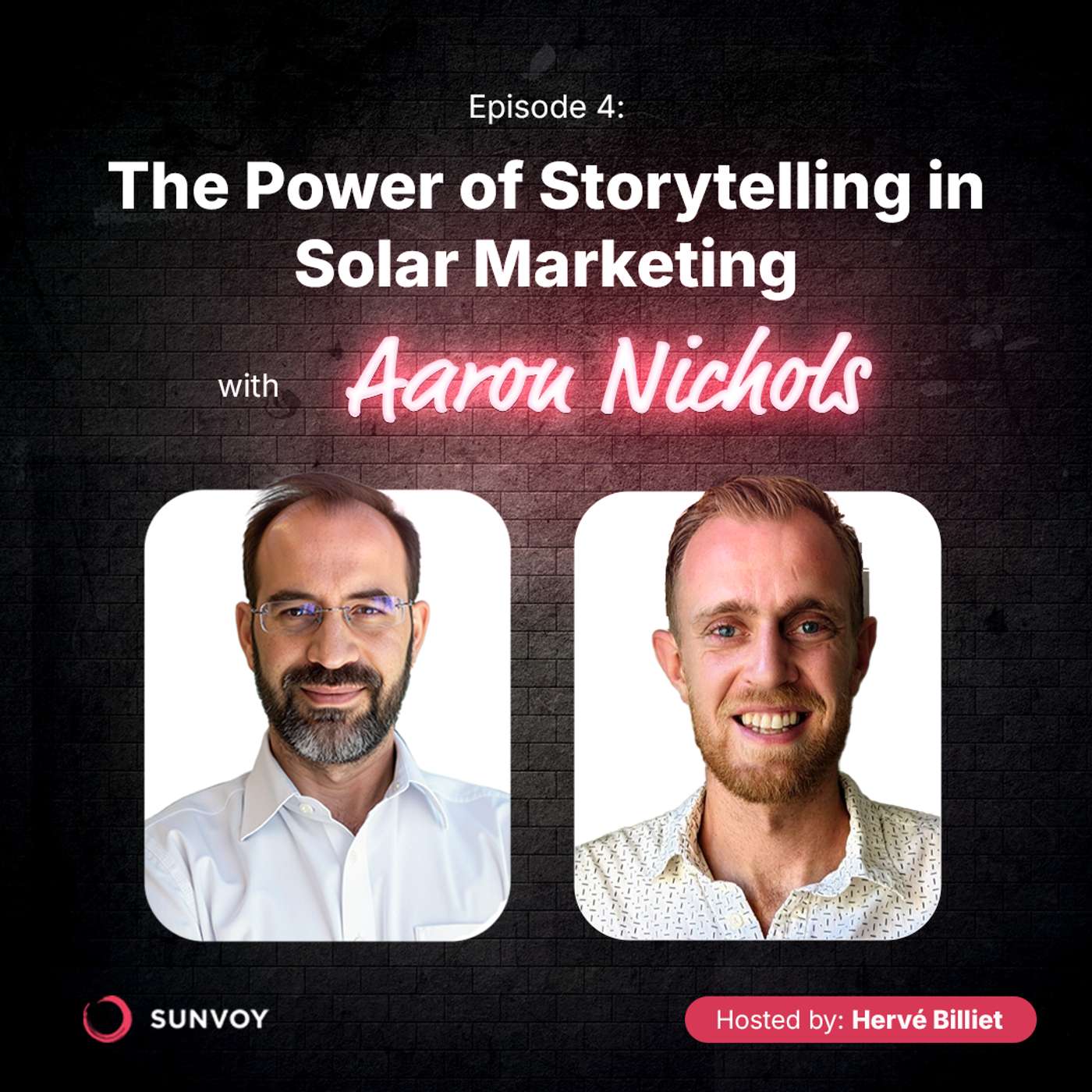
View All EpisodesEP 4
The Power of Storytelling in Solar Marketing
About this episode
Aaron Nichols didn’t take the usual path into solar—unless running into circus performers in Ecuador is more common than we think. In this episode, he breaks down why good marketing isn’t about quick wins, but about storytelling, community, and staying human. If you're still treating LinkedIn like a digital resume, Aaron's take might just change how you show up.
Transcript
Speaker 1: I will say that our business is stronger than it has ever been.
Speaker 2: The success of growth and where I see companies growing consistently really is your people.
Speaker 1: I mean, the story is not does it make power? Because they all make power. The story is what does it power? This is what solar installers need to know with your host Herve Billie and Joe Mahamati.
Speaker 2: Hi there. It's Herve and Joe in what solar installers need to know, where we interview solar CEOs and experts on how they run their business on the solar cluster. We ask their private revenue numbers. We give actionable advice and learn about trade secrets so you can run and grow your solar business. Joe and I built a solar company from 0 to 12,000,000 sales and got successfully acquired.
If you'd like to do the same or do better, go to sunro dot com slash blog to get actionable behind the scenes lessons on running and growing your solar business. And now without further ado, let's jump right into the next episode. Hey, everyone. Welcome to another episode of what solar installers need to know podcast, where we learn from other solar installers and experts about what works and what doesn't. So welcome to the podcast, Aaron.
Glad to be here. Alright. Well, let's start with how you got in the solar industry.
Speaker 1: That's a very fun story, and it starts with meeting circus girls on a beach in Ecuador.
Speaker 2: Tell me more.
Speaker 1: So I was I had left teaching a few years ago, and during COVID, I went traveling with some money I'd saved, and I was gone. I ended up being gone for two years, but I was learning to surf, and I was living in Ecuador. And I met two women whose passion was circus arts, and the way that they supported themselves was by doing door to door solar sales. Alright. And they worked for a company that did what they call blitz strips where they would fly, yeah, they would fly a group of door knockers anywhere in the country and stay for a couple days and just knock on doors.
And I went on a few of those, And that was my intro to solar, was door to door. And didn't realize until I actually got into solar later that we were using a very dishonest pitch after we knocked on the doors. And, you know, if anyone wants to go look at some of the stuff that happened in door to door sales in solar, you can. I think as an industry, we need to present to United Front right now, so this is not the time to be airing dirty laundry. Alana Samuels wrote an excellent four piece series in Time magazine that you can go read.
So at the end of that time traveling so I supported myself on a couple of those trips. I kept the trip going by knocking doors. And at the end of my time traveling, I was in Bali. Didn't know what I was gonna do. I just got online and found a six week grid alternatives solar installer training.
I really love working with my nans. So I completed that when I had gotten home, and then I went and worked in Alaska for the summer doing nothing to do with solar, and I came back. Mhmm. And at the time, I was in a relationship with a woman who was putting pressure on me and get to her income level very fast. And so I started copywriting.
And at the time, I was freelance. I was just consulting. Copywriting turned into marketing expertise. Eventually, Exact Solar found me, which is who I'm with full time now. At the beginning, I was on with as a consultant.
And, yeah, I just started posting on LinkedIn. Eventually, Suncast found me. I worked with some huge names in the solar industry. And now I'm on full time with Exact Solar.
Speaker 2: Yeah. Very cool. Full start of the of the story. That's that's super fun. Yeah.
Speaker 1: So I did nothing that you're supposed to do and just kind of blindly stumbled in some. I
Speaker 2: wouldn't say that, but it's it's fantastic how you you picked along the way all the the marketing knowledge and experience to kind of make it make it working in this oil industry. Yeah.
Speaker 1: And it's it's been a wonderful journey, and I've been just repeatedly amazed by the kind of people that this industry attracts and just the maverick, free thinking, freewheeling, bohemian people that I've gotten to know since I've started it. That's just been wonderful.
Speaker 2: There's a lot of CEOs of solar companies that we call, like, smart hippies. Not definitely hippies. But Yeah.
Speaker 1: I've spent my fair share of time with some hippies. I can definitely relate.
Speaker 2: Yeah. But it's not just running a business, you really have to be, like, nice to people and to your employees, but at the same time, you cannot be too nice or you there's nothing left. And so you need to find that balance between I mean, you still need to say no and fire people too. So Right. Being nice either.
Yeah. Totally. You also spoke some about the marketing. So but what do you like so much about marketing? Because you've been in marketing for many years now.
What is it that attracts you?
Speaker 1: The thing that attracted me in general in the beginning was I've always been an educator. I've always been a storyteller, even before I was a teacher. But I'm classically trained in education. My degree is I got a teaching license from Colorado State University before I briefly went to the Peace Corps and was evacuated almost immediately by COVID, and I spent a year as a teacher. So I've always loved teaching, and I've always, always, always been a writer.
I won a poetry contest at the age of nine with my local dairy farm, probably still the proudest moment of my life. I don't think anything any accolade I've gotten since then has come close to that. I wrote a poem about an alien who loved milk. But
Speaker 2: Yeah. Yeah. Yeah.
Speaker 1: Alright. Yeah. So I've always loved storytelling, and I've always loved teaching people about things that I'm interested in. And it was once I discovered that I love renewable energy, and I was a storyteller, and I was an educator, Then all the pieces fell into place, and then I was like, all I have to do is learn how to use the tools that make storytelling an education.
Speaker 2: So tell me about when you joined ExactSOAR. You had all that marketing experience. You joined a SOAR EPC, like, a more vertically integrated. What are some items that you either put in right away or things that you did for the long term benefit of the company?
Speaker 1: Well, the reason that they brought me on was because they wanted to write in-depth technical content, and that was something that they hadn't had the bandwidth to do before. And once they saw that I had spent a lot of time publishing my own writing online and had also worked as a copywriter and was Snapset certified, That's what made me a good fit for the job. So we started publishing very in-depth SEO optimized content right away.
Speaker 2: Alright. So you're copywriting and Knapsack certified. So those are the two I'm not gonna say two opposite, but it's not really common to have that.
Speaker 1: Yeah. That was the feedback I kept to get. And that was what was so perfect about the consulting work I was doing. It's like, I mean, Nico was the first person to say it. I didn't realize how special that was.
I had no idea. Because when you're just when you're doing something, it just becomes your reality. And then when Nico found me and I started working for Suncast back when I was still consulting, he was like, do you not realize how cool it is that you're an experienced copywriter and you know how to get on roofs that actually build solar systems? Like, nobody nobody has that.
Speaker 2: Now now if you're a solar company, you want more leads, usually, they hire a marketing agency, and they say, like, I want x amount more leads tomorrow. Please execute. And then usually, it's like, well, there's a few ways to do that, which it's not always lasting or it costs a lot of money. So what are some normal timelines that you can of people listening of another solar company. If you start writing content now, like, what's some SEO benefit?
Like, what is a realistic time frame they could expect to see some leads and and attention coming?
Speaker 1: It's definitely something that you can't guarantee a timeline because it depends on how often you're publishing content, how in-depth your content is, how much the person you've hired knows what they're doing. It's but if you're working to build a legacy reputation that will continuously bring more web traffic to your brands, it's probably going to be six months to a year, at least. It's definitely not a quick fix. The problem with short term lead generation is that, generally, those channels dry up pretty fast. You know, like, is someone finds a new avenue for getting leads, and then they figure it out and they figure it out well enough that they can charge a lot for it.
And then once it starts drying up, then they sell a course on how to do it. And then everybody else rushes to do that, and then that lead source, it becomes saturated, and it doesn't work. So long term reputation, though it's painful in the short term, is always going to return more over time. It's like an investment.
Speaker 2: Are there other forms of marketing that you tried out? Do you speak about, like, content and and long term or long form content? Did you try everything else something else? Like, have you been trying TikTok dancing around, whatever, to get attention? Let me try that.
Speaker 1: I'm not the guy to talk to about TikTok or TikTok. I don't know anything about it. But, no, we we're very fortunate in that Exact Solar has been around for twenty years. So, you know, I came on and like, Exact Solar has been around since 2005. It started with a couple that was installing installing solar water heaters as their first product.
And it was just so delightfully wholesome for so long. It was family owned, and then eventually, it came under new ownership. It's now under new ownership and has since expanded quite dramatically, but the the story is so easy to tell. It's just like we've been here the whole time. We're awesome.
We have track record of being awesome. We have great reviews. People love us, and you should be a part of it too. So I'm very fortunate in that that's the story that I'm telling. But in terms of short term leads, it is very difficult because, like, if you're you're a new installer and you're trying to get in, you're probably just gonna be leaning on word-of-mouth for a while.
You're probably gonna have to do great work and then just work with people who know the people that you've worked with until you have a reputation and until you have reviews. Because when you're selling a product that is intended to last twenty five to thirty years, trust is the only brand that works if you're looking to save the game on that.
Speaker 2: I wanna share one piece of advice to for for people that wanna write content. If you're anything like me, when you have a website of a solar company as I was running for eighty years of solar company, in front of a blank screen is like, what am I gonna write about? And sure enough, you have other things to do, and you just don't write anything. Until I realized one quick tip is when you start writing an email and answering a customer's question, and it's the third time that you write something similar, go to your website. If you have a WordPress website, open the blog page, just write the answer as a blog post, and then tell the homeowner, like, hey.
We have a blog post about this. Go with the blog post. No. You deliver just so much traffic to your website, and you just more efficiently can answer more questions because, like, you just refer to the same blog post, and you you you have more SEO and and so on. You have also content on your websites.
My quick tip is, like, just as soon as you see some common questions, just post as a blog post. I don't what you think of that.
Speaker 1: No. That's totally, yeah, completely correct. And that's what I've called that is write down what you never shut up about. Because that that's that's even where I started when I was doing my own personal writing years ago when I was just starting as a writer on Medium. It was just like all of the life theories that I have that I just kept repeating to my friends.
I was like, okay. That's where I start. And it's the same thing. If you're just like, god. I'm so sick of answering this question, then that's what you need to write about.
Speaker 2: Yep. And sometimes it may not be good because I remember one of our customers wanted to have a curved roof and solar panels on a curved roof. It's like, fine. Like, I'll take some pictures, and I wrote about it because it's kind of a unique situation. Now if I probably still today, if you search solar curved roof, you probably find the post I wrote, like, maybe eight, ten years ago.
But that doesn't mean, you know, SEO means leads. Like, how because then we had questions from all over the world. People with Curred Wolf is like but that those are not our customers either. So it's a mix between having content, but also toggling the right audience. Mhmm.
To make sure you you attract the right eyeballs.
Speaker 1: Yeah. And I don't wanna give too much about away about what's working for us, but I would say just write content that applies in your geographical zone, whether that's incentives, like, it's a list of incentives that applies hyper locally or something similar. Just make sure that the content you're writing applies to the audience you want it to. Because like you said, otherwise, you end up with people in India who are like, how can I also run your current route? And you have no way to help them.
Speaker 2: So you are becoming fast and expert with the the IRA and tax credits and all of that. So why then do you become an expert and you post a lot about that when your target audience for exact Solar is b to c. And when you write about, like, the ROA, is it your audience is b to b?
Speaker 1: That is an excellent question. Also, Exact Solar is very much b to b as well. I mean, we do we do residential and commercial. We do huge commercial jobs. We are working on our commercial page right now, but that's another going on the the list of things that needs to be implemented.
But we've done very large deal commercial jobs. Now to answer that question, that's more about personal branding to me. I am very motivated by becoming an authority, and that helps Exact Solar as well. But there's a reason that I hang out on LinkedIn so much and go on podcasting and talk to people is I do want a personal brand that will help Exactsler in the long run. And to be honest, the tax credits are just one of the most high engagement topics that I found, and I've been repeatedly smashing that button because it's gotten a lot of engagement.
And it combines a lot of factors that you need for social media engagement. Those being, like, the people I agree with are interested in it. The people I disagree with absolutely hate it. And so my comments section becomes the place where people hash this out and argue and discuss this company. That is something that has served my profile well.
And it's taught me a lot about personal branding, and it's taught me a lot about how I wanna position myself in the industry.
Speaker 2: Super interesting. Now you speak about your personal brand. You speak about ExactTor brands. Like, what are some forms also maybe when you were working as a consultant for other firms? Like, it's always about branding and then telling a story to strengthen the brand.
Like, Can you also damage your brand somehow? Like
Speaker 1: Yeah. Of course, you could damage your brand. And, you know, I'm a human being. I'll write last minute stuff on LinkedIn. It's just completely dumb.
I've had to I've had to, like, learn to just not post after three in the afternoon because that's when my brain is tired, and I'm not thinking. And any idea I have that I wanna put on social media tends to be pretty ridiculous.
Speaker 2: Alright. Well, we're recording these at 04:30 in the afternoon.
Speaker 1: Speaking is fine. Yeah.
Speaker 2: Alright. Yeah.
Speaker 1: But yeah. So so to answer your question, yes. Like, there are so many things you could do to damage a brand, and a brand is built over time. And a brand is not the same as like, you meet someone, they have a personality. That's a completely different idea.
A brand is you choose the best parts of yourself that you want to show to the world, and then you intentionally figure out how you wanna tell that story to show the world and highlight that you have those attributes that you consider powerful. So that's that works for a company or a person.
Speaker 2: Do you enhance a brand, for exact, solar maybe specifically in different ways than writing content copywriting, like SEO on their on their website? Is the marketing more involved in it?
Speaker 1: Yeah. And let me let me highlight one of the things that it's my favorite thing about Exact Solar, and it's the reason I agreed to come on full time. And it's the thing that when people ask me, why do you like your job? That I gush about. But we do so much in the community, and we work with nonprofits.
And we really highlight the interesting stories that we've done. Like, the my favorite example is that last year, we built we built a solar system for a charter school in Philadelphia. The solar system powers an off grid greenhouse. That greenhouse now grows hydroponic hydroponically grown food. There's, like, fish tanks.
The fish, you know, fertilize the water, and the water gets cycled through garden beds. The whole system is soil free. That's powered by renewable energy. It's totally off grid. And it now grows organic produce in a place that's a food desert, and students sell that organic produce in farmers markets on-site, and they use that in the cafeteria, and they prepare food for staff.
That's an incredible story. And it's such an incredible story that we ran a press event, and we ran a rivet cutting, and a senator came, like or sorry. Congressman. The congressman for that district came to speak because he was so excited about it. The Pennsylvania state representative for that district came to speak.
Several news organizations showed up. There's a there's a local NPR chapter that showed up as well. We didn't pay for any of that publicity. So that's the thing I'm always telling people is advocacy is marketing. When you're doing good things in your community, people want to tell those stories, and they will come out of the woodwork.
There's so many nonprofits who intersect with what you're doing in the Venn diagram that are dying to tell a story as cool as yours as long as you give them the tools to do so. And, like, it's so much more fulfilling and easier and less frustrating than running paid ads.
Speaker 2: That's a nice story. And and talking about stories, another thing that I did as a as a selling story is, like, we put, like, our portfolio. You put pictures of projects that you've done, the big ones, the the nice pictures, and so on. Then we always put, like, this is more like kilowatts, and this is, you know, history phase and, like Yeah. Then you realize, like, people don't really wanna have that technical information.
So we switched it, and we moved all the technical information, replaced it by stories about the homeowner, story about the school, and so on. So less technical. I'm an engineer by trade, but more storytelling, and people appreciate that a lot more.
Speaker 1: Yeah. No. This is why when I was still a consultant, I called myself a nerd whisperer because that's exactly what happened. There's there's billion dollar companies in this industry. You go to their website, and it's just nothing but technical jargon.
And they're missing out on so many people who are interested in what the technology could do for them and who to whom kilowatts means absolutely nothing.
Speaker 2: Yeah. No. I totally agree. I think a lot of solar companies, if they've been around for a while, they probably have solar panels installed to grow some some pots somewhere or more recently, like solar panels to power some AI or Bitcoin data mining centers. So we've done those two.
There's a lot of stories to be told there, not just we installed a seven and a half kilowatt system today.
Speaker 1: Yeah. And that's that's a that's a really good point. I mean, the story is not does it make power? Because they all make power. The story is what does it power, and why is that interesting?
Speaker 2: Does it power? That that's it. I think yeah. Once you have that question, you're good to write, like, a lot of content for many months. That is always different instead of just changing the number from a 13 kilowatt to seven and a half kilowatt.
Now you have a story to tell. It's fantastic. Do you do you use LinkedIn for the commercial customers of Exact Solar, or do you use LinkedIn mainly for your own personal branding?
Speaker 1: Both. But it's also it's just enabled me to do some really interesting things, and it's connected me with founders that have been helpful to Exact Solar. Interesting. So it's mostly been a tool for, like, within the industry finding people to work with. Great.
Speaker 2: Alright, Aaron. So tell me more about how you use LinkedIn and if you have some interesting stories to tell you.
Speaker 1: Yeah. One of the first, when I was still consulting was hosting on LinkedIn just about the stuff I was learning about solar with how I met Nico Johnson. And that's how I ended up working for Suncast and eventually going on Suncast as a guest. Nico introduced me to a Peace Corps group. He runs a WhatsApp group that's full of return Peace Corps volunteers.
So, you know, I can't technically call myself a Peace Corps volunteer because I was in the hall for seven weeks before we were sent home due to COVID, but he graciously let me in anyway.
Speaker 2: Good.
Speaker 1: And through that, I met Robin who runs one day solar. And not that long ago so because I live in Colorado, I am on the local organizing committee for solar twenty twenty five. ACES is conference. And they put me in charge of sourcing materials for a women's TV workshop, which is gonna happen right before the conference. A group of only women installers are going to build a system on a probably a school or a nonprofit.
We haven't found the site yet. But just because I had been co posting content on LinkedIn and I knew Nico and therefore knew Robin and everyone else in this Peace Corps group, I just put out an announcement in there, and bam. Like, three days later, I had a lead on free panels, like donated panels that were given to us by a sponsor and donated racking. So LinkedIn has been very useful for things like that. And then just, like, as in as a way to just say hi and connect with people, it's been unparalleled.
I've been really focusing on just, like, post content and ask for nothing, and that has helped me a lot. And it's amazing how just trying to offer value and not asking for anything in return actually brings people out of the woodwork who wanna help you. The other really cool thing and something that I just wanna plug is you are in the Longmont or Boulder area. I have started a monthly green drinks with a speaker. So at the last one, we had Byron Komadek who runs Jack's Solar Garden, and he came.
We had about 40 people come, and I've been using LinkedIn to promote it. And the turnout has been amazing. The support has been great. But there's a link on my LinkedIn profile as well if you want to join the email list. But it's just as a tool for, like, announcing that you're doing things in the community, finding new people who can help you, networking with industry people, meeting people who are in the solar industry, who works for companies that have really innovative products that you didn't even know about and can save you money and time.
All of that has been tremendously helpful, and I would totally recommend anyone in this industry use it.
Speaker 2: Atul. Alright. Well, thank you very much, Aaron. So if you wanna know what circles how Circles Girls got you involved into solar and how you wrote about an alien that loves milk, if you wanna also know, we gave some tips in the podcast about what to write your blog post on. If you have a blog or for your solar company, don't know what to write about, we also give some tips about that.
And then we also end with Aaron's link about monthly corn drinks in Bullock, Colorado if you close by. Thank you very much.
Speaker 1: And before we close, just think about the power of storytelling there. Think about now the two things you remember. Remember that I won a poetry contest when I was nine, and Circus Girls got me into solar.
Speaker 2: I think that proves it all. Right? Yeah. Love marketing. Love storytelling.
So let's let's do this more every day, telling the story about why we're fighting climate change, why you're in the solar industry, what you can offer homeowners and save their monthly energy bills. So so many stories. Let's make it. Maybe that should be the thing. Let's just make less technical.
Speaker 1: Alright. Thank you so much, man.
Speaker 2: Thanks, Adam. If you'd like to do the same or do better, go to sunvoy.com/blog and get actionable behind the scenes lessons on running and growing your solo business.