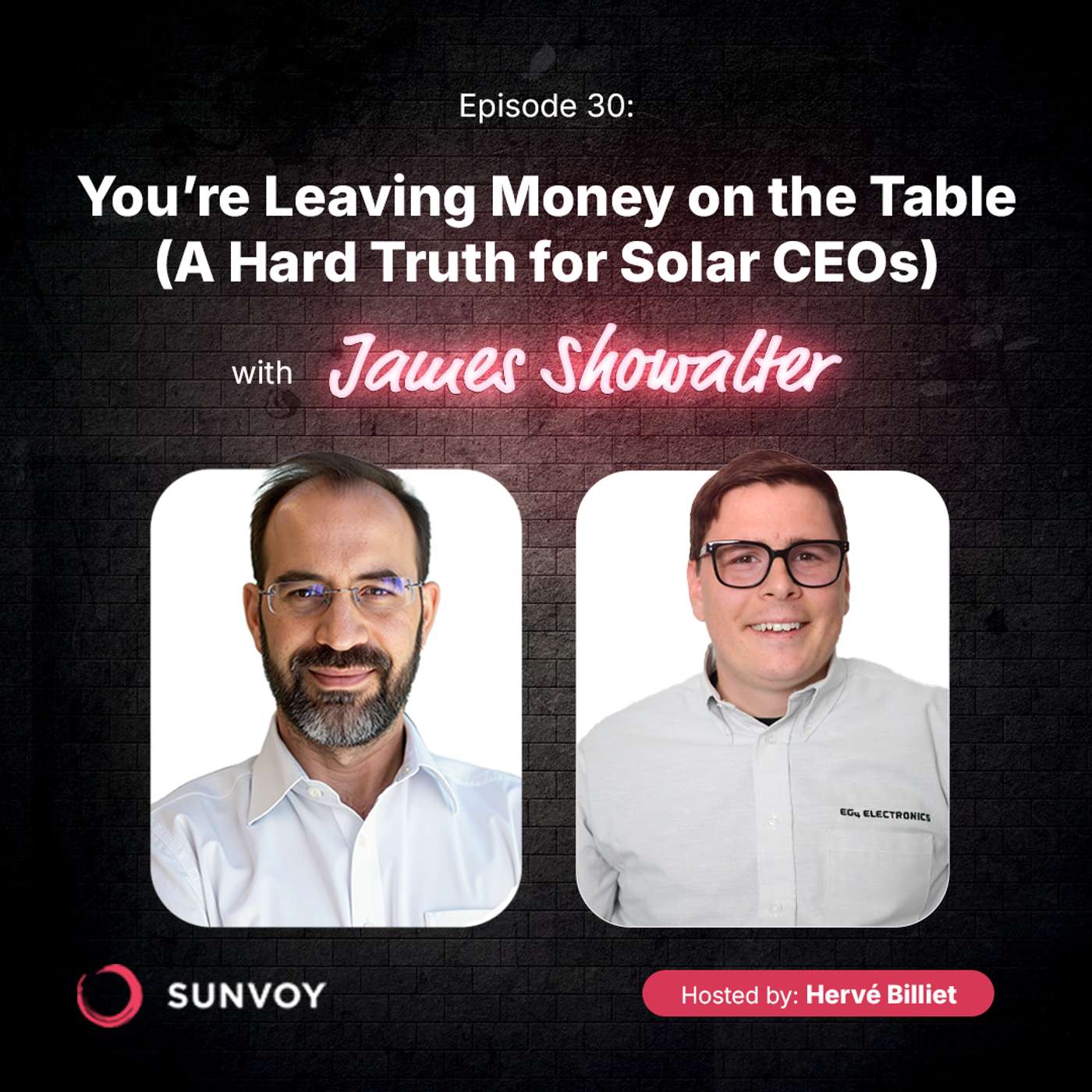
Voir tous les épisodesEP 30
You’re Leaving Money on the Table (A Hard Truth for Solar CEOs)
À propos de cet épisode
In this episode, Hervé Billiet sits down with James Showalter to unpack what’s really changing under the hood of solar and battery technology.
They get into the messy reality of product development, why domestic content is suddenly mission-critical, and how virtual power plants and energy management are reshaping the value stack. It’s a sharp conversation about building the right teams, working closely with manufacturers, and staying profitable as the market gets more competitive and more complex.
Transcription
Herve Billiet (00:00)
Welcome to the podcast about What Solar Installers Need to Know. I invite James Showalter to the program. Hey James, how are doing?
James Showalter (00:07)
Doing great, Herve.
Herve Billiet (00:08)
So before we get started, maybe James explain a little bit the different companies you focused, you're working with, and then we'll focus on the EG4.
James Showalter (00:16)
Yeah, so I run EG4 Electronics, which is a hardware company, big position in the residential battery space. We've been at it for six years, over a watt hour of batteries deployed last year and on the residential sector. And then we also run Signature Solar, which is a direct retailer of hardware and also focused on long tail installer needs for
solar and storage components for their jobs. And then we also run a factory company, which is doing the manufacturing for EG4 for our domestic content, 300,000 square foot facility outside of Dallas. And a couple other operations that we're looking at helping provide install sales services at Signature Solar with a lot of our DIY customers, ultimately really just wanting support on a
turnkey install that was a little more transparently priced and they start with the materials cost and go from there. It's more of a flywheel than it is a diversified portfolio. So just different companies that support each other and really compound the leverage on practically any opportunity. But the goal that we have is to ultimately, you know, attach to supply chain and particular hardware designs that
move the needle for installers in terms of value and economics.
Herve Billiet (01:29)
Let's speak about that needle. So you were in a hardware manufacturer company. What moves a needle you think? I'm sure we're going to speak about domestic content. That's top of mind now for, for solar installers, but what do you think moves that needed the most?
James Showalter (01:44)
Well, I think the thing you can do in product design is you can listen to and define the product around your customer, or you can chase the competition. And so a lot of times the opportunity to move the needle is going to be seeing what's missing in the industry and really opportunities for better value. So if you look at the residential storage layout today, ultimately everyone is chasing Tesla.
And they're the cost leader in the space for most people. And then they're ultimately yielding products that are a premium on top of Tesla for these wall mount solar batteries. in our example, we started noticing that our customers were buying two to three batteries or more on these wall mount setups. And we said, look, here's the problem is going to be that
installing a bunch of small batteries to have a lot of storage capacity may not be the right approach. So we focused on, I think a really cool product platform we're unveiling at Intersolar, which is a 60 kilowatt hour whole home battery with a built-in high power inverter that's on top of that. So it's pre-commissioned and drops in on a platform as opposed to a bunch of small wall mount batteries and custom wiring and everything. you know, that's where you can move the needle typically is
Okay, well, you know, surprisingly, if you can define and build a product for that type of customer, which we think is a big, a fast growing sector of the market, more than big enough for us to go after and support, I think we end up at unit economics that are half the price of Tesla for these larger battery systems, while still being domestic content. So that's, that's really one of the areas that a hardware player can do something is, you know, stop trying to keep using the same cookie cutter.
make a new cookie cutter, listen to the cost of the components and the technology and to listen to the people that are using it and try to create something that looks more like what they're focused on.
Herve Billiet (03:27)
So 60 kilowatt hour battery, like huge battery, one battery instead of a lot of little pieces. So the brains and face have got it. You call it a gateway or whatever. Those names also keep changing over time. So it's kind of hard to keep track of it. But all the logistics, all of that is all built into one case.
James Showalter (03:47)
Well,
I think the home energy management panel is going to look like your current generation of hardware from 2025, which is we call the grid boss and that is a smart load management interconnection with the power company and all that other stuff. That's going to be the same. know, real value is going to be in the overall, you know, kilowatt hour stored and capacity of that energy storage system.
Herve Billiet (04:10)
Can you lift to me about what it means to bring a product to market? Most people listening are sort of CEOs. They run their own companies. They need to make decisions about products with their teams. But can you tell us more like how long does it take for you to go from making a decision about like, this is I think what our customers actually want, actually being able to unveil it in a few weeks.
James Showalter (04:28)
Yeah.
18 months to two years. There's a whole stack of certifications you have to get through and you know, we're unveiling it in two weeks, but it's in advance of first article rollout, which will be in April. So, you know, it definitely takes a lot of planning and alignment. and that's really why the industry isn't hyper responsive to people's interests. I think, the other problem that domestic content puts on top of that is that...
Herve Billiet (04:36)
Mm-hmm.
James Showalter (04:55)
There's only so many supply chains you can use, which means you have to align with long-term, you know, advanced planning supply chains to get to a place where you have a domestic content product.
Herve Billiet (05:04)
Now, if it takes two years, when you made that decision, we had different president, we had very different rules and active in the soil industry. making, I mean, I can't imagine me being a solar installer, having to plan two years in advance when I'm going to buy or placing beds.
I hope you have a crystal ball that works really well to figure all of those things out.
James Showalter (05:23)
You have to stick with some fundamentals, right? mean, at of the day, people's energy usage, the kinds of systems that are going to need to be installed, the profitability, the grid services profitability, right? What's the real bottleneck there? So you stick with fundamentals that, you know, way predate the solar industry. And that's, I think, where you can get to something.
Herve Billiet (05:44)
So two years ago, when you looked at the fundamentals, saw that the grid becomes more more expensive for regular homeowners and small businesses to buy. And that's still the case. That's still true two years ago. Are there other hypotheses that you made that you can share, those long-term decisions are based on?
James Showalter (06:02)
Yeah, I think number one grid services monetization is limited to the transformer size of the home. Grid services are going to be needing or moving to three hour dispatch and headed for four. So, you know, that creates a natural coefficient of inverter sized battery reservoir. You know, the removal of net metering and practically
every market is something that puts you in a spot where you need about three kilowatt hours per kilowatt of solar. So you end up with a spot where homes are gonna need 30 to 60 kilowatt hours of storage, depending on the amount of solar they're putting in. Also you have an efficiency factor and everything there. And then also your homeowners are gonna get more more motivated for backup. So one of the things we're seeing in...
independent analysis, government analysis, really every analysis of the energy space right now, is the AI demand crisis is going to create a lot more backup motivated homeowners, people that are actually concerned about what happens if I actually use my backup system. And they get range anxiety with these small batteries. And so that's something that we saw as an opportunity to say, how do we create a hardware form factor?
that is so value focused that it does all of that stuff well. It puts a bigger reservoir on the house of energy than any of these warm-up batteries can feasibly do for a cost-effective amount of money. It has maximum return per job in terms of grid services, virtual power plant revenue. And it also is in a space of max monetization for the value of the system with domestic content.
So what can you build that's American, that maxes virtual power plant, that has the highest amount of reserve energy for backup available and is domestic content.
Herve Billiet (07:48)
Are you a typical end user or homeowner, small business owner or do you want to play in like the larger industrial space?
James Showalter (07:56)
We make residential hardware so far. Some of our hardware is heavy enough that people are using it for commercial single-phase applications. And you'll probably see us in the commercial space coming.
Herve Billiet (08:07)
Okay. I have a question about management in general. When you were running Signal, a distribution company, it's already hard enough to run a business. What were you doing or what did you think you did right to be able to elevate you out of your own business so that you could start other projects and run multiple pieces? Having an EG4, for example, how are you able to keep all the balls rolling in the right direction?
James Showalter (08:31)
I mean, in terms of there's just no, like the reality is that you're gonna have to pull people onto a team that really are value add in the line of your mission. And when you do, you're gonna be in a good spot in general. And you can go about it with some system or the other as to how you go about doing that. But ultimately the missing ingredient is always gonna be the people.
And so you really have to know when you've got the right person or when you don't have the right person so you can do something about that and at least not trust them too much. So that's one of the things that startups are always struggling with. And I think my own experience has been we found some great people and they've really taken a lot of the battles I used to fight off my plate and it's created holes and opportunities where
we can still go after growth with my time, but at the same time, we've also had people that, it's been the best thing that you can do is you can realize that they're not the right solution long-term and then you can operate on that. No one's going to build it for you. But I guess just a simple...
Question of hey has the person done it before right when you cross that threshold and you're in the eight digits You really need to stop Assuming that someone who has never done something before is going to do it well
Herve Billiet (09:42)
That's a good point.
James Showalter (09:43)
or stop assuming, stop hoping. The hope shop for people to grow is in large stable companies that have the budget to make mistakes on people. It's not in these small to medium sized companies that are in the private sector.
Herve Billiet (09:56)
Now of running a company, what do you enjoy the most? There is a legal aspect, accounting, there's a technical aspect, there's a sales marketing kind of getting the word out. I also saw you quite active lobbying. So of all those different hats that you wear, what did you enjoy the most?
James Showalter (10:13)
I think it's definitely the product side and it's really just listening to people, looking at components, kind of watching. There's a way to count cards in the overall picture as component regulations have gotten written that are requiring domestic participation. There's only so many supply chains out there. There are only so many components out there that exist. There's a lot of talk, a lot of stuff gets into scientific journals, never gets a factory. And then...
Herve Billiet (10:38)
Mm-hmm.
James Showalter (10:39)
the stuff that gets a factory, only so many of factories ever get to production. So you got to look at what's going to get to production. And then you create a world of possible products. it's actually a relatively small number of combinations, and especially in the domestic content world that we're in. And we could just import anything we wanted to be a little different. that's something that game is interesting, really the execution and process and testing
that has to occur is something I like. I think that working with portfolio owners and strategic EPCs that are going after profitability and the right hardware fit, I like working with those guys as well.
Herve Billiet (11:17)
Okay. Since you like the product the most, let's speak a little bit more about the product itself. If it takes around two years-ish to go from an idea to something that's commercialized, you must be now already start placing your bets for the next development. So do you see any trends or any next developments that you wanna talk about?
James Showalter (11:40)
Yeah, trends are next developments. know, honestly, it's, I think what's coming next after what we drop in the industry, what's coming next is really, it's up for debate. And the reason is because of so many people are promising factories, but only so many, but we really don't have credible execution yet on technologies past lithium iron phosphate, right? So I think sodium ion may reach a point where it's commercially.
make sense in the United States, but we're going to have to kind of track, build execution success for people capitalizing and setting up production lines. you know, similar for the concept of solid state battery, right? You there's, there's, you've got, you've got a few different players that are making great claims. And they have practically no capacity. And so we'll have to, we'll have to see who plays out in the, in that game of.
of supply chain because if in the American space, right, I think the solar tax credit ends in a couple years, a little less than a couple years for any of the 40-80 people unless if you safe harbor it. I think the backbone of the industry is the battery tax credit. And I think a lot of solar installers are going to strategically place their soft costs for the solar and storage system entirely on the battery.
So you'll see really cheap solar rates, maybe 50 cents to a dollar a watt, where they're just pushing it through at materials cost for the solar. And then they'll put all of their installation profit, permit costs, soft cost, et cetera, on the battery system, because the batteries credits are good through 2032.
Herve Billiet (13:14)
That's I think a safe analysis, right? You just put everything PV very cheap at cost and then you get the tax credit on the battery and everything combined. Yeah, that makes perfect sense. Do you see some battery only or is it still battery powered by PV? What do you think the market is going?
James Showalter (13:33)
I mean, you're going to see some battery only plays. I think that battery only has a significant exposure that's very similar to, um, and we're already seeing them, but the exposure on the battery only plays is that it's very much what, like what happened to net metering. The more net metering solar went in, the less net metering solar became valued at. So the more batteries we connect to the grid, the less it's going to be valued, right? The value of storing a kilowatt hour and discharging a kilowatt
is going to drop. And so if your entire payback for the homeowner or your entire profitability long-term is, you know, I'm to make money off the battery, you've got to recover that cost pretty rapidly. And that's probably a five-year window or less. And if you don't recover it rapidly, it's an at-risk business model, right? You don't want to end up with a fleet of old batteries making 25% of what they used to make sitting out there because of,
at some point in the grid's future, and AI may delay us reaching this point five years, maybe a 10 year run for us, at some point it will not be as valuable to charge during a cheap period of time and discharge during an expensive period of time. People are going to be, you know, having enough storage on the grid where someone else is already transporting that power from one point in time to the other.
Herve Billiet (14:49)
I fully agree with that. Like I spoke with somebody from Belgium that has so much capacity that once they discharge, they literally suck the entire profit out of that market. like one switch and your investment yourself is gone because a larger player walks away with all the capacity. So I totally agree with that one. Let's speak more about EG4. You have one main battery. Like do you have other,
maybe smaller auxiliary products or other ideas in mind besides what we just spoke about.
James Showalter (15:22)
You know, we're actually, think we're going to, you're going to want to just, just focus on fewer and fewer products, right? And I think that the residential platform, we're trying to do something there that's different than everybody else that really provides a lot of value to backup motivated homeowners, virtual power plant motivated, rapid payback guys, you know, net metering avoidance, you know, larger homes and, and cost motivation. I think we'll be able to deliver something that has, you know, over four times the power of a
Tesla Powerwall for less than two AC Powerwall's cost. So that's really, I think what we'll just focus on, because the whole industry is just trying to copy the Powerwall 3. It's a wildly successful product and everything else. So we'll see how that plays out.
Herve Billiet (16:07)
Yeah, so maybe we'll copy the cover, even look alike. But so you spoke about like changes in chemicals that's coming, changes in usage of your battery. Let's speak about like the virtual power plants. Like, is that something that would happen everywhere in the US, specific markets only? Or will it be kind of like the manufacturer takes care of all the virtual power plants and distributes the profit back or?
Will they be like middleman being part of that value chain?
James Showalter (16:34)
Yeah, you've already got markets that have tens of millions of people in them that are open up to this. So, you know, getting the cost economics on battery storage is chasing this. It's really something that I think our next generation stuff goes after. But, you know, beyond all that, you've got new, you will see more groups get involved in virtual power plant solutions.
There are going to be questions and concerns because it's not the same as technically it qualifies in a few different categories that help out power companies, but it's not the same as gas turbine capacity that can run, you know, 8, 10, 12, 24 hours, whatever they need. So it fits kind of a, you know, a mid usability sector. And you'll also possibly see some AI data centers aggregate,
and create their own virtual power plants depending on the grid regulation in the different states. So, you know, we'll see it play out, but there will be a way to monetize that energy. You could even use, on a more universal play, we're looking at opportunities where you can use distributed AI or GPUs or, you know, burning power with the excess capacity of the battery that's charged by the excess solar energy or off-spec time of use.
You've got non-VTP markets where they're providing virtually free energy for a part of the day. So time to use arbitrage opportunities. So it's going to be, I see it becoming a universal conversation in most of the country.
Herve Billiet (17:57)
Some of those markets are still owned by local utilities deciding that they allow certain batteries or they make a virtual power plant market. So if those utilities decide, then they also select a certain amount of manufacturers. So hopefully you then expand in being allowed in different utility markets to play there.
James Showalter (18:22)
Okay. Yeah, I think the key thing to keep track of is the, uh, you totally companies make money when this happens. So, they don't ever get involved in a program where they don't turn a profit on it. So there should be a general incentive. I think their biggest question is, it going to be worth our while? And that's going to come down to how much battery capacity is available to affect their particular market. You know, can they get tens of megawatt hours or a hundred megawatt hours of capacity lined up?
Herve Billiet (18:47)
Well, let's talk about profit and profitability. So for homeowners, not a tax rate is going away. What do you think is the best or easiest way for them to buy your batteries? What do you see some trends?
James Showalter (18:58)
Yeah, think you're going
You're going to see people, depends on if they're ownership motivated or if they're trying to, or if they're open to a third party ownership play where they don't have to put any cash out. I think you're going to see homeowners come in and they'll do the prepaid PPA approach or the prepaid energy services agreement. That's going to, you'll see a lot of those, you know, up and cranking over the next 60 days.
as people are adjusting to the industry. And then you'll also see the homeowners get involved in TPO's that look more like just a nominal amount where they can get access to the battery for 30 or $40. And then the third party ownership fleet basically makes the money with the power company.
Herve Billiet (19:40)
So for you, do you see your marketing and your branding, is it influencing the installer? Is it influencing the distributor? Is it influencing that homeowner that has the installer, that has the distributor that buys from you? Like who's your target audience, actually?
James Showalter (19:57)
Well, I think we only have a message for all the different audiences, right? Your asset managers looking at a lot of different things. If you're talking about a TPO play, retrievability of the asset, right? Versus screwing all this expensive hardware on somebody's home. You're looking at installation costs. You're looking at profitability against the hardware. So we've got, you know, a key focus for those asset holders. On the homeowner side, they're focused on value and really in credibility on the backup side and how much backup they get.
So that's another key concern for your homeowners. And then on the installer side, I think the other thing we'd go after is the different format we have. It's just a battery on a platform showing how to get that thing installed in a time efficient manner and then supporting certification efforts that help with AHA permitting and everything else. So, we've got a different message, different support package to everybody on that one.
And yeah, that's what you got to do as a hardware company. that's really the key thing though, I think is that there is some missing hardware pieces, warm out batteries that everyone's seeing. A lot of them are dependent on Chinese battery cells being available. They're not as good of a fit cost wise value wise, you know, for, for practically anything. you know, the industry has gotten obsessed with because kind of the, the market leader is the coastal areas.
They're deciding these smaller homes, smaller energy usage and higher energy prices that can afford anything are deciding what the industry chases. And so just possible hardware isn't being created that would lift the iceberg and get more people in play. Make more homes make sense on energy effectiveness and payback.
Herve Billiet (21:30)
I want to translate that. You're not on the east or west coast. You're in middle of country in Texas, right?
James Showalter (21:35)
Yeah, we're just outside of Dallas.
Herve Billiet (21:37)
So you see in that market, there's a lot of homes that can have like one large cabinet attached to the side of the home. And you think that's.
James Showalter (21:45)
Yeah, I
I mean, that's the way that our industry works. It's, you know, people use a lot more energy and they can easily fit more battery capacity and they need more battery capacity. So it's actually saves versus this, you know, a lot of small batteries on somebody's.
Herve Billiet (22:02)
When I was a solo installer, it's very important to have good relationships with manufacturers. You know, what's coming, you can prepare your crew, there's lot of training, right? When people, when we start selling a market or product, you want to make sure that the people have the warehouse space for it. Everything's assigned, because all the different software. And then, you know, the people in the field need to now have training to know how to install it.
That was when I was going to trade shows at the time. I was trying to figure out like, what's coming up next and prepare my company for what's coming. But I always started on my side. So maybe from your side, James, like what can solar installers do to build long-term relationships with a manufacturer? Helps both sides, right? They don't stop flip-flopping. They buy some one battery today and then the next day something else. How do you build long-term relationships with a manufacturer?
James Showalter (22:50)
Well, I think we're entering a new world right now. One of the big, you know, where I think the driver is going to be not the installer, right? There's going to be very few installers that are driving their sales. It'll be TPO formats or it'll be sales agencies going to the customers that are focused on a really profitable ownership, prepaid TPA approach. So I think the biggest thing with installers that happens all the time, and we've seen it with a lot of installers we sold to as an installer before I started this company
was don't grow too fast. Slow down, don't be putting people on a job site that never got training and then you're calling up your manufacturer with someone who you didn't even bother to go through the webinars, go through the training and you're creating strain and poor quality work out there and you're making it your manufacturer's problem. Everybody wants to grow, everyone wants to make more money,
but there is a point where it's just too much. So don't do that. And that would be, I think, one of the biggest things. So be a reliable player where the manufacturer knows that if they partner with you, because I think that the flip side is gonna be, the manufacturer needs to know if they partner with you, that you're going to be sending somebody experienced to the field, someone that took the training, someone that's done it before. Otherwise, you're gonna have manufacturers and TPO groups there where,
you know, the hardware is spec'd in, the hardware has to be what goes in. The TPO group or the finance structure already calculated the tax credits on it. This is what you have to install. And they're gonna be like, well, this installer, when we pushed them out there, they're gonna send some rookie in the field and there's gonna be a problem with the way that they're installing stuff. And so they're sketchy or bad. And so then that'll cut opportunities. as well. So...
you know, blowing this thing up to the point where you're not sending experienced people to the job site. Catch yourself when you're doing that. It's kind of like what you were talking about earlier on. I faced it in growing company. It's like, know how to realize when you don't have the right person or you don't have the right person in the seat. And the most important seat as an installer is really the guy sitting in the truck or the guy sitting in the truck that's going to run your job site. Your job site
Manager needs to know how to have to build a system themselves that they had to do all the work inside out And if you don't have someone who has that in the job site coordinator seat, you need to get them there or you need to you need to invest higher.
Herve Billiet (25:02)
Maybe last questions. We already spoke about like a switch or move to more TPO focused larger batteries as they are getting deployed price sensitivity where a lot of the PV only PV cost of an entire project will actually shift all the software cost onto the battery side to take the ITC. Are there some other trends or
piece of knowledge you'd like to share.
James Showalter (25:26)
You know, honestly, I think it's going to be just about it. It's domestic content, larger batteries. And, you know, those would be a big factor. Virtual power plant participation and revenue to arbitrage the cost of the systems. I think we end up in a net position. It'll take the industry a little bit of time to recalculate, but within six months, we'll end up in a net position where this makes sense.
Herve Billiet (25:46)
James, thank you very much for being on the podcast.
James Showalter (25:49)
Appreciate you, Herve.