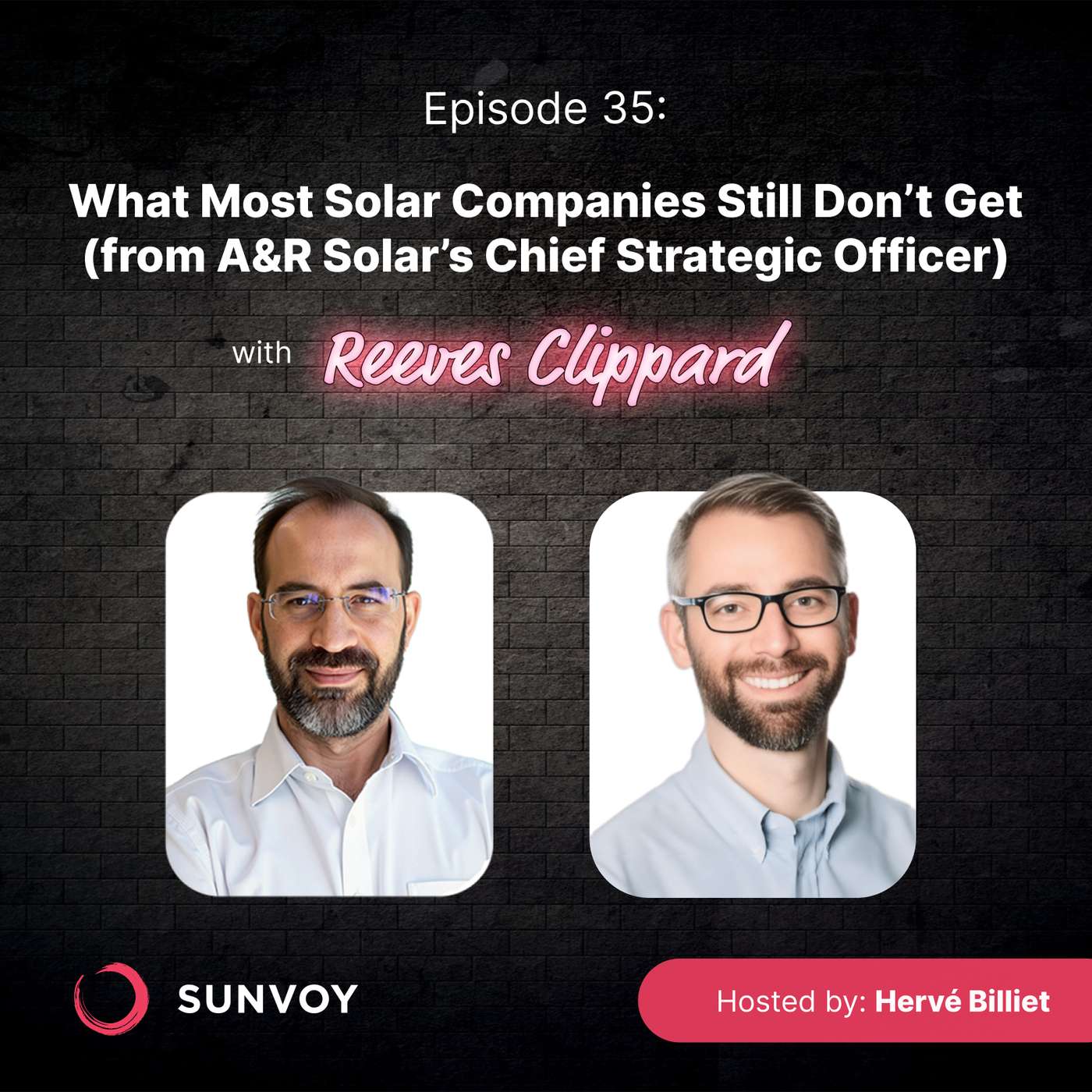
Voir tous les épisodesEP 35
What Most Solar Companies Still Don’t Get (from A&R Solar’s Chief Strategic Officer)
À propos de cet épisode
Reeves Clippard from A&R Solar joins Hervé to talk about what it really takes to play the long game in solar. They get into strategy, shifting policies, and why companies that think beyond installs—into storage, microgrids, and long-term customer relationships—are the ones that last. If you’re navigating market swings and trying to build something durable, this episode hits on where the industry is headed and how to stay ahead of it.
Transcription
Herve Billiet (00:00)
Hey everyone, welcome to another podcast of What Solar Installers Need to Know, where we invite Reeves Clippard, co-founder and Chief Strategic Officer of A&R Solar, Hey Reeves.
Reeves (00:10)
Hello, good to be here.
Herve Billiet (00:10)
You have a really amazing and cool title, so tell us a little bit. What does a strategy officer actually do? What do you do all day?
Reeves (00:17)
So it's just a part of what I do day to day, but generally, it's leveraging some of the skills that I had as I developed my career at A&R over the last couple of decades, where I'm looking at policy trends, upcoming pending legislation, market and industry reports, and...
translating that, simplifying that for our executive team so they can best understand what kind of opportunities or threats might be facing the business. And so that will end up being maybe some policy reports when we're in legislative session. And then throughout the year as we're doing strategic planning, that might be providing, I have a strong data background, and so providing
market intelligence, like what do we think the addressable market might be? How large is this opportunity if we want to take it on? Which could be something like thinking about a geographic expansion or diversification of services and things like that, or growing existing services. What are we learning about how the market is changing?
Herve Billiet (01:18)
That sounds really cool. I think every solar company should have a person dedicated to that. I think a lot of times as the CEO that needs to do that in between everything else. So is it safe to say that you try to make long-term decisions, at least look at long-term views about how it affects in our solar?
Reeves (01:36)
Yeah, absolutely. Long-term views, I think it was last year, it might have actually been the year before that. We actually did a 20-year visioning for A&R Solar, that I led with a facilitator where, at least in our territory, where we have our headquarters are in Seattle and then we have a satellite office in Portland, Oregon.
And looking at this territory that we operate in is we have 100% clean energy targets by the state. And so what does it mean to be a solar contractor in a grid that is 100% clean or very close to it?
We'll be doing some installations, some removals and replaces, repowering, things like that. But what value are we bringing to the marketplace? What value are we bringing to our employees? And so it gave us a very long-term understanding of how we want to evolve.
And then we're able to start using that to back into some other strategy to say, OK, well, what do we need to do in the next 10 years? What do we need to do the next three years? And of course, we can't predict the future. But these are general directional things to say, well, clean energy is going to be here. And how are we around within that customer? How are we managing our customer relationships and our employee relationships in that kind of landscape?
And it's nice when you work in a marketplace like Solar, we operate in residential and commercial, don't really do utility scale. But it kind of gives you this perspective when you start hearing what your customers are saying and thinking about the trends and how your relationship with your customer has changed to say, wait a minute. Yeah, I can attach that data point to this far off future that we were talking about.
And so it helps with alignment. Yeah. And so it's a, it is a lot of forward thinking. And then it also gives you a chance to think about like, when something happens to you in the short term, how might we better react? Are we going to react in a way that helps us move towards that future that we envisioned? Or do we need to do some short term pivot that we know is going to just be a short term fix before we can get back on that road. So,
I mean, everyone's got a plan. I think there's a famous quote out there. I always forget who it is, but everyone's got a plan until they get punched in the face, right? And that's what happens in solar allies. You make these really long-term plans and then the market changes, policy changes, something changes. But at least we know the direction that we want to go.
Herve Billiet (03:49)
Yeah.
Well, let's speak some about that because you've been around the block a few times. You've been in solar for a long time in your in our solar was founded
Reeves (04:08)
in 2007.
So I got into the industry in 2005. And then we founded A&R in the spring of 2007.
Herve Billiet (04:16)
So you must have seen lots of ups and downs, lots of policy changes. Do you see any trends in policies or like as a business? When you think about the next 20 years, you've been already in the business for nearly 20 years. That entire view is basically 40 years. That's a long time. So any trends like the price of panels may go up and down doesn't quite affect you long term. Like you install more solar panels no matter what or
What are some major trends that you could share?
Reeves (04:45)
Yeah, absolutely. In the beginning, do we even have the right to exist? Are we allowed to install this technology and interconnect it with the utility? Does it even work? Yeah, so much of our customer relationship was sitting down and doing solar 101. What is a solar panel? What is an inverter? How does it connect? how is my relationship changing with the utility?
And now people understand this, right? They've lived in a place with solar already before moving into our region, or they know someone that has solar, or there's enough general knowledge that our customers are much more well-informed. From a policy perspective, it was like, can we even interconnect with the utility? Are we allowed to do that?
And then it was a lot of like incentive work, like can we create some incentive to spur the growth of the industry and increase the base of people that are putting clean energy on the grid? Because at the time, in the mid 2000s, it's like climate change and peak oil were known, right? And not necessarily accepted from a
broad public standpoint, but they were known, there was still just a lot of like politicians didn't seem to be doing anything about it. Corporations weren't doing anything about it. And so solar was this thing that our customers could do without waiting on policy to change. And so, you know, that spurred a lot of, you know, that early adopter is just a frustration with the status quo of not addressing
what was this, you know, there was scientific consensus that there was this problem and there were known solutions, so let's just deploy them. And there was that policy, the policy landscape was how do we accelerate that deployment through incentives, tax credits and grants and rebates. And honestly, like we're still working on that kind of thing today, but it's less and less of
can we give somebody a little extra money? Because for a little while, whatever the size of that incentive was might be really important to that end user, making it financially viable. But one of the things that we identified in the late teens was that really those government programs just provide a valuable signal to people who are on the fence.
So it's less of the size of the incentive and just here is social proof that my jurisdiction, my political entity says, we do want you to move forward with this. And now where policy is going is it's much more traditional kind of power politics, which politics is power and vice versa.
And I mean that in the literal sense of our electric grid is very intertwined with, with policy and politics. I'll say, do a lot of policy work. I'm not very active in politics and I make a distinction there where some is like technical language. And how are businesses going to either take advantage of this or be harmed by this versus, you know, moving
different pieces on the board in order to make sure that that language actually turns into law. But within that policy landscape, it's how do you make sure that people are protected? So we work on consumer protection.
But then it's also moving out of that kind of like federal and state level of, how do we incentivize this to just regular regulatory processes? Can we streamline permitting? Can we change energy code or update energy code? So we're not doing demonstration projects anymore. Solar demonstrated its effectiveness decades ago. Let's move on to doing some real things. Fire code and building code. So
interconnection processes with utilities. So that's where a lot of the policy work is happening now. And there's still the incentives, right? Like we, as your listeners would know, like we just lost the federal tax credits and it would be great to have those. It would be great to get funding moving again for other things. And so I don't want to discount the value of that moving our industry forward, but over the next 10 years, I think it's going to be more of the block and tackle,
you know, making sure that buying a permit in this jurisdiction is just as easy as buying a permit in the next jurisdiction over.
Herve Billiet (08:59)
That would be nice to have. You think there is a bigger, does the solar industry heard more that our federal government is openly against solar compared to having the ITC with 30% tax credit? Do you think like that number 30% would make a difference or is it just that signal that you mentioned? In the past, it was nice to have social proof. The government made a signal like, yeah, we should do this. Whereas now the signal is the exact opposite.
Now the market has also changed, right? People know about solar, it's not like as new as it was before. So you think that signal from the government is hurting the industry more than the 30% tax rate?
Reeves (09:39)
I think that's a complicated question. I have an opinion. I don't have an answer. I think there's a lot of places within the U.S. and where solar is still financially viable without the tax credit and it's doing just fine. We don't live in one of those areas. So we just wrapped up the end of 2025. We were able to deliver all of our projects that could qualify for the tax credit and we're waiting to see what happens with 2026.
It doesn't mean we're not taking action. certainly hope it's not a business plan, but we're not quite sure how the market is fully going to react. But we are expecting a big downturn for residential solar. And so I think it is important. think it's really frustrating to me to see how solar has been politicized in the two decades that I've been in the industry.
Solar has pulled very high across all political spectrums. Solar is a very, I'll call it a democratic energy source. Not everyone can put a coal plant in their backyard. Not everyone can put natural gas or geothermal or hydro or nuclear in the backyard, but just about everyone can do some solar. And so...
And people are drawn to it for all kinds of reasons. would say what I've observed in our customers is there's two factors that are aiming for
kind of the first position on making a decision is, I want to do something for the environment or I want it to make financial sense or I want to do something that makes financial sense and I want it to align with my values. You know, it's just kind of two sides of the same coin and it's a very subtle difference. But we also have a lot of areas in the Pacific Northwest that are a more libertarian bent and say like, I want to have control.
I want to have reliable power. We have a lot of natural disaster, I shouldn't say a lot of natural disasters. We have a high risk for natural disasters in the Northwest between earthquakes and wildfires. And, you know, we're having summer after summer where you need to keep your doors closed because the smoke level is so high that it's dangerous. We have communities where the utility is turning off their power to try and prevent wildfires,
and people want to have reliability. So, that's been a big shift for us as we spent 15 years telling people, I'm sorry, your solar has no storage. If you lose power, you lose power. And now we're finally able to have these really elegant solutions to say, no, no, like you can have storage. You can have some resiliency. You can have reliability. And I think that's a big shift for us as well as a lot of our utility fights.
If we had been installing storage for the last 20 years, I don't think the utilities would be arguing about some more solar coming onto the grid.
You know, we've been saying for years that eventually we could see the market shift to where we're more of a storage company that sometimes does solar instead of a solar company that sometimes does storage. And we're already seeing that shift in the last couple of years where the vast majority of our customers are adopting that new technology. And we have very few financial incentives for people to do that. And when I use incentive in this, this meaning, mean, price signals at all. So storage might help you
do save money through rate arbitrage and time of use rates or demand charge reductions. We don't have that in most of our territories. But it's coming, and our customers want to be ready for it.
Herve Billiet (12:59)
I feel like it's merely calming. It's not there yet. I know in Virginia a few years ago, the utility came up with a new price rate, literally for batteries. So we did a calculation. The payback time was like 103 years or something. It sounds amazing. But then when you look into it, it didn't make any sense. But the people still wanted to have it. There's, like you said, an entire section of people that want to have the independence. I also want to take the moment to tell you that
my house has been disconnected from the grid. And so this entire podcast has been for the last hour that we've been talking. Yeah, everything's powered by our solar panels.
Reeves (13:28)
Peace.
That's fantastic. I have a really fun story to share. So I have some early teen kids. So they are orthodontics now. And we had a weather event, I think this was last year, maybe a year before, where the entire region lost power. And they had an orthodontics appointment to do some work on their braces.
And we call up the office and they're like, no, we're still open. And what the orthodontist had done was backed up and was powering all of their health and safety equipment. So the autoclave to sterilize tools and gear and all that. They had that. then all of the dental technicians and everyone else were working from headlights, but he was able to keep his business going. Right. So it's like, you think about the, if you've ever had a kid with orthodontics, they are not cheap.
And this orthodontist was able to like keep his business up and going and productive that entire time. So his employees were able to continue to get paid. People were able to receive the care that they wanted or needed. I just love that because I think there's opportunities for a lot of small business owners to kind of have that competitive edge that it's regardless of what is happening to the external world, I'm able to keep delivering my service, my promise to my customers.
Herve Billiet (14:48)
And I think if you do that now, you have kind of a marketing value, right? You're not going to forget an orthodontist. I had a similar with my childcare for my kids. Like, received a call, like, sorry, we out of power, come pick up your kids. It's like, why don't you sell batteries? And everybody would know, this daycare has batteries, runs no matter what. Like, why now? It's perfect marketing. Once I imagine at some point, lot more businesses and people will have batteries. It's not going to be like, just like solar.
The first few people are like, well, you have solar in your roof. Wow, everybody knew it. Like that's the house with solar panels. Now it's there and you see them so often and it's not a thing anymore. But I think with businesses, I think it's going to be the same. I had a situation with my daycare, but I think a lot of businesses can now play on that. It's difficult to forget about them.
You mentioned that you would sell not just solar but also batteries and maybe lead with batteries. So do you think you'd still call yourself a solar installer in 20 years with your long term vision? If you install maybe more batteries than just pure solar, how do you call yourself then?
Reeves (15:54)
Yeah, as we're thinking about that landscape, we're really focusing on reliability. I've already said it a bunch of times, so I've tried to get used to saying the word myself, but it's really about reliability and it's an energy ecosystem. As we're talking about like, you talk about market changes and this, that, it's like our utilities are our partners, but the utilities are
in our region are slow to really embrace distributed renewables. We have a couple of pilot virtual power plants. We have a few pilot demand response programs. And I just, really see
that's going to just be an accepted part of the future is that the grid is going to have a different kind of ecosystem. If you think about a healthy ecosystem, there's things operating at all scales from the microscopic to the macroscopic. And what we've had in our power grid so far is just macroscopic monoculture. And that model is showing stresses, especially as there's a drive to electrify because it's such a flexible way to deliver
energy and power. And so as we think about reliability, it's like you said at the scale, which is like, will every single business in every single house have solar and a battery? No, but maybe there's enough that you're able to keep. I mean, we're seeing this with microgrids all the time, right? It's where it's like, we're going to isolate this community, but they're able to still operate,
maybe not at full capacity, but at a capacity that really mitigates the worst of going without power in the modern world. And so as we think about that, it's maybe we're leading with storage, but we might also, I think what we'll be leading with is reliability. And so what are the energy systems in your house and are they controlled in a way that allows you to live at a level of comfort that is acceptable?
I might not be able to run my table and the hot tub and the other things. We hear about that in like Australia where someone's still 100% solar, even though they're charging both of their EVs and, you know, heating a pool with it. We don't have that kind of climate here where we're at. But if, when we lose power,
the fact that my fridge keeps running without food spoilage and that we're able to keep our backup heat source running, that's absolutely huge because if a massive earthquake happened or there's some other big disruption, my family would be able to maintain their health
And it's something that it's not just my house. Last time we lost power and we were watching a movie and hanging out, the neighbors are calling and saying, how is it that your lights are still on? Because I know we're on the same circuit. I was like, oh yeah, no, we've got the batteries. But if you want to come over and watch something or get warm or you need to keep your medicine cool or charge your phone so you can communicate with the outside world, come on over.
You can do that. So I think as the technology gets out there, it's going to be, even if you're not in a position to necessarily install it and enjoy the direct benefits of it, you might be able to enjoy your neighbor, might be able to enjoy the community center. I think it's going to do a lot to maintain, you know, just a quality of life that's really important in situations like that.
Herve Billiet (19:01)
Yeah, I think the more climate disasters are gonna be, I foresee in the not so distant future that like little pool houses or each HOA has a community place. Like put a battery and some solar panels there so that you have a community of a central place to go. And same happened to me when the power was out in my previous house, previous neighbors. They all knew that I was running a solar company and batteries. And so yeah, they all came.
And then all the kids downstairs just watch a movie and the parents just having a beer. it's a nice occasion. Now, if it would go off more regularly every weekend, I think maybe at some point it's a different story, but it's something definitely enjoyable. Now, a year or two ago, I had a person calling me when I was running Ipsun Solar, and he said, like, look, I have a piece of land, I'm going to put 10 homes on it.
Reeves (19:32)
Yeah.
Herve Billiet (19:53)
And I want to put solar batteries in all the homes and have those homes kind of its own microgrid. And so I've called with a few people from Amicus that did microgrids, but it was always a commercial level microgrids, like with one company owning the assets. And so after some of the research, basically I couldn't find a single case where like 10 homes individuals,
the chance that they all use the same power at the same time is not high. Some people are probably on holidays, and then the money's out of the town. But in case of a grid outage, those homes would share power. And we had an immediate problem, like how do you charge your neighbor for the power that you provided? Like blockchain wasn't really a thing at the time. Well, maybe it was, but that wasn't the way of it. But so yeah, there's still lot of things we have to figure out. How to...
to share that power and maybe blockchain is one solution there.
Reeves (20:45)
I think this comes back to the policy conversation we were having of like, where is energy put into policy? And I think one of the greatest revolutions that will come over the next handful of years is the contractual relationship that you have with a utility. Where it's like, what is the value of that power? What is my role on an interactive grid?
And it's exactly that, how are you sharing power back and forth with other people and getting compensated for it? Because we do provide grid services and microgrids do the same. So I think there's a lot of innovation that's happening in the microgrid space, especially on the West Coast with a lot of, as I mentioned, the utilities turning off certain circuits to prevent wildfires. And so I think we'll see
very rapid development in that space.
Herve Billiet (21:29)
Well, those microgrids lean very much to virtual power plants. In Europe, they call it home energy management systems, or HEMS. It's all kind of the same play. If you change perspective, a virtual power plant is usually like utility controls and can turn things on and off and then sends money to the end owner of the assets.
Home energy is like if you as a homeowner you want to control your own assets if there's a negative pricing on the grid you just turn your power off basically it's all about controlling. So, you know, we turn for we try to play on that market, but the number one reason why we have not done it too much, so far is because the money issue. It's a really cool technology. It's really cool to build but
the policy is there. There are some places where it's like, well, we could be doing it, but still we still part of like an economic entity. So you don't want to tell a person with like an expensive battery like, yeah, we're going to play with it and here is five cents. Like that's not working either. So there's still a lot to be developed and discovered, I think. So really cool technology.
Reeves (22:39)
Yeah, absolutely.
Herve Billiet (22:40)
Let's go back to the strategic point where you have a 20 year view into the future. Do you see yourselves solar companies besides solar and battery doing other services?
Reeves (22:51)
Yeah, absolutely. We consider them all the time. Most of the time they don't make it through, you know, off the cutting room floor. And a lot of them just don't meet, you know, like they kind of get filtered out as they come through, which is like, is it adding carbon to the grid? It's out, right? So we don't provide backup generators
to our storage systems. We have customers who are interested in that, we provide the capability, but we're not working with diesel or natural gas generators because they're adding carbon to the equation and that's not what we're here for. So we're always considering things like EV chargers, right? Like a lot of our customers get EV chargers from us, but we don't operate that as a separate business line. And so that's always kind of interesting to see
what's going on there? Where's the money flowing? What does the market really look like? Same thing kind of goes for like high efficiency heat pumps. You know, it's heating load in the Northwest is one of the largest energy consumption areas in the home. And so we're doing the production side, we're doing the storage side. Can we also work on the consumption side?
So one of the things that we've noticed over the years, especially as PV became the majority of our business after solar hot water, was that ⁓ once we got to the point where people were just maximizing their roof, like how many solar panels can I put up there? The good and the smart advice was always, your money's going to be better spent on energy efficiency before you adopt solar.
Herve Billiet (24:01)
Thank you.
Reeves (24:14)
But you can't look at and feel and see a negative utility credit based on energy efficiency. And so a lot of times our customers, and at the time we had incentives that had a limited availability. And so a lot of our customers adopted solar and said, okay, well now I have a benchmark. I'm only producing 7,000 kilowatt hours a year from my roof, but I'm consuming 10 or 12.
Now let me go with a very focused intent in reducing my consumption. This is what our customers were up to. And so if we can help them think about that entire energy equation for their home,
whether it's the water heater moving to a heat pump water heater, their heating moving to a heat pump, the electrical vehicle infrastructure, and can we do this in a way that embraces the idea of an interactive grid? Like right now our utility is controlling our water heater and our EV charger through a smart demand response program, and they're giving me a check at the end of the year for that.
So,
how do we help our customers figure that out? So we were, I was CEO of A&R for I think about 16 years. And then as I was interviewing a potential successor, what she was saying is like, we need our customers to have an emotional connection with their bill. And that's when they're going to adopt solar. And I could not have disagreed more because what people want to do is just turn on their power and turn it off.
And as we're saying, it's like in the very beginning, we're having to say, well, here's a solar panel. It's made up of solar cells and here's how the wires move. And this is what an inverter does. And still to this day, we have to look at their bill and say, what's going on with your bill? Here's a kilowatt hour. Here's a demand charge. Here's what time of use means. And you're just having to do this like level of education that is above and beyond what a typical homeowner wants. Is it going to save me money? Is it going to work when the power's out?
And if it's any more complicated than that, it's too much effort for somebody. And so I of forget where I was going with that. But it's just like, how do you make it simple for people? So how when someone says, hey, it's just like, I have high bills, and I don't want them to be so high. Can we guide them through data like we get through Sunvoy to say, hey, we noticed this is what's going on in your consumption patterns.
We already know these three things about your house because you've worked with us for the solar and we've worked with you on the storage. And when you were doing the storage, we did a load analysis. Why don't we go ahead and swap out this appliance for you to something that's high efficiency you trusted, or if we don't provide it, we'll get you in touch with one of our friends who does because this is our space. This is where we're at, right?
People, as I mentioned before, like people came to solar because they were tired of politicians and utilities not taking action in the very beginning. And people are still coming to us because as much as the utility invests in education and outreach for their customers, all their needs aren't necessarily getting met by the utility. And so how can we be that,
you know, kind of that third place for that customer to come and be a trusted partner and to be that third leg with the utility to say, "Hey, this customer is facing these things." And I understand at a deep level, these seven different programs that the utility offers and these other three programs that the state offers and the one program that the city offers. And let me navigate that for you. And let me just make it simple. And I think that's where we're still going to be 20 years from now
is, we're in this interactive place, people are comfortable with the technology, but they're just going to need help navigating and making sure that not that they're not getting taken advantage of, but that they are taking advantage of what's available to them.
Herve Billiet (28:00)
Thank you. And what you mentioned is one really important part is trust. They trust you as a company, otherwise they would not have signed with you. Well, I hope so. And that trust, now that I talk to different industries and so on, we have something unique as solar companies is that it's a high ticket item. They trust you and you stay in contact with them over a long period of time. If you remodel your kitchen,
that's there is no app for you to track anything. You're just done. Project is done, you move on. And if you need to do some another remodeling, you may literally forget who remodeled your kitchen. But do something special with a solo installer where you stay in contact with that homeowner. And now that you think about different services to provide, there is actually tremendous value in having that business, not business.
Yeah, I guess business relationship, but you know, customer relationship. So I think that is one piece that that solar companies tend to overlook that the amount of people that reached out to me saying like, it would be great for us to reach to your solar installer network. And then through them talk to all the homeowners on your platform is like, do 200,000 people like, no, not allowing that. But people see a lot of value. And
the solver installer doesn't always realize it's like, yeah, it's something that needs to be nurtured more. And I think a lot more can happen there. Not in like a business, pure business way, but just relationship way, just help people because you have the knowledge. Might as well try to do something with it.
Reeves (29:33)
Yeah, I absolutely agree. And I think it was a blind spot for us for many, many, years is that we were always chasing the next installation, because if we installed it right, then that system should be there for 25, 30, 40, 50 years. Why would we invest in that relationship? And then not realizing actually by being there long-term that you're
you are helping that person, even if it's just a service call or answer a question or something like that, that's benefiting you and it's delivering on the promise of solar. Like these are not maintenance-free systems. They do still need some love and care. And if we want to help this clean energy future happen, then that asset needs to be operating for 30 years.
And when you're, we see this on our fly by nights. I was talking to someone who's kind of in the investment banker, private equity space. And we were chatting about clean energy in the Northwest and solar. He was just like, are you afraid of, I won't name, you know, it's like the latest national competitor that's generating all the buzz is coming into your market.
And it's like, no, I'm not concerned because I've seen the last six of them come and go. They have a lot of consumer protection issues. They have a lot of complaints against them. And are they really good at getting into people's homes and into their pocketbooks? Yes. Guess what? Like three of them just left Washington with the expiration of the ITC. And there's 12 megawatts of assets there that need tender love and care.
And we're going to be there to help them because we're building, designing, and operating a business that is going to be here for that long term. When they need to have a panel replaced because of a hailstorm, or they want to expand, or they want the latest technology.
Or as I mentioned, we have an understanding of what's going on with their energy usage because they've reached out and we're looking at their monitoring and can say, I noticed you're still on just a resisted water, electric resistive water heater. Why don't we upgrade that for you and we can save you a couple hundred bucks a month? That's a valuable relationship for people to have. Especially we can be proactive in that. But they're just looking for someone to trust. That's why you ask your friends, where do you take your car to get serviced?
Because you're looking for somewhere where you can trust somebody to work with them and on things that are important to you. And like you said, I think solar companies end up, if you're doing it right, in a really great position of trust because you're coming into someone's home, you're disrupting their life, you're disrupting their business. And if you're able to do that in a respectful way that accomplishes their goals and your goals and you're able to have that partnership, that's such a rare experience for people to have.
Herve Billiet (32:13)
I think we tend to forget that as soon as you turn a solar system on, you install everything as a solar install, you drive away. That homeowner has something like, what did I just buy? How does this work? Where's the on off button? And then it's like, here was not an app to log in. like, how is this working? Is this all working the way it's supposed to? It's actually quite a challenge. Most people are in the dark.
As installers, we have our own systems, we have access to so much more data than they have, and we can troubleshoot it ourselves. But for other people, they need that help. There's just no other way. And you mentioned trust. So with AI coming, I'm not sure that was part of your 20-year plan, AI. But trust becomes a problem with AI. Having real people and local businesses that you know are real or you can trust, I think that's a...
think right now maybe still undervalued, but in a few years when you don't know what to trust or what to believe, what's real and what's not, having real people in your community that you can actually trust, I think that's going to be another play there.
Reeves (33:16)
Yeah, absolutely. 100% agree.
Herve Billiet (33:18)
Reeves, it's been a real pleasure. Thank you very much for sharing your experience and knowledge in the solar industry and thank you for your service in fighting climate change for so many years.
Reeves (33:26)
Absolutely great. Well, like I said, thank you for having me here. It's good to catch up.
Herve Billiet (33:30)
Thanks, Reeves