
Why Declining Subsidies Make Customer Ownership More Valuable

Last week something happened that not only has never happened before, but I never could have even imagined.
In a period of 24 hours, I spoke with solar installers from five different countries.
Australia, Costa Rica, Mexico, Thailand, and the United Kingdom.
Of course when we launched Sunvoy, we only ever conceived of providing our service in the United States, where we had built, scaled and sold our own solar installation business and our communities lived.
But something funny happened as we started to tell our personal and professional story (pod and blog).
Our stories of both solar business failures and successes (as well as those of the friends we interviewed) started making their way across the globe.
We started hearing from installers in Canada. Then Mexico. Then Chile. Then Scotland. Then Spain. Then Australia. Then the Philippines. Then South Africa. Then Nigeria.
This trend has only grown in the last month, to a degree we would never have imagined.
And the crazy part?
Every single company has the same pain points, concerns, and growth opportunities.
1) They see solar subsidies declining as the technology and deployment matures, leaving them with little choice but to invest in entrenching their brands and gaining market share.
2) They see the millions of orphaned customers as well as their own customers who not only need and demand O&M service attention but are willing to pay very handsomely for it.
3) They know that they are sitting on a gold mine of reviews, referrals and upsells from their existing fleet of customers but are unsure of how to tap it.
In the same way that traveling opens your eyes to the reality that most people are fundamentally good and want the same things, this experience has taught me that solar installers all over the world are fundamentally the same and want to scale their businesses to bring us to a Net Zero world as fast as possible.
As a result of our experience, we have also translated Sunvoy into several languages (French, German and Spanish specifically).
Our hope is to have Sunvoy on every habitable continent by the time I write you this newsletter a year from now, which requires only Asia and Africa to go!
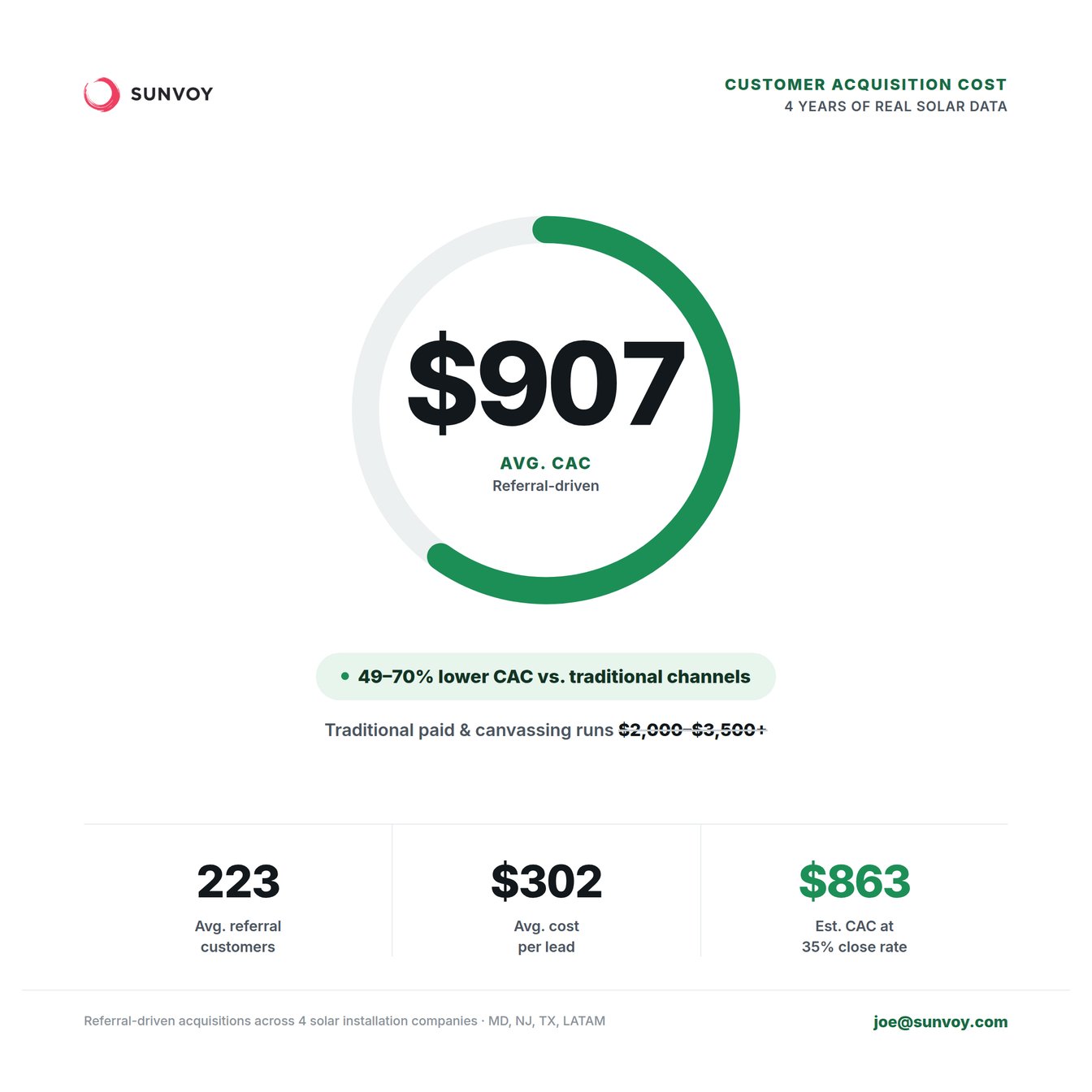
p.s. Check out the latest results from our study of the CAC impact to our Sunvoy customers below and reach out to me if you have any questions. My personal cell is +12022978326.
**
Why Solar Installer Growth Looks the Same Everywhere
Solar installer growth looks remarkably similar from one market to the next. Whether an installer operates in Australia, Mexico, Thailand, Costa Rica, the United Kingdom, or the United States, the same pressures keep showing up: declining subsidies, growing service obligations, and an installed customer base that is not being used nearly enough.
Last week, I saw that firsthand.
In 24 hours, I spoke with solar installers from five different countries: Australia, Costa Rica, Mexico, Thailand, and the United Kingdom.
That had never happened before.
Honestly, when we launched Sunvoy, I never imagined it would.
We built Sunvoy for the U.S. market because that was the market we knew. We had built, scaled, and sold our own solar installation business here.
Then we started telling the truth about what it takes to run a solar company.
We talked about what worked.
We also talked about what failed.
Through the podcast and blog, we shared our experience and brought in friends from the industry to share theirs. Those stories traveled farther than we expected.
First, we heard from installers in Canada.
Then Mexico.
Then Chile, Scotland, Spain, Australia, the Philippines, South Africa, and Nigeria.
The geography changed.
The business problems did not.
Solar installer growth is becoming the same problem everywhere
Every market has different incentive structures, financing models, labor costs, utility rules, and interconnection headaches.
But once you get past the local details, installers are asking remarkably similar questions.
How do we protect margin as subsidies decline?
How do we support systems after PTO without letting service consume the business?
How do we generate more reviews and referrals from customers we already paid to acquire?
How do we create recurring revenue from O&M, batteries, upgrades, and other post-install opportunities?
And how do we build a brand customers remember when the market gets more competitive?
Those are not uniquely American questions.
They are solar installer growth questions.
What surprised me most was how familiar every conversation sounded: fragmented systems, weak customer communication, and concern that more installations were not creating a stronger long-term asset.
Declining subsidies expose weak customer relationships
The first shared concern is straightforward: subsidies do not remain generous forever.
As solar technology matures and deployment increases, incentive programs change. Some shrink. Some become harder to access. Some disappear.
Installers cannot control that.
What they can control is whether customers recognize and trust their brand.
When incentives are strong, a company can sometimes grow by riding market demand. The urgency and financial case are already there.
When that support weakens, the installer has to do more of the work.
The sales process matters more.
The customer experience matters more.
The reputation built across hundreds or thousands of completed projects matters more.
That is why brand entrenchment is not a cosmetic marketing exercise.
It happens when homeowners remember who installed their system, know how to contact that company, receive useful communication after PTO, and feel confident referring a neighbor.
A logo does not create that.
A relationship does.
Installers that disappear after the install are not building a defensible brand. They are completing transactions and starting over from zero every month.
That gets expensive when subsidies stop doing part of the selling for you.
Orphaned solar customers are a problem and an opportunity
The second shared concern is the growing number of orphaned solar customers.
Some were abandoned because the original installer shut down.
Others have an installer that is technically still operating but has no real post-PTO service process.
The system is on the roof.
The relationship is gone.
Those homeowners still need monitoring support, repairs, warranty coordination, upgrades, and someone willing to answer when production does not look right.
That work has a cost.
Service requires staff, truck rolls, documentation, and clear boundaries around what is included.
But treating every post-install interaction as a liability is bad math too.
Many homeowners are willing to pay for competent O&M support because the alternative is uncertainty. They have a major asset on their roof and no dependable company standing behind it.
The opportunity is not to accept every orphaned system with no process.
The opportunity is to build a service model that makes the economics work.
Define what you support, what you charge, how requests enter the business, and when a service issue becomes a paid job.
Installers across multiple countries are reaching the same conclusion:
The installed base is becoming its own market.
Your past customers may be your most underused growth channel
The third shared opportunity is sitting inside the CRM already.
Reviews.
Referrals.
Batteries.
System expansions.
Maintenance plans.
Paid service work.
Most installers know these opportunities exist. Very few have built a consistent system to capture them.
The usual pattern is painfully familiar.
The company spends heavily to acquire a homeowner.
Sales earns the trust.
Operations gets the system installed.
The project reaches PTO.
Then communication fades.
Months later, the installer buys another lead from someone who looks almost identical to the customer they stopped talking to.
Read that again.
The installer already paid the CAC, completed the difficult work, and earned the relationship. Then it abandons the cheapest and warmest audience it has.
A customer fleet should not be treated like a closed-project archive.
It should be treated like a long-term business asset.
That does not mean blasting every homeowner with promotions.
It means having a real post-PTO customer strategy:
- Give customers one clear place to view their system and contact the installer.
- Make service requests easy to submit and easy for the team to track.
- Ask for reviews and referrals when the customer experience supports the request.
- Identify legitimate battery, upgrade, and maintenance opportunities over time.
- Keep the installer’s brand in front of the homeowner instead of handing the entire relationship to a manufacturer app.
None of this is complicated in theory.
The hard part is making it operational.
The local rules change, but the installer economics do not
Travel has a way of showing you that people in different places often want the same basic things.
This experience has done something similar for me inside the solar industry.
Installers across the world want to grow without losing control of the business.
They want better margins, customers who trust them, fewer handoff failures, and less dependence on buying attention from strangers. They also want to move their markets toward Net Zero as quickly as possible.
An installer in Scotland is not operating under the same conditions as an installer in Costa Rica. A sales process in Australia will not map perfectly onto one in Mexico.
But the underlying business model keeps pulling everyone toward the same place:
Install more efficiently.
Support the fleet.
Own the customer relationship.
Turn that relationship into reputation, recurring revenue, and lower acquisition costs.
That is the pattern.
Why we translated Sunvoy into French, German, and Spanish
As these conversations expanded, we translated Sunvoy into French, German, and Spanish.
That was not part of the original plan.
It became necessary because customer communication cannot feel like an afterthought when an installer enters a new market.
Language is part of the experience.
If the homeowner portal, service communication, and ongoing relationship feel disconnected from the customer’s everyday language, the installer’s brand feels less present.
Our goal is to have Sunvoy operating on every habitable continent by the time I write this newsletter next year.
We have already spoken with installers in Asia and Africa. The next step is turning that interest into active deployments there.
That would have sounded unrealistic to me when we started.
Now it feels like the natural direction of the industry.
Stop treating PTO like the end of the customer journey
The biggest lesson from these international conversations is not that Sunvoy is reaching more countries.
It is that installers everywhere are being pushed toward the same decision.
They can keep treating each project as a one-time transaction.
Or they can build a company that gets more valuable every time another system reaches PTO.
Start with the customers already in your fleet.
How many have heard from you in the last six months?
Do they know where to go when they need help?
Do you have a paid path for O&M and service?
Are you systematically asking for reviews and referrals?
Can you identify which customers may need batteries, upgrades, or additional work?
Those questions matter whether you install in Virginia, Victoria, Veracruz, or Bangkok.
The future of solar installer growth will not come only from putting more glass on roofs.
It will come from what you do with the relationship after the system is turned on.
From "aha" to "oh crap", we're sharing everything on our journey to help install 100,000 residential solar systems per year.
We're learning a lot and so will you.
Residential solar systems installed through Sunvoy in the past year:
Real time metrics tracked bysunvoy
Before starting Sunvoy, Joe was the Co-Founder and COO of a top residential solar installer in Washington DC with 60+ employees and $12M+ in annual revenue. Now he helps solar companies scale far beyond through Sunvoy.