Ver todos los episodiosEP 1
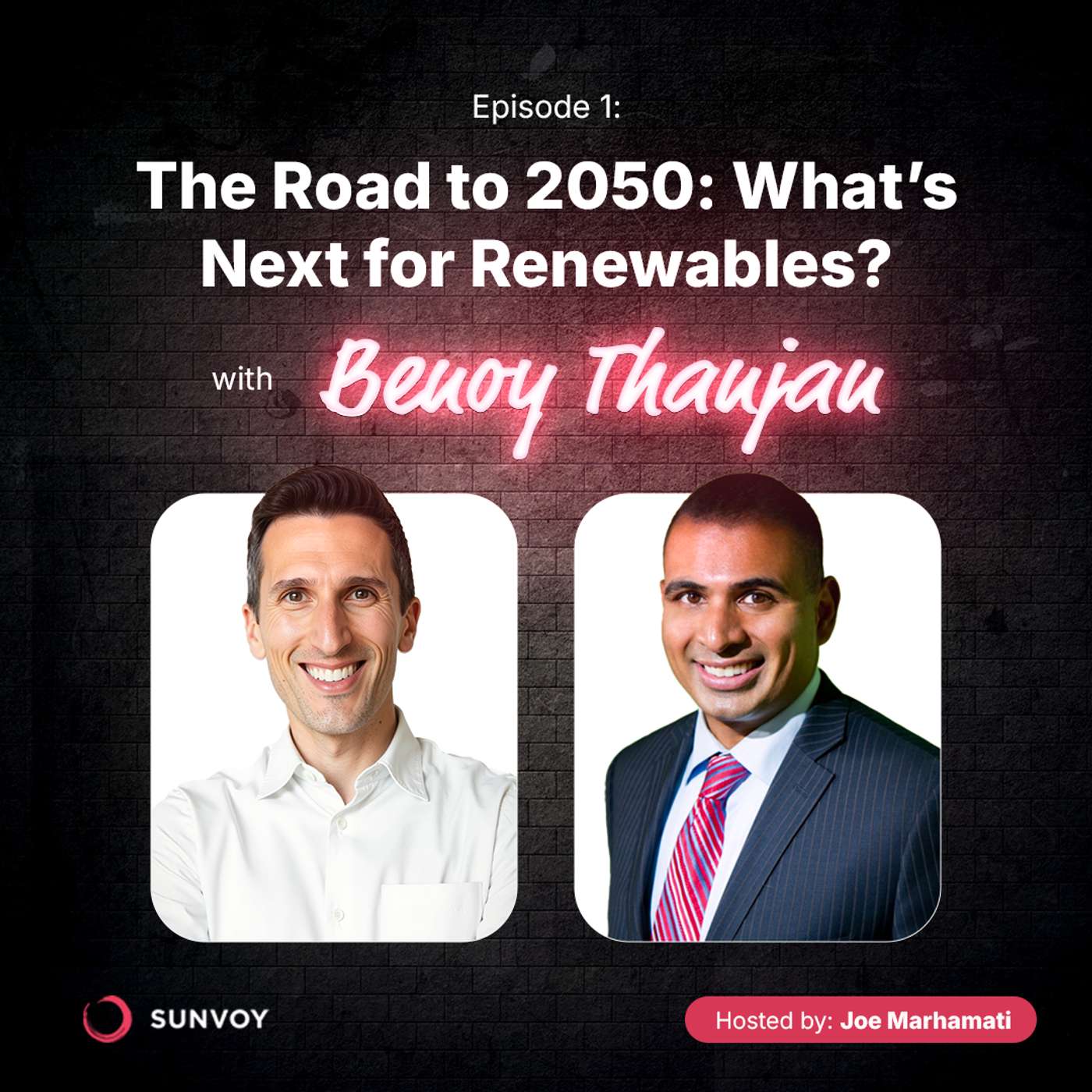
The Road to 2050: What’s Next for Renewables?
Sobre este episodio
Benoy Thanjan has been in solar for 20+ years, and in this episode, he sits down with Joe Marhamati to talk about everything from community solar to why interconnection is still such a pain. They dig into how project financing has changed, the underrated power of renewable energy credits, and what tariffs are doing to the industry. If you're into energy independence, battery tech, or how blockchain and vehicle-to-grid might change the game—this one's got it all.
Transcripción
Joe: I will say that our business is stronger than it has ever been.
Benoy: The success of growth and where I see companies growing consistently really is your people.
Joe: I mean, the story is not does it make power? Because they all make power. The story is what does it power?
Benoy: This is what solar installers need to know with your host Herve Billie and Joe Marhamati.
Speaker 3: Hi there. It's Herve and Joe Lourdes, Solar Installers Need to Know, where we interview solar CEOs and experts on how they run their business on the solar cluster. We ask their private revenue numbers. We give actionable advice and learn about trade secrets so you can run and grow your solar business. Joe and I built a solar company from 0 to 12,000,000 sales and got successfully acquired.
If you'd like to do the same or do better, go to sunvoy.com/blog to get actionable behind the scenes lessons on running and growing your solar business. And now without further ado, let's jump right into the next episode.
Joe: Hey, everybody. My name is Joe Marhamati. I'm one of the cofounders of Sunvoy, and I'm here on the What Solar Installers Need to Know podcast with Benoit Thanjin, CEO and founder of Renew Energy. They're developing 80 megawatts of solar projects, and he also is the host of the Solar Maverick podcast. Welcome, Benoit.
Benoy: Thanks, Joe, for having me on the podcast. It's really great to be here. And, you know, we had both you and Herve on the Solar Maverick podcast episode one sixty one, how Sunvoy software helps solar installers. I'm excited that, you guys are doing your own podcast, and I really appreciate you having me on the podcast today.
Joe: Yeah. Thanks for thanks for coming on. I know we met in person at IntraSolar a couple weeks ago, and we were just joking about how this is not your first rodeo, but it's actually my first rodeo in the sense that it's my first episode hosting the What Solar Installers Need to Know podcast, but that's okay. I've done a few other interviews. I mentioned I did college radio before, so I think this is gonna go great.
And I've got a list of questions very specific to your experience. And and the first one, I actually don't know if I know the answer to this even though we've talked so many times. Walk us through your journey into the solar industry. What first got you interested in solar?
Benoy: Yeah. Definitely. It's been a long journey to get to this point. I it's now amazing. I've been in the solar and energy industry for twenty years, and it's been most of my career has been in energy.
Primarily, I first actually was doing my MBA, and I worked at Deloitte and Touche as an intern. And then the partner in the energy group, worked for that summer. Then she ended up, giving me an offer after my summer internship was over. Then I started working at Deloitte and their energy financial advisory services practice. And that was an amazing experience, especially coming right out of school.
I was there for three years. She's actually now the head of the renewable energy group at Deloitte and Tush, which is interesting. And then I wanted to work on the, like, investment side or the what they call the buy side of private equity. So my background's in finance. I have an MBA and undergrad in finance, and then I worked at a at a private equity fund called Ridgewood Renewable Power, and they own basically renewable energy projects.
Not solar at the time. It was biomass, hydro, landfill gas. Predominantly in The US, they had some international assets. So I helped with potential investments, maximizing the existing portfolio. Then eventually, they decided to get out of the business and sell projects.
And, so I worked on the sale of all those projects. And then I was doing research and maybe it was like fourteen years ago, fifteen years ago. It's kinda crazy more than that. Oh my gosh. When I think about that and I was doing so much research and I was thinking that solar, this is like sixteen years ago, was gonna be a huge part of the energy transition going forward.
And I was telling everyone, hey, like solar is gonna be huge. This is like sixteen So go back to you. Like, oh, you don't know what you're talking about. I ended up, I was like, I have to get a job at a solar company. You know, I have renewables.
I have energy experience. I worked at an EPC, a contractor called Vanguard Energy Partners. They're a large commercial industrial utility scale installer based in Branchburg, New Jersey. I was doing project finance for them. We did some of the first, like, tax equity sort of structuring for projects in New New Jersey then got a lot of experience with SRECs.
So that's kind of how I got into the solar industry was really being in energy. I really wanted to do other. I was able to break into renewables because I'm passionate about renewables and sustainability, but I felt like the biggest impact could be, you know, in solar. And then after that, I worked at Tesla Solar City. I started their environmental commodities trading desk at project finance, then I started with new energy.
Now it's gonna be thirteen years, which is pretty amazing to see. And we obviously develop projects. We're also very involved in renewable energy credits. We brokered about 45,000,000, 50,000,000 in rec transactions. Transactions.
And then we do also owner rep related work. So helping building owners or large companies look at, you know, their existing facilities or land sites to do solar. Joe. But it's
Joe: it's funny you say sixteen years ago because the second you said sixteen years ago, I was thinking about where was I sixteen years ago? And I was actually starting my career in solar at the Department of Energy's loan programs office when they were financing all of the first utility scale solar projects over a 100 megawatts. And there were several that I got to go out to and and work with developers on in that sort of project finance shop within DOE that's still there. And, you know, one stood out to me was this Tonopah, a 110 megawatt solar concentrating project, thousands of billboard sized mirrors on a 600 foot tower, and, it was an amazing project to witness the development of. Was there a project in your career, earlier in your career, that really just blew you away where you thought this is gonna be the future?
We're gonna have hundreds or thousands of these all over the country and all over the world that inspired you to, you know, get into and develop renew energy.
Benoy: Yeah. Definitely. So the one that got me excited was, like, one of the first projects that I worked for at Vanguard Energy Partners. It was the Somerset County project, which was funded through a municipal bond financing and the 16 o three grant, which was during your time, which enabled that project to happen. And, obviously, the 16 o three grant led to a lot of construction of solar because of that.
And it was also owned by Citigroup, and they also did like a sort of a municipal bond financing based on the sort of county credit. And then it was, I think, eight, maybe 14 projects, and it was like 7.1 megawatts. At the time, it seemed like a really huge behind the meter project. And then we're able to aggregate, like, the different publicly owned facilities by Somerset County. And it was at the time, like, what the first of its kind and extremely complicated.
And that got me really excited. And and, it's amazing, obviously, to see, like, how big projects have gotten now. And 6.7 megawatts is not much these days, which is obviously exciting, you know.
Joe: So what gets you excited now? What what type of project are you working on or do you see coming down the pike that, you know, gets you excited today?
Benoy: So, I mean, we're doing a lot of community solar in New York and New Jersey. What gets me excited about community solar, It's an opportunity for people who don't have access to solar to be able to get a discount on their electricity bills. Also, like if folks kisses on low moderate income, which, you know, obviously major, you know, major expenses, people's electricity bill and they're able to save money and also be using renewables. We're actually doing the largest solar project in Manhattan with the New York Housing Authority on 12 different buildings for two housing developments in Harlem, which we're gonna start, construction in about, a month or two. And then it's an amazing project because it's all privately funded.
We partnered with the private equity fund that's gonna provide a lease payment to the New York Housing Authority to use a roof, then we're providing discounted low moderate income communities, discounted electricity with the off take for customers in Con Ed service territory. We also organized two job fairs with our partner one of our partners in this project's Kinetic Communities. And so we organized two like New York clean energy job fairs and was able to get eight, I think it's eight jobs for NYCHA residents, and a few of them were are hired by we're not the EPC for this project, but they were also hired to build the project that we're gonna build. And it's kind of the first of its kind that could be used in other housing authorities in other cities. So and it's so complicated of a project just obviously working with the many different city agencies and the incentives.
And then I don't know if people are familiar with New York, but they have, like, a tariff called Veeder, which is the value distributed energy resources. So, you know, it took a long time here for us to, you know, get an investor comfortable with this type of project. The mayor of New York City, mayor Adams put up press release about this project because, you know, he thinks it's a pretty cool project. So that's, you know, one of the one of the projects that we're currently working on that I'm really excited about. And it'll be the largest solar project in Manhattan.
So
Joe: Wow. Congratulations. That's really cool. Thank you. So I talked to a lot of rooftop installers who are doing behind the meter projects, and they might be considering community solar.
Maybe they get some opportunities here and there, but perhaps they're intimidated by it or they think that it's not within their skill set or their scope. So So if you're talking to a behind the meter rooftop installer that's used to doing self consumption owner occupied buildings, what advice would you give to them about the opportunities in the community solar space?
Benoy: Yeah. So I I think the community solar space actually offers a lot of opportunities. You know, obviously, not every building's owner occupied, the easiest thing to do is either they own the system directly or they do some sort of power purchase agreement, and it's obviously easy to show the savings. But I think community solar allows, like, non owner occupied or say if there's excess generation that maybe can't be used that they could potentially do a community solar project instead. So it creates opportunity because obviously there's a large a lot of large sort of rooftop owners who lease out their building to different types of customers.
And usually these customers are using, especially when you talk about commercial industrial, like a large amount of electricity. We're also seeing building tenants are requiring that their electricity be from renewable resources. So obviously, if you're able to market that, you know, that you have like rooftop solar or even like there could be some land around the property. I think it creates another opportunity. It's it's obviously a more complicated sale than owner occupied, but I think it creates more opportunity to sell more rooftop solar, which is the most important.
Joe: I love community solar because it's accessible to everybody. You know, the people who have shade on their roof, the people who live in apartments. I've actually encouraged and successfully convinced several family members who are very right wing, to go with community solar and and save 10% on their utility bill, because a lot of times now, you can opt out. You can opt out with no penalty. It's basically zero risk and pure savings.
And because anybody can do it, it's a great catalyst for growing solar, coast to coast. Whereas, obviously, in in rooftop solar, it's kind of roof by roof. You have to look at the shade profile, you know, and it's it's just more narrow. And so it sounds like you're gonna be working on community solar projects for many years. What percent of your portfolio do you think is gonna be community solar versus the big, big stuff?
Benoy: Yeah. So I would say, like, maybe 70 to 80% will be community solar, and then 20% is utility scale. Right now, actually, our, like, pipelines mostly New York community solar, not just obviously, we talked about the NYCHA rooftop opportunity, but we're doing a lot of land opportunities. So, like, five megawatts AC land, you know, community solar opportunities. And, yeah, you I mean, I think the great thing too, obviously, you did a great job, Joe, mentioning the benefits of community solar.
And it's also quicker to get these projects, like, permitted, and you don't have to go through, like, certain queue processes compared to utility scale. So you're able to get these projects to come online. And I think in the near future, hopefully, in the next next three to five years, all 50 states should have some sort of community solar program, which is exciting because I think it creates, obviously, like, an opportunity for people who don't have solar to have solar and get a five to 10% savings as you mentioned, but it also creates a lot of economic opportunity from it. Obviously, the development, the construction, the ongoing maintenance. Also, two, like we didn't talk about, it helps with the grid.
Grid and infrastructure is extremely old. Having community solar or any distributed energy projects save on, you know, the amount of upgrades that's required on the grid in the future and creates actually energy independence as well too. Obviously, the more solar that's online instead of getting it from a big power plant and transmission and distribution that allows, like, distributed energy.
Joe: Love that. Yeah. If we could get the community solar legislation enabling in every state, that would be amazing. I'm gonna crib a question from EnergySage because I was on an EnergySage podcast or interview an hour ago, and I'm gonna and I'm gonna ask it to you because it was a really good question. If you were king of the solar industry for a day, what would you do?
What one change would you make or policy? Wave of magic one. What would you change?
Benoy: Is this for The US or is it internationally?
Joe: Let's say let's say for The US. Okay.
Benoy: Well, that's a great question. Okay. I have, like, basically, like, national rules on interconnection.
Joe: That's what I said. We have the same answer. Alright. No. But you're you're on the other side because I've mostly done, obviously, behind the meters.
You're more a little bit more front of me or community solar. So what would change would you make in the interconnection side?
Benoy: So, you know, I don't know how familiar people are with this, but really like the developers paying for the interconnection upgrade for community solar project, which is actually not fair because it's creating a lot of benefits for the utility and others. So I believe, like, the utility should be subsidizing or paying a wage portion of it. But I know this is, like, a lot easier to say, but to actually get it done. But, I mean, they really should be actively looking at the benefits, and it shouldn't be all up to the developer. The great thing with the investment tax credit now is that it, you know, includes also the interconnection upgrade cost, But we we really do have to you can't put it all on the developer to and you yeah.
If you're able if the utility is able to subsidize a portion of that cost that will allow more proliferation of community solar.
Joe: That's a good answer. Okay. And and tell me, how has your perspective on solar project financing evolved over the last decade? Since you've been in this game for over fifteen years, how has your perspective on solar project financing changed?
Benoy: So to me, like, obviously, like, the inflation reduction act, having transferability instead of the complicated structuring of solar projects, like, obviously, that's really beneficial to streamline the transactions. I think, like, the financing community is always, like, behind on certain things. It takes them a while. Like, for example, like, merchant power, energy storage, and the different cash flow streams. Like, right now, it's extremely challenging to hedge unless you're in certain markets or if they have, like, long term, like, contracting, like, for example, the smart program in Massachusetts.
So, I mean, I think too, like, uncertainty as well, like, it's challenging times actually on a from a financing perspective because of their potential repeal of the tax credits, which I don't think is gonna happen. Also, a high interest rate environment. So it's creating, challenges and I believe, like, the financing community should I mean, this is all, like, basic sort of stuff and it's the ones who understand, like, the risk and who could, you know, we'll be able to finance more projects. But right now, it's extremely difficult. And then also development capital too, like getting early stage capital.
Obviously, like, I think things are simpler now than they were in the past. But, you know, the financing community usually wants other parties to do it and then they'll once they see other entities getting comfortable with that they're more likely to to follow suit. So it's interesting because my background's in finance, but now I pretty much do everything. But I do look at things, obviously, from a financial perspective.
Joe: And tell me a little bit more about the rec business because you mentioned that sort of in passing. I I didn't realize you were doing that kind of volume. I I normally think of Sol Systems, SREC Trade, Flight Exchange, some of the big national aggregators. You're doing that kind of volume on SRECs just within your business?
Benoy: Yeah. So, I mean, we started as a wreck broker and so this the when I say, like, the $40,000,000 in renewable energy credit transaction volume, that's over the thirteen years of business. I'm sure, like, the big companies as you talked about, I don't know how much volume flood exchanges are doing, you know, obviously more volume than us. You know, so my background actually is in racks. At Ridgewood Renewable Power, I actually managed racks as well on their behalf.
And so I have eighteen years of rack experience. I started, like, Solar Cities slash Teslas, you know, SREC or rack trading desk when they were moving to the East Coast markets. That's how we actually started renew energy as a rec broker and asset manager. So we actually manage about maybe 20 megawatts of projects where we're basically managing, like, the p g m gats account. We actually do customize research on the rec markets too, which initially we were just doing the, like, the Northeast Mid Atlantic, the compliance markets.
But now so I thought, like, you know, with some states obviously getting rid of wrecks, New Jersey moving more to, a fixed wreck program. You have Massachusetts with the the s wreck one two program, and now they moved to a feed in tariff that wrecks would actually slow down. But now, like, large corporations are looking to buy, you know, wrecks, like, lower value wrecks to basically meet their sort of 100% renewable energy goals. So we're now getting a lot of business. So that's kind of why I moved we did financing for a while, like, we're brokering financing, which we still do.
But then we're like, hey, we could we're helping developers with just financing and then they're asking us to do a lot of other things. And I'm like, why don't we just start developing our own projects? But now it's interesting too because now the wreck business is actually coming back and there's not a lot of people with that sort of knowledge. We're actually helping corporations both domestically and internationally coming up with the strategy of procuring and managing wrecks on their behalf. So I think it brings great perspective too just because I've seen the wreck markets over eighteen or nineteen years and been a lot involved in a lot of transactions.
And it's it's a great opportunity for corporates if they don't have enough on-site solar to meet their 100% sort of renewable energy portfolio standard to buy racks and then retire it. And I don't know how deep you wanna get into this construct this conversation, but greedy is a very popular, like in The US for standard, you know, a rec standard that makes corporates comfortable because a lot of corporates use like greedy racks. The other thing too I find interesting is corporates want the racks close to where their facilities or buildings are. So that kind of creates as well more of like an investment in that those areas too.
Joe: It's it's funny because I I spent a minute in the Obama White House and the Council on Environmental Quality and we were trying to encourage federal agencies to go a 100% renewable energy. And, of course, they all wanted to buy REX. And so I had a colleague there who thought that REX was equivalent to buying your way out of hell. And what I'm hearing you say is there's actually a direct line between some of these large entities trying to go a 100% net zero, by purchasing REX and the development of new projects and investment in new projects. You can draw a direct line between those two things.
Benoy: Yeah. Definitely. So that's a great thing that I think the corporates are doing because, that in incentivizes more development. And what we're seeing in is interesting is, like, rec prices, especially even the low value recs, are starting to go up in price. And as solar continues to get cheaper, you don't need the $200, you know, s rack.
Obviously, like that was a time when panels were $4.50 and water $3.75. Solar is a technology, not a fuel. So production obviously is gonna increase and the price is gonna go down. Like these lower value racks are now like a a great, like, cash flow stream to allow, like, development of projects in markets that maybe that didn't work, you know. So it's exciting actually to see that.
And then, you know, obviously, like, the current administration hasn't obviously, it's only been, like, two months, but it's really gonna be up to state level legislation and corporates to continue the demand for renewable energy. And I believe, like, we need so much electricity to come online that you're gonna need all renewable resources and all fossil fuel. I mean, it's interesting to see, like, how plants are not getting mothballed that they're keeping in operation. There's the 3 Mile Island Plant, which is a nuclear plant they're planning on reopening because there's not enough electricity generation in The US. And, obviously, solar is the easiest and fastest way to to put electricity onto the grid.
So I know that's a little bit of a tangent. But
Joe: Yeah. Well, speaking of the new administration, what do you think tariffs are gonna do to the current environment? Do you think we have enough domestic manufacturing to keep up with the pace, or do you think it's gonna have a demonstrable impact on development?
Benoy: So I think, like, the thing about tariffs and is it, you know, obviously forces us to look at domestically manufacturing and as part of the, you know, inflation reduction act, there was incentives for manufacturing with the effects tax credit. The interesting thing was, I don't know if you saw this jail, which blow my mind was like Sia came out with a press release three or four weeks ago saying that we're producing enough solar in The US that that we've exported, which is amazing to
Joe: me because
Benoy: I thought it was gonna take three to five years, not like two years, three years. I think at the end of the day, like, what we realized during COVID was so I'm a big free trade person, but during, like, some sort of, like, pandemic, you know, how challenging it was to get not just solar equipment, any sort of important supplies, medicine, and other things. So I think, like, I was very against the tariff, but now I think, like, it's amazing because we need these essential sort of manufacturing to be in The US. The other thing, it obviously creates jobs for American citizens and it can't be imported to other countries. So I think tariffs in a sense has forced the solar industry to become more creative.
Obviously, the inflation reduction act has created a lot of jobs in manufacturing in red states too. So that's what's great too. Obviously, people are talking about tax credit repealment, but really, like, lot of these incentives have created jobs in in red states.
Joe: Okay. I'm really gonna go off on a tangent now. I'm just humoring myself here because I'm so curious. I'm so curious how you've evolved on this subject. There's a quote I've been thinking about for the last several weeks.
I think it was JD Vance said that 300 cheap toasters is not worth one American job. What do you think about that today? Do do you agree with that? Or do you have more of a nuance view? Because it sounds like you've evolved on this.
Benoy: So I don't know. I don't think toasters is an essential industry.
Joe: And solar panels? But, yeah, but you're biased.
Benoy: I'm biased, but I'm obviously even though I'm a solar in the solar industry, I'm a finance person and capitalist. I had issues about, you know, the tariffs. But if another country puts a tariff on us, we should be putting, an equal tariff on their goods as well. And what that aligns is it starts creating manufacturing in The US. The other thing too is, like, technology is getting so advanced that a lot of it's done by, you know, robotics.
It's not as, like, physical as, like, maybe the nineteen forties, fifties, or sixties where, you know, it's very capital intensive. But to have these essential industries, like, for certain products, like, I think, like, cars, steel, you know, some, like, commodities, certain industries, like, I believe, like, we should try to onshore medical supplies, pharmaceutical products. Toasters, to me, you know, we could live without. Like, it's fine if we wanna buy it from other countries. I thought it was interesting, by the way, president Trump in the prior time he was president, he was putting, you know, tariffs on solar, but he was also putting tariffs on by washer and dryers in Asia, which I didn't understand, like, the strategy behind that.
So I believe, like, you know, not everything there should be tariffs. Like, other countries could produce it at a lot cheaper, but essential sort of things like cars, transportation, we're start I think Kia just announced, like, they're gonna invest in some, like, car, you know, in I think it was in George. I forget somewhere down south, They're gonna, like, build a huge, like, car manufacturing facility. Apple just recently said that they're gonna bring, you know, domestic manufacturing into The US, so it's not just gonna be totally outsourced. And, you know, like, I I know, like, COVID has been like five years away, but I do think that we're gonna have probably more pandemics, unfortunately, in the future.
And then more that could be deadly, deadlier than, you know, COVID. And so, you know, I believe, like, we should have a certain amount of stuff that we're manufacturing here than being totally dependent or food supply and other things. It's
Joe: a good answer. Yeah. It's difficult subject, but it's good to hear that. And I appreciate you referencing CS study because I I did notice that, and I thought that was really interesting, that they basically are saying that, you know, we're we're years ahead of schedule in terms of where we thought we'd be in domestic manufacturing. And I also was very skeptical at the time.
But, you know, I I walked the floor on the Dalton, Georgia facility that Q Cell built. And seeing that facility, it was inspiring, to see modules made by our compatriots here. And they're, I think, expanding that facility or plans to expand that facility and, obviously, facilities in Arizona and Florida, like you say, a lot of the red states. So I think we made a good bet and and good thing for it because we're gonna need it. I gotta ask, what do you think the solar industry isn't paying attention to right now, either in, in terms of untapped opportunities?
And and speaking to installers, again, like, you know, we're talking mostly to rooftop installers that are maybe doing fifty fifty resi commercial, but mostly self consumption projects. What should they be looking at in terms of untapped opportunities?
Benoy: So I I talked about this a little bit more a little bit before, and I feel like the also sentiment of our country has changed. Like, we really should be as solar pushing, like, you wanna be energy independent. Right? It's not just certain freedoms that are determined in the declaration of independence, the bill of rights, But you should be energy free, and you should own a solar and storage unit. You'll be independent from the grid.
And what we know is that they're gonna be more blackouts happening in the future. Obviously, if you couple it with an EV, it's gonna be a lot cheaper than having, you know, a gas consumption or combustible vehicle. So really, like, you could get to control because that's the one thing to talk about is energy independence, but then also the price of energy is going to go up exponentially. And it's we're already starting to see that obviously in capacity markets like in I know, Joe, you're pretty familiar with PJM and we're already starting to see that translate into residential customers bill. And, you know, for twenty years, we've been saying, oh, yeah, the rate is gonna increase by I mean, if you were is zero to 2%.
Obviously, there are some people putting, you know, these projections of twenty years of four three to 5%. But I think you're gonna start seeing, like, exponential increases, not exponent, but high percentage of increase. And really, like, installers, you have to get it into the customer's mind that it's not just about renewable resources. It's also about energy independence and controlling something that's gonna increase substantially with inflation. And you could basically hedge it once you have solar installed.
Obviously, all the energy that you're getting is, well, depending on how it's structured as a PPR if you own the facility. And I think with the way our country is going, like, if that resonates energy independence, and I don't think we talk about that enough in the industry.
Joe: It's it's funny. I've I've got a customer, a Sunvoy customer, very large one on the East Coast, the rooftop installer, and they actually will allocate their marketing dollars based on where utility rates are increasing. They will move them from one location to another. And I'll put a plug in for Genability. They actually track all these tariffs throughout the whole country, and they'll send you, I think, monthly or weekly reports as utility rates increase.
And I used to track that in my own solar business. I would see where utility rates were increasing across our installation territory, and those are the folks who would inevitably be reaching out when they had a $600 utility bill. So, yeah, I think that is a huge untapped opportunity for installers and developers to really look where there are markets of utility rates that are outpacing inflation, which if you look at the last few years, it was in most of the country, utility rates were outpacing inflation, which which is obviously helping the solar industry too.
Benoy: Yeah. Definitely. That obviously helps as so as, you know, energy continues to get more expensive that increases rates. That's a great that's smart, obviously, to follow where rates are going up the highest. And also maybe, like, coupling other resources like energy efficiency or bringing partners in.
Obviously, I talked about EVs as well. But, like, I think smart metering too as well. Like, I just feel like with Google Nest, like, now residential customers are more aware. People love as you might know even better than me, looking at their app, seeing like how much solar is generated on particular days and how much they're offsetting or savings. Maybe even get I've seen as well gamifying applications, you know?
I've seen startup companies doing that. I think, you know, more and more people are interested in that, but I think the real thing is energy independence. I've been through some major hurricane Sandy and some other events. I was actually just in Puerto Rico installing solar and storage for residential homes with a charity called Let's Share the Sun Foundation where they help install solar and storage for people who have, twenty four hour medical needs where they need electricity. And in that town, we lost electricity for most of the day.
And then Wow. After New Year's port most of Puerto Rico's grid went out for three or four days. So I know in The US, we've been like, you know, think it's oh, you just turn on the switch. But I think what people don't realize with the aging infrastructure, we're gonna see more blackouts, power outs. We also have the issue of cyber attacks, you know, where people are trying to take down our grid.
So obviously, you have localized energy, I'm actually surprised because part of the time I live in San Diego and I'm surprised like how many times we lose electricity. I'm like, wow, this is like a first rule country and city and we're losing power. Like maybe two or three times a month for like a few hours. And I'm like, to me, that's very surprising, especially, you know, in 2025, but everything's going to be smart, you know?
Joe: Yeah. It's funny when I used to sell solar several years ago and storage was just coming out. I would tell homeowners that it was zombie apocalypse insurance because as long as the sun rose in the morning and was powering that, that battery, they could run their home for indefinitely. And and there are people doing that now. Obviously, when storage first came out, it was more difficult, but now you've got Blackstar batteries.
You know, you can actually afford twenty, thirty, 40 kilowatt hours at your home, and and you see people going off grid, especially during the the summer months, sometimes for days or weeks at a time. And it's it's pretty impressive. It seems to me that in five, ten years, solar and storage could be almost as ubiquitous as HVAC. Like, it'll be strange to not have a battery next to your air conditioner because your neighbor will have one. Do you really think that that's where we're headed?
Benoy: I definitely think it's where it's headed. I mean, right now, like, we're seeing the same cost declines in lithium ion, batteries that we were seeing back in the solar. I mean, we're still seeing large drops. But, like, I think the past three years, lithium ion prices have gone down 40%, and I think you're gonna see even more dramatic decreases. I have the experience of installing a dyno power energy storage residential units that's based in China.
And, obviously, like, China has been very aggressive on developing lithium ion battery technology. B b y d is, like, you know, creating electric vehicles a lot cheaper than a Tesla. But, obviously, with the tariffs, it's, you know, it's more expensive. The other thing too is electric cars are gonna go down dramatically in prices because the battery is the most expensive part. And then I think the other thing too, in intersolar, I saw a lot of battery companies that were using other technology outside of lithium ion and more fail safe, you know, where you don't have to worry about fires as much as, you know so it's it's interesting.
It's still very early. I wouldn't be surprised in three to five years. I mean, I I was also at already plus in Hawaii as well in January and it was just interesting, especially like islands, like, they understand the issues with not having power and blackouts and obviously having a lot of sun. Like most of them, if you have a solar and storage system, you pretty and and obviously the sun is rising every day, you could basically be off grid. So I think, you know, most Americans and myself will will wanna be have an off grid solution.
I think most Americans understand that.
Joe: Yeah. Especially if you've got sun on that roof and with the cost coming down. And and with vehicle to grid technology becoming, hopefully, commercialized, always drift around the corner. I gotta ask you. How do you think BYD is making cars so cheap?
Is it just scale? Is there some government in there? Do you have a theory on this?
Benoy: I mean, there's a couple of things I have about this. So I I was actually reading I forgot where I was reading it this past week, but they have, so the real way of, like, reducing the cost of a lithium ion battery is like by the way, I learned this from a Tesla. It's like everything has to be in one location. Before it was expensive because you're doing all these different things and bring by the way, I'm not a scientist as that you said before of finance person. But, like, having everything in one space and then the those the plant, like, I don't know how many gigawatts those plants, the BYD plant.
There's one plant they they have in China that is, the biggest basically battery storage plant. Due to economies of scale. They're able to, you know, lower the lithium ion battery prices compared to the other thing. I think as well, like, the difference between The US and China. China looks at energy storage as a vital industry to have now in the future.
And obviously they've invested a lot of money into these companies as well to expedite the whole process. Obviously, you were part of the, time of when the department energy funded Tesla or maybe you weren't, but it was huge benefit to The US economy and is now, you know, that gave like, you know, so I think like as a country, like we should be nationally being more strategic and investing in, like, industries that we think are gonna be, you know, huge game changers in the future. And, I mean, the great thing about The US is our innovation, and we're constantly innovating faster than other countries even without the public sector. I mean, now as not actively involved, but that could change in the future too, you know, because like the growth effect too, like from having that and how, what it does for the economy is really hard to factor, you know. If you really think about it, like, we wouldn't be where we are in electric vehicles without Tesla.
And that happened through the the grant program. Well, the loan repayment program. And, obviously, he paid back or Elon Musk paid back the loan, but the economic opportunity that it created both for The US and internationally is substantial.
Joe: It's enormous. Yeah. And and, of course, there were a lot of unsung projects in the program too from utility scale solar projects that I think were one of the major catalysts of the current industry. You know, the manufacturing, cellulosic biofuels, the first new nuclear reactor in thirty years, geothermal, the list goes on and on. Of course, the ATVM program, which also invested in a lot of the technologies that are commercialized today.
So, kudos to the loan programs office, even if it's only online every four years. Some good people still there.
Benoy: Yeah. For sure. And, I mean, it's interesting because it becomes political. Right? Like, I forgot I can't believe I'm forgetting the panel manufacturer company that received a lot
Joe: of Solyndra.
Benoy: Solyndra, like, you know, you can't assume that every investment in early stage important technology, you know, it's, these are, you know, there's some, as you mentioned, there's some big hits that allowed, you know, the industry to get to where it is. So not everything's going to be perfect, but unfortunately, politically, you know, at a certain time, everyone was talking about Solyndra, which annoyed me, you know, to a
Joe: certain extent. Me too. I was was in the room when they announced that, and it was a sad day. But, fortunately, I think still 98% plus of the investments of the program are are doing well. Yeah.
I gotta ask you. Where do you think the industry and and renewables in general is gonna be in 2050? You know, there's a lot of these net zero promises that the the countries and and corporates are still sticking to. Where do you think the energy mix is gonna be in 2050?
Benoy: Yeah. I mean, that's twenty five years from now. It's interesting to me, like, right now, The US solar generation's only 5% of the total mix of energy. So I can't imagine in twenty five years, I think like solar is going to be the dominant form of energy. I think there's going to be obviously, they'll still be, you know, fossil fuels.
You module you talked about like modular nuclear. Some I think there could be like, obviously, you'll see a proliferation of micro grids. I think there's gonna be some technologies that we haven't even that we don't even know about, especially, you know, now that you it's amazing to me like how, like, AI is advancing so quickly. Like, even chat GBT every month or two is, like, getting more and more advanced, which I see, you know, because I use a lot of the AI tool. So, you know, I believe, like, solar is gonna be, like, the majority.
Solar and storage is gonna be the like, I would say it should be in 2050, like 60 to 70% of the total generation mixed with other sort of fuels. And then energy is gonna be smart. Right? You know, you're already starting to see the utilities look at time views, ways of like, you know, dispatching, you know, batteries and into the grid. I think it's just gonna be, I don't think we can imagine it.
I couldn't have, first of all, like if I look at like the seventeen years I've been in the industry, like I can't even imagine. Like where we are now. Like I have to really, you know what? I should spend time and think about this. Like when I first came into the industry, like solar was like, there was just a panel was like $400.04 40 per watt.
Sure. It's what, like just to give her, I mean, it kind of ranges. Let's say it's like 30 to 50¢ and just to see even storage, like how quickly it is. And if you look like if you fly over The U S and internationally, like most rooftops don't have solar. And that's like the target market.
Like every eventually every rooftop will have solar because it just makes I mean, it already makes too much sense. Right? Especially if you're behind the meter, it works in every state. Obviously, like their challenges related to roofing and roof replacement. And so basically you have to have, you know, solar with a relatively new roof or restoration.
But I think, you know, we'll figure that out, and I'm really excited. It's still obviously, if we have some younger listeners here, like, I'm really excited because it's still early in the energy transition with when it comes to renewables, specifically solar. And even though I've been in a a long time, like, could see that this is all gonna happen even more exponentially than I could even imagine in my mind, and especially when you get to twenty fifty.
Joe: It's funny. You know, every time I'm up high in some city and I look down on all these rooftops and I see 1% of the roofs have solar, it always blows my mind, especially when I'm in Arizona. I was in Arizona a couple years ago. I was at the top of a mountain. I was looking down on all these roofs, and I could barely see any solar projects.
There were some, obviously, but still the vast, vast, vast majority of them didn't have solar in a state with infinite sun. So do you think there's gonna be some tipping point? And what could that look like where if you're just an average business owner and you have one or two properties, maybe you've got a a mid or large sized roof and you don't know anything about solar, what's gonna be the thing that pushes that average person that's not aware of our industry to consider solar? Is it just gonna be sky high utility rates? Is it gonna be dirt cheap solar panels that now, you know, you're saying they're so cheap, they're actually using them as fencing and building materials in some parts of the world, which is mind blowing to me?
What's gonna what's gonna be the catalyst for everybody to put solar on their roof?
Benoy: Yeah. I mean, like, it's amazing to me, like, when we talk about ten or fifteen years ago talking about solar, most people had no idea, like, what you're talking about. But it's interesting to me that both the residential customers and commercial customers are a lot more educated about solar than before, but I think the real driver is going to be electricity pricing. And worst in the start of this whole thing of electricity pricing rising substantially, but wait till it keeps coming. Like people are going to adjust and, you know, they're going to educate themselves.
And there's so much knowledge out there now in the solar industry than ever before. I think the other exciting thing is like building products. Obviously we know, you know, windows and any pain and all these things will be have like, you know, solar panels in it. Obviously like it's still in the early stages of that, you know, technology. And, but I really think it's gonna be electricity prices are gonna force people because it's a large part of their expenses.
And then obviously solar is gonna continue to get cheaper. As I said, it's a technology, not a fuel. It's just gonna be, and then once you couple that with storage, like, that's like the game changer. Everyone's like, what do I do when it's dark outside? And you're like, oh, well, when storage becomes economical enough, which is not that far away, that's three to five years.
So I think you're gonna see, like, it's I think we can't even imagine. I I don't think I could imagine, like, how much growth is gonna be, like, once lithium once batteries become economical and you don't really need incentives and combining those two. Yeah. So sorry. This is like a long winded question, Joe.
Answer to your your question, Joe. But I really think, like, once people start seeing the exponential increases of electricity costs and it's sitting in their purse, they'll start being like, we can't keep doing this. You know?
Joe: Speaking of intermittency, when somebody asks you the intermittency question and says, you know, how how can you not just have solar move through a day or a week, but through seasons that, you know, solar's never gonna scale or it's gonna have a ceiling because the technology is just not able to account for the inner intermittency over long periods of time. How do you respond to that?
Benoy: You're talking about, like, basically when it's when there's no sun out or basically seasons like fall, win like winter production of the system and fall production of the system.
Joe: Exactly.
Benoy: So I mean, I think, like, really, like, as you said, solar panels are getting so cheap that actually, was reading an article today that in California, there's now excess. They're basically having negative electricity pricing because there's now an excess of solar panels. So at a certain point, like, I believe, like, everywhere, there's just gonna be all the it's better to actually oversize your system because the incremental cost of putting more solar is really very marginal. But then, you know, when you have these seasons where maybe it's cloudy and you're not getting enough production, that'll be able to cover that sort of inter sorry. Intermittency issue.
And then obviously, I feel like too people are gonna also as storage gets cheaper, they're probably gonna have more excess than they need because it's not as incremental as before or is it it's worth that energy independence. I also believe, like somehow there people are gonna incorporate other technologies and obviously you can always consult, consume, you could consume from the grid, but I also think there's gonna be a way of like communities, like through a micro grid, you know, where you could share, you know, any excess electricity with your neighbor, and there's some sort of, like, you know, payment system in the future.
Joe: The blockchain is coming. You think it's actually gonna be Alright. Yeah. I've been hearing about it for a long time. Has it coming?
Benoy: We've been talking about storage for, like, ten to twelve years. Storage is gonna be big. You know, filing, we're starting to see, like, know, and I think like the blockchain is obviously a great there's been some startups to do it, but I think eventually you'll see that. And as people get, you know, now, like, people don't really pay in cash anymore. Everyone's doing, like, virtual transactions that you're seeing, like, cryptocurrency, like Bitcoin being adopted by major financial institutions.
Even they, I think have like sort of a, like mutual fund or sorry, ETF where you can invest in Bitcoin. So I think in other countries, are more progressive on that because they have like issues with currency and, you know, it's not like the U S dollar, which is basically the main currency for trading. But when you're in, you know, countries that have hyperinflation, you have to diversify outside of your currency. So it's interesting to see in other countries how big like, you know, the blockchain or crypto or is absolutely.
Joe: Yeah. I can't wait for, for that technology to come through. Can't wait for vehicle to grid technology to come through.
Benoy: I've been Yeah. That's annoying.
Joe: For years. Do you think do you have an opinion on it? Because it seems like it's just it's like the nuclear fusion of the solar industry. It's like, oh, yeah.
Benoy: I think the technology's out there. I just think, obviously, like, the utilities are gonna be more hesitant to use it. And, you know, the you know, it's challenging because obviously you need, certain you know this probably better than me, like, just laws and regulations. And to get to explain to some of these agencies and, you know, maybe they're not incentivized, right, to do it. Right?
Because they're other thing too is like the modern utility to its day is gonna be totally different twenty five years in the future. And, you know, unfortunately, like a lot of utilities are holding into their what they've been successful or trying to, you know, slow down this sort of transition. And then also just educating people, like, just, like, when it's gonna happen. And right now, I still feel like we're kind of early, but there are a lot of exciting companies that are trying to create that technology have that technology, but it's not, like, mass used in mass, you know, or marketed well enough. You know?
So Absolutely.
Joe: No. I mean, I appreciate you saying that. And the the reason that I wanted to wanted to have you on the podcast and that I actually got through 10% of my questions, I could talk to you for hours, is I was a solar installer that was intimidated by developing large projects, by getting deep into community solar and utility scale projects. And so part of what I wanted to do today that I think that we accomplished is to demystify developing large frontometer projects, which you've done so well. So I I really appreciate you being here today.
And where can people find you?
Benoy: Yeah. Definitely. I appreciate the time, Joe. So you could find me on LinkedIn. It's Benoit Banshin on LinkedIn.
The company is renew energy. We're gonna we're actually in the process of updating our website. It's reneuenergy.com. And I have a weekly solar podcast called the solar maverick podcast, which is one the most popular podcast in solar. We have a 103 episodes that we've released.
We come out every week and we talk to major leaders in the solar sector and hear what they're doing. You know, we have the pleasure on episode one sixty one to have Joe and Herve on the podcast to talk about Sunvoy. So, you know, it's actually a very interesting conversation. I got a lot of great feedback from that, so I appreciate you making the time and like these platforms that we're creating and communicating. Like now I've done 203 podcasts.
It's amazing how how it's helped people in the industry or come into the industry. And I I appreciate, you know, the work that you're doing with Sunvoy, but then also educating the community as well, Joe. So thank you for your time today.
Joe: Likewise, Benoit. Thank you for being here, and I'm I'm really excited to share this with our solar community. And now I can say this isn't my first rodeo because it's done.
Benoy: And maybe actually, I'll I'll I'll, of course, as well play this podcast on the Solar Maverick podcast and I you know, because I think this is great content. Like, this was a great conversation, and we need more of these great conversation, Joe. So I'm excited to hear more of your podcast as you go forward, and and good luck on the journey.
Joe: Oh, I appreciate that, Benoit. That's very kind of you. I I appreciate you taking the time out here today, and I I hope that when we get a 100 under our belt, you'll come back on.
Benoy: For sure. Anytime. I'm always happy if you need me to come on. So, yeah, definitely. I appreciate the opportunity and your time today.
Joe: Thanks, Panoy. And thanks everybody for listening. We'll see you next time here on the What Solar Installers Need to Know podcast brought to you by Sunvoy.
Speaker 3: If you'd like to do the same or do better, go to sunvoy.com/blog and get actionable behind the scenes lessons on running and growing your solar business.