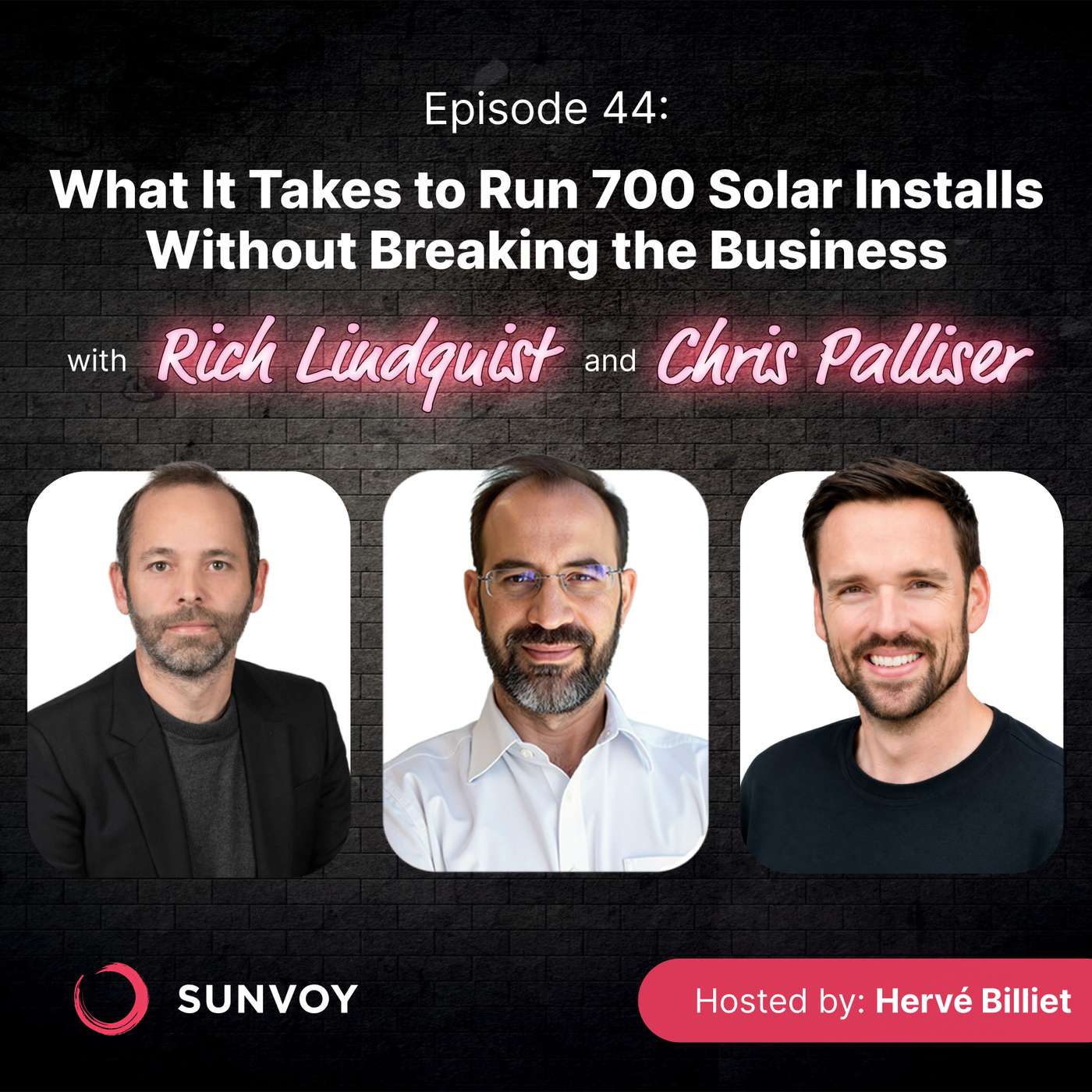
Ver todos los episodiosEP 44
What It Takes to Run 700 Solar Installs Without Breaking the Business
Sobre este episodio
Shift Energy Group is trying to do something hard: grow across Canada without losing the local trust that makes solar work. In this episode, Hervé talks with Rich Lindquist and Chris Palliser about how Shift scaled from a small team to one of British Columbia’s largest solar installers, doing hundreds of installs a year across multiple provinces. They get into operations, local market challenges, community marketing, customer feedback, batteries, brand trust, and Shift’s bet on building-integrated solar through Adra. It’s a great look at what it takes to scale a solar company without becoming just another faceless national installer.
Transcripción
Hervé Billiet (00:01.94)
Hey everyone, welcome to another episode of What Solar Installers Need to Know. Today we have two guests from one of Canada's largest solar installers in British Columbia, Shift Energy Group. Rich Lindquist is VP of Operations, a master electrician, economist, and former business partner who keeps the whole machine running. And then we have Chris Palliser, is Shift's Community Manager and host of The Solar PVcast. Gentlemen, welcome to the show.
Chris Palliser (00:30.222)
Thanks for having us, sir.
Rich Lindquist (00:30.675)
Thanks, Hervé. Thanks for having us.
Hervé Billiet (00:33.724)
All right, so before we get started, why don't you explain a little bit and introduce Shift. Give us a few key numbers so that we all understand better what Shift is doing and who you serve?
Rich Lindquist (00:47.703)
Yeah, so we've been doing solar installations since about 2017. You know, that's changed over the years how we've gone from, you know, a few installations a year to last year's about 700. It's mostly residential, probably an 80-20 split at this point. You know, that goes up and down depending on the years.
Revenue-wise, we're between 15 and 20 million a year. We work in four provinces at the moment. We've got an office in Victoria, BC as our head office, office in Vancouver, and we've got offices on the East Coast as well. So we've seen a significant growth over the last few years, but as most people in the solar industry know, it's ever-changing. So we're adapting as we go.
And then we've seen our headcount in terms of employees. We've gone from three or four in the beginning to upwards of over 100. Right now we're at about 60 to 70 employees. And again, that changes sometimes as we go through various seasons or projects, that kind of thing. That's where we stand right now.
Hervé Billiet (02:05.832)
Well, let's start a conversation at beginning of the time then. How did you get started and what have you learned about growing a business?
Rich Lindquist (02:16.055)
Well, I came in early days with Solar to Shift. Shift was actually in the business of doing commercial lighting retrofits, is where it originally started. And my electrical background was where we combined forces to do a lot of the work in-house. We're a turnkey, you know, design installer. We do all the work ourselves. We don't subcontract.
the solar work or the energy storage. So that started around 2017 where we brought everything internal and then from there, you know, growing through doing work in the fields, growing the teams, growing the crews, growing the locations. You know, my work has been involved heavily in operations and growing our workflow and our processes to adapt to that growth. We've tried to match our
operational growth with our pipeline of opportunities as that expands and contracts. It's always a challenge, but that's something that we've found out along the way. The solar in Canada, I would say, is behind a lot of other countries in the world. A lot of the processes aren't fully developed. lot of the electrical authorities aren't fully up to speed with the latest product or code or items that
There's always differences in that respect and we run into a lot of that. We've helped improve that, I think, along the way, working closely with those jurisdictions. But it still remains a challenge for us with the equipment and the products. They're always evolving, so we have to adapt to that as well as we go.
Hervé Billiet (04:04.912)
Are a lot of the U.S.-made products or international products all compatible with the Canadian market?
Rich Lindquist (04:11.47)
Most of them, right. I think some of the big differences when you look at commercial, the building voltages are different. So there's some 480-volt equipment that may be common elsewhere is not, we have building voltages for commercial that are 208 or 600 volts, whereas other jurisdictions, other countries don't have that same aspect. And Canada being relatively small on the solar scale.
We don't get a lot of, I would say, custom equipment for our installations. We take whatever we can get. The residential side is pretty standard in terms of North American use for inverters. So that part of it is okay, but we do have challenges sometimes with what's available, what we can install, what's approved. The Canadian certifications are actually a little bit different than...
the US. there's sometimes you run into that as well, just given Canada on a whole is small compared to the rest of the world for solar and storage.
Hervé Billiet (05:17.2)
Interesting. What about all the racking and like the other products besides electrical? Is that any problem?
Rich Lindquist (05:25.348)
not necessarily. I mean, we've, we've tried a few different vendors, you know, and in terms of racking over the years, it's something that we, you know, at this point, it's hard for us to change. We've in our processes, we've built in with procurement and sales and installation and, again, trying to streamline things. we have made, I think maybe two years ago was our last sort of major change with, with racking.
We actually use a company that is for the most part made in Canada for a lot of their equipment. And that helps us support somebody within and also helps keep our workflow steady. We have tried some international suppliers for racking and we've seen challenges with that. A lot of our decisions on racking are around warranty and engineering based on our
guarantees that we provide our customers. That's not something that we're, you know, we're not constantly changing it. We're trying to improve our process. We're trying to stick with a system that's simple like most installers. And we've found success with the ones that we use currently.
Hervé Billiet (06:42.452)
All right, well, you just spoke about systems. Let me ask you a question about systems, because you're operating across Canada, multiple offices, multiple time zones. How do you keep everything aligned? And do you have some specific offices that still have a lot of flexibility to cater to that local market? Like, how do you keep a coherent business going?
Rich Lindquist (07:05.464)
Well, you know, I guess it starts with our sales cycle where we have, you know, the sales team where they're selling, you know, they're in those local markets. So they have access to, you know, do they need to go and do a client site visit? Do they need to talk to that person on the phone? They're, I guess, the start. The package that they provide is, I would say, for the most part, national.
You know, when we're selling a particular module or inverter or racking, that's something that's fairly consistent. You know, when we talk about residential, that from there, as they develop the projects, you know, we've shifted our model a few times over the years. We were generally centrally based in BC when we started and we've
adapted to have local representation in operations in the markets that we install. We found with time zones and customer inquiries and all the things, it's been easier to have local support. That's really, I think, helped us in trying to keep that local image. As much as we're a larger solar installer, we're not a huge company.
but we do have, you know, compared with some of the other installers that maybe have, you know, under 10 staff, we're perceived as a large company, but we really don't run a large operation in those markets. We run our own install crews, we have, you know, an operations project support, and we have sales support in those markets.
Hervé Billiet (08:56.404)
being local. Chris, I have a question for you. your title is being community manager. So that's not a very common title that I see around other solar companies. And so can you explain us what that title means, what it does, and what's the link with being local?
Chris Palliser (09:13.484)
Yeah, for sure. I think. Sorry, you got me there? Yeah. Yeah, for sure. I think that's one of the strengths of Shift is we're trying to be local across the country. And I think Colyn and Rich and I mean, my position is kind of a unique one is kind of you just highlighted. I came from broadcasting and I got on this I got on the solar train with Shift by a conversation with Colyn and a conversation with Rich and it was essentially
you seem like you're good at engaging with people you should just come and work for Shift we don't know what that is yet but come in come and work for us so my role has been evolving from day one which has been awesome for sure there's some days where you're like am i doing the right thing but yeah it's good and and it all stems from being local i think Rich and Colyn wanted to have someone that could introduce solar and introduce Shift to people online and offline so
Community manager, you know, when we were going through titles, it started as something else and it's kind of evolved to community manager and I'm sure it's going to evolve again because I'm kind of the yes man I can help. So it's I've been very fortunate to dabble in a lot of the workings of Shift and it's been exciting but having somebody that can represent the company on a national stage, if you will, and also on a local stage, maybe it's at in school education at a local elementary school.
or maybe at an Earth Day event or maybe at a music festival where we're providing LED lights for the outhouses. You know, and we've got our branded solar trailer sitting at the event or whatever it is. So it's, it's, it's been a lot of fun to kind of get out and because as Rich touched on solar is in its infancy in Canada, and there's so much opportunity to be the place where people learn things. And I think that's where I personally come from and Shift as well. It's,
an opportunity because when they learn from you, they promote you. So because there is this opportunity for education, we want to make sure that Shift is at the forefront of all of it. It's kind of a recall mentality when someone is, you know, I heard about solar. you know, I saw that company Shift. I saw them at this event or I saw them online. And of course, with marketing, it's all about touch points. So
Chris Palliser (11:32.61)
Part of my role is to just create as many touch points with our brand as we possibly can in our local markets in the regions that we serve across the country. So Atlantic Canada Solar Summit, know, one year and then it's back over to Vancouver for everything electric. We're just trying to make sure that we are creating those touch points. So maybe they see the Shift van drive by, then they see us at an Earth Day event, and then they see a digital ad.
And so it just builds that trust. And that's part of our goal is to be the most trusted solar installer across the country. And there's ups and downs that go with it. As Rich touched on, know Colyn doesn't love this term, but solar coaster is a thing. And I'm excited to see it stand on its own feet now on the residential side that we've kind of been limited with incentives. So I think it's a really cool place. Yes, there's been ups and downs.
but I think we're positioning ourselves well to help transition as many people as we can in Canada to solar.
Hervé Billiet (12:38.092)
And you also have a podcast, so The Solar PVcast. So tell us more about that. Like, do you think other sort of companies should do the same? And I guess have competing podcasts, but tell us like, was the, how difficult is it to run a podcast? What's the goal and what is the podcast?
Chris Palliser (12:40.908)
Yeah.
Chris Palliser (12:56.244)
Yeah, for sure. The Solar PVcast. Thanks for the shout out. Again, it comes back to education and in terms of competition, bring it all day because I think the more people talking about solar, whether that's on a podcast, whether that's solar installers, we love that because if I see solar panels on someone's house, whether we did it or not, that's a win for the industry and it gives us an opportunity to install on their neighbor's house.
So it gets more and more people talking about solar and that's what we all want in this industry. So 100%, I would love to see more podcasts and I'm confident that The Solar PVcast will do well. It's just a labor of love. When I started, I came from radio and the first thing I said to Colyn and Rich when I started was, okay, we should have a podcast. Can I start a podcast?
priced it out, found my platform and just started The Solar PVcast. And I think it was like day four when I called Rich and Colyn into a meeting, having no idea that they're trying to grow this massive solar company like, Hey guys, I just want to corner you here for a second to get a, your idea on a name. And, so The Solar PVcast is what I came up with and it's been a lot of fun. And I would imagine it's the same reason you have a lot of fun doing this podcast because I get to have some incredible conversations with
incredible minds in the world of solar could be Dan Balaban, the head of the Traverse Solar Project in Alberta, Canada's largest solar farm, or it could be Steve Arnold, a guy who runs a solar pedal bike cab company in Halifax, Nova Scotia. I've had some wonderful conversations with people from the David Suzuki Foundation, a gentleman who lives in Nunavut, because and he's the first house in Nunavut to get solar panels and they're vertical.
on the side of his house because obviously the sun is so low. So it's been a lot of fun. It continues to be a lot of fun. And so I think it's great that you've got this podcast going. We've got The Solar PVcast. We just want people to be talking about solar. And that's how we're going to move this industry forward.
Hervé Billiet (15:06.548)
And Chris right before the recording started you talked to me about like your different pillars So a few years ago you had a rebranding and can you explain about what those pillars mean?
Chris Palliser (15:19.864)
For sure. Yeah, I mean, 2025 was a huge year for Shift in terms of growth, we learned a lot. And part of that growth was revamping our, our brand, refreshing our brand, no major changes. And, and a new website. So it was, I was very fortunate to be a part of the team that was kind of taking that challenge on and to sit in the conversations, the first initial conversations in the workshops about what is Shift.
What is the personality of Shift? How do you want people to see Shift? How do you want to position position yourself in the market against competitors? And, and it was a lot of fun and out of it became, we came up with these four pillars, and it's accountability without exception, sustainability with purpose, education without barriers, we're not gatekeepers of knowledge. Again, we want everyone to know everything when they go on this solar adventure. And then people above everything.
Because at the heart of Shift and at the heart of solar, just like every other business is people, we're just people that have a passion for harnessing the sun and we want to, we want to help as many people as we can. So those are four pillars that I feel aligned with me personally as well, which is also why I enjoy my day job at Shift. And, and it's just, it's all working towards that goal of being the most trusted solar installer in Canada. And, and in our industry, there's a lot of.
You know, unfortunately, whenever there's a boom in any industry, you're going to get companies that hop on that bandwagon and ride those coattails and just go for the sales, sales, sales, and Shift is always something I've admired about Shift is it's always tried to take the high road and, and accountability without exception. We're human. There's going to be screw ups here and there. We're just out here doing our best. And so those are kind of the four pillars we landed on, which I'm really proud of that Shift stands by and
Hervé Billiet (17:12.466)
And what you do with those pillars is that besides being on your website, like is that something that lives in the company gets rephrased and reused in different departments or?
Chris Palliser (17:17.238)
Yeah, for sure.
Chris Palliser (17:21.998)
Yeah, for sure. There's an inter Yeah, there's an internal newsletter that goes out again, culture, culture is something that we're really trying to solidify because, you know, again, in this changing industry, there's your ups and downs and culture is always at the forefront of, of our mind here at Shift. And so we have a weekly newsletter that goes out. And so it talks about the pillars, obviously in their company communications, the pillars are mentioned in their
They're kind of just something to remind us all and keep us all on track that we're making sure we're heading in the right direction. I have a sheet in my office and it, and every time I'm doing something, I'm looking into something, whether it's digital ads, creating ads, speaking engagements, or saying yes or no, you know, sometimes in marketing, it feels like you're throwing a bunch at the wall and you're hoping it sticks. And we're all out there trying to do the best we can, make sure it's, you know, our spend and our ROI and this, that and the other.
Something that I look at constantly is, does this make solar simple? Does this educate Canadians on the positive impact of solar to their lives? Does this build trust, support sales? Does it save time? And does it create a future where solar is the natural choice? And that's kind of our tagline at Shift and something we carved out last year. At the end of the day, energy is going to be scarce in the future. It is. We take it for granted...
We take advantage of it right now, you you plug your phone into the wall and it charges. That's fine. I don't have to think about it. But the way we're going in this world, energy is not always going to be like that. And so we want to at the end of the day, the vision is make solar the natural choice, whether you want an ROI, we can talk about that. Whether you want to focus on the environment, we can talk about that. Whether you love the tech, we can talk about that.
whether you want to lock in your cost of energy for the next 25 years in these wildly unstable times, we can talk about that. Those are kind of, it's all folded into the fabric that is Shift and something we use to make our decisions, at least in my opinion, in my thought, in all our decisions, whether it's Rich in operations, Colyn, you know, with the business direction, all of it, we try to weave it into the fabric wherever we can.
Hervé Billiet (19:42.366)
we record these a few weeks after the war in Iran started. You guys already see kind of a shift, pun intended, from being solar, what you mentioned, to fight climate change, which some people could say is a nice to have. mean, in the end, we only have one planet, so I don't think it's just a nice to have, but it's perceived as like a nice to have. You see a shift to a more like essential, like I want to have energy. You guys already feel that shift in the market or not?
Rich Lindquist (19:52.83)
I think there's been, you know, not necessarily in the last month or so, but building over the last maybe year, year and a half. I'd say we started to see that.
more in 2025, pairing batteries with solar installations, a higher percentage of clients wanting that compared to years past. It's still very different than say the US or some other countries in the payback and the ROI when you're looking at time-of-use billing and that kind of thing. You have to really want it in Canada. It's not cheap and the payoff takes a while. There is a few incentives, whether they're provincial.
They're not federal programs at this point. So that does help a little bit, but we have seen, there's definitely more people asking that the narrative has changed in terms of what systems people will be willing to entertain in terms of the theme brand or what they're looking at. That's something that has definitely shifted. And it used to be what we've heard of Tesla give us that.
You know, now it's, it's, we have the opportunity to share with, well, you know what? There is Tesla, but there's these other best in class systems that you've probably never heard of, but here's the tech and here's how it works. And there's a lot more acceptance to that. So that's probably a part of that shift in mindset in terms of what's available where we live specifically in BC. Most of the power is, is hydro power. You know, so it's relatively stable compared to some places and countries.
Hervé Billiet (21:39.156)
Hmm.
Rich Lindquist (21:44.944)
But I think even that, you know, with climate change, even this past winter that basically just ended Vancouver, BC, I think they went, they track snowfall at the airport in Vancouver airport and they went this winter without significant snowfall. They essentially counted it as the first winter in 43 years without snow. You know, there's snow in the mountains, but within the city.
And, so looking at that, affects snowpack, that affects water runoff, you that does have that is on people's minds, you know, whether it ultimately makes a difference to charging their phone at the end of the day. It's still something it's part of the conversation now, for sure.
Chris Palliser (22:26.668)
I think it's been really interesting, actually, you know, with the state of global affairs, thanks to south of the border there from us here in Canada. It's been interesting and how it's played a role in our business, because obviously, when everything is unstable, and you don't know what is gonna have you're gonna wake up to on the news headlines, people maybe hold their money a little closer and to Rich's point.
solar is still this kind of in the early, you know, we're moving past the early adopters in the in the curve. But people are like, they still see it as a want, oh, this is really cool. I want to do this. And so all of a sudden, the wants people pull back on those when when there's a lot of uncertainty in the world. But then there's the other side. Wow, there's uncertainty and the sun doesn't have to go through any sort of straight around the world to get to my house. It can
Hervé Billiet (22:58.877)
yeah.
Hervé Billiet (23:18.932)
Can't this one.
Chris Palliser (23:21.088)
it can just come straight to my house. I don't have to worry about that. So there's this stability that solar offers as as you know, and a lot of people are aware there's this stability that is also now coming to fruition. It's kind of this idea that I'm not going to do that. wait, actually, no, I need stability. I had a conversation with a client two days ago drives an EV. And she said, I'm so thankful.
going into retirement, this is sometimes people are going into retirement, I'm going to sell my house. It's not for me. And she's like, I'm so thankful going into retirement, that I now know the cost of my energy for the next 25 years and the cost of my fuel for my EV. Because if you know, once you put the panels on, as you know, the fuel is free if you have an EV. So it's kind of been the world's trying to figure out and in Canada here, we're trying to figure out where solar is going to land.
And that's why I'm okay that there's no federal incentives right now because we're figuring that out. Where does solar stand? And that's going to help us all make these business decisions and marketing decisions. We're not kind of, we lost the incentives. What do we do now? Okay, we know where solar sits. We know what's going on in the world. We know it provides stability. Whatever the reason is, we can kind of market to that.
Hervé Billiet (24:37.332)
Yeah, think as I think geopolitically now a lot of countries would have to make a decision either they go install more solar and be wind and solar to be local, or they start buying coal and burning coal again. Hopefully they don't go to that option. But yeah, I think those decisions are probably happening right now in a lot of countries that
Chris Palliser (24:51.418)
Yeah, I gonna say.
Chris Palliser (24:58.06)
Yeah. And it's and it's, it's, it's long term decision. It's so hard to make long term decisions right now when you wake up again to a different news headline every day. But solar is one that you can, you know, make a pretty safe long term bet. And, and I always get on my high horse about stop talking about ROI, because in my mind, it's the marketing the oil companies that are
Rich Lindquist (25:10.231)
Okay.
Chris Palliser (25:25.976)
forcing us to prove that solar works. Well, let's prove it to you. Here's a good ROI. This is the proof. This is the proof. So I'm always like, it just works. Why do we have to prove anything to you? It's a way to generate energy. Next. But that's another podcast episode.
Hervé Billiet (25:45.106)
Yeah, well on that episode you can speak about marketing and one of the best marketing I think ever is from a gas company because when you talk to somebody that you're to replace your gas furnace with like an induction oven, electrical, inevitably people say like, I like my gas because the best chefs cook on gas. like, you know that is really a marketing campaign from India?
Rich Lindquist (26:07.989)
That's the plan, yep.
Hervé Billiet (26:11.988)
70s or 60s and people still talking about it. So can you imagine Chris that you would make a marketing campaign for Shift today and What like 50 years later people will still talk about your marketing and they don't even know it's a marketing campaign. It's that's incredible The plan
Chris Palliser (26:28.11)
I'm working on it. I'm working on it. Yeah. Yeah, no, market marketing is everything. And that's, that's the perception that I'm out there and the Shift team every day, our installers even like all these great opportunities to have a conversation. And we've got some of the best installers in the country. I see all our Google reviews when they come in and for sure installation team was great is a huge part of it. And that's Rich's team and
And we take pride in that and it's always, it's always top-notch service, which is great. but yeah, it's, it's, it's a lot of fun trying to market solar. Yeah. I don't remember where I was going to go there. had a fun point, but it's gone now, but, yeah, there's a lot of challenges with it. There's a lot of challenges with it and it's, it's a lot of fun for sure.
Hervé Billiet (27:13.46)
You will see in a minute.
Hervé Billiet (27:19.742)
lot of fun, but also a lot of stress. So this is stressful world to be living in in general, but also running a solar company. remember my CEO always we went through a few because it's such a stressful job to be running a solar company and so Rich. You're one of the chillest people that I know. So how do you do it? How do you do to stay so relaxed when
Rich Lindquist (27:35.955)
Okay.
Chris Palliser (27:39.854)
Yeah, yeah, yeah.
Chris Palliser (27:47.222)
I'm listening here, Rich.
Hervé Billiet (27:47.413)
I'm sure there are fires happening at any moment. So when we work together, when I call you, you give attention to you in the present, in the moment here. And I'm sure there's fires going on, maybe Shift is that good that everything runs smoothly, perfectly fine. But so how are you able to keep so calm in a very stressful situation?
Rich Lindquist (28:12.004)
Well, mean, it's, know, like Chris has alluded to, it's always evolving. I think we've been in the space long enough to know that. And I mean, like a lot of things, perfection is very difficult. Making everybody happy all of the time is next to impossible. You know, that's the goal. But you're going to run into.
things along the way that whether that's from a particular install, whether that's from a particular crew member, whether that's for a particular, you know, maybe a shipment didn't show up when it was supposed to show up. Maybe you've got a client who's changed the goalposts on you. You know, there's all kinds of reasons that things come at you and change. I think what we've, and Chris has actually been a big part of this as well, in our feedback loop from clients, you know,
trying to put yourself in their shoes in their instance, you know, like if that was me, what's going to be the best outcome? You know, are they trying to, you know, is there a problem on site that, you know, we've got to deal with right away? Is it a problem that, you know, we need to look at across the board and build into our process? It's something that, you know, the level of, you know, I guess living in
within the fire and being reactive all the time, you the level of that, it changes, you know, it ebbs and flows. And we see if we go into a new marketplace, we obviously run into new challenges and we try to mitigate those along the way. If we run into a new, you know, we might put a new product line in place. And then all of a sudden there's a recall or there's something going on that we have to deal with. You know, we deal with a lot of that. It's no different than any other solar company. I think just the
ability to respond quickly to client concerns, you know, trying to make best of the situation and resolve and put them in a place where we, you know, ultimately we do get a review that hopefully is five stars. But that's something that it's always involving. Obviously there's a lot of team members within Shift that have a lot of experience in the space, you know, whether that's in our
Rich Lindquist (30:33.818)
Commercial jobs, our field execution, some of our off-grid work that we do, there's a lot of that. Our design team, they've got a lot of team members that know how to adapt to a situation if what we thought was going to be the case. And then we go and do a site survey and something's completely wildly different than we had expected, making those adaptations on the fly.
and working through with the client to come up with a resolution that works. It's challenging. There's a lot of day-to-day points that need to be addressed, but you go through the motions, you get them done, and you move on to the next. think we've always prided ourselves on delivering to the end. You contract with Shift as the client, we'll get that done for you. It is construction. There could be speed bumps along the way.
But at the end of the day, you're going to get the system that you contracted. It's going to work. And we're going to stand behind our warranties and our guarantees. At the end of the day, like any other service company, we have to stand on that. There's lots of... It's the same in the US and other countries. There's lots of industry players that will say they do that and then don't. Lots of people have bad experiences with contractors and we don't want to be that. We want to make sure that we're...
We're looking after the client at the end of the day. So that's always in the back of our minds. We try to instill that in staff to ensure that we're heading that direction with everybody. And at the end of the day, getting more five-star reviews than zero-star reviews.
Chris Palliser (32:13.39)
Yeah, think transparency is everything I think being vulnerable and transparent. The moment somebody realizes you're just another human. Everything just calms down. I'm not going to sit here and say we nail it every time I see the reviews and sometimes we don't nail it. Sometimes it's not us. Sometimes it's us. But at the end of the day, we're just humans and we're trying to do the best we can. And I think we've got a good group of humans on our team.
Hervé Billiet (32:15.697)
Yeah, and and
Chris Palliser (32:43.116)
And they're all just trying to do the best that they can. so I think that's if there's a secret, that's maybe it that we're just trying to do the best that we can each day.
Rich Lindquist (32:46.657)
Yeah, definitely.
Rich Lindquist (32:53.76)
Yeah, I think, you know, as we've grown over the years, putting technology to work for us, putting systems in place, I mean, you know, bringing on platforms that help in that process, provide a better client experience or provide a, you know, a more streamlined experience for our staff. That's a part of the equation for sure. You know, you can't go from a couple of people to, you know, a hundred employees and not adapt and change that along.
that's very important. We're going to lean into that more in the coming this year as well because there is no other way to stay on task and keep handle of all these things. That's a big part of it as well.
Hervé Billiet (33:34.005)
And then I have one piece of good news for you guys. So you use the Sunvoy user Shift app and which you ask to have when a homeowner gives you the NPS score tells you if they are happy or not to give also like the reasons why. That's now. Yep.
Chris Palliser (33:50.254)
I saw that. I saw that. That's Yeah, I did. Because I've been getting the the happies and the sads and then I got to reach out and be like, Hey, I saw you're not too happy. Great opportunity for us to have a conversation if you got some time. Now I kind of go into that with an idea. So nice work, Sunvoy.
Rich Lindquist (33:52.139)
Chris is probably your most excited advocate on that point for sure.
Hervé Billiet (34:10.739)
I can remove it and you can have that conversation with your clients.
Rich Lindquist (34:10.88)
Yeah, I think.
Yeah, and it's
Chris Palliser (34:14.188)
I do like the conversation, but context is good.
Rich Lindquist (34:17.501)
It's been a big, you know, again, like looking at technology and how to support us and have a feedback loop of what we're doing and trying to respond, you know, given the number of installs we're doing, not all the information makes its way to people that need to know that information to fix things. And, know, and this is a way for us to get direct access, good or bad, to know that we're doing something right or we're doing something wrong and trying to fix that along the way and that improves the process for the next person.
That's a big one for us.
Chris Palliser (34:46.904)
Totally. Yeah. No, it's a big mentality here for sure. I see a lot. I almost smile when I see a negative. Well, maybe not smile, but obviously we want more positives and Shift does really well. We're very fortunate in that way. But when I see a negative, I think here's an opportunity for conversation. And then I get to be the annoying guy that passes it off to the ops team and says ops, do this, be better. We're not doing well here. And then I just wash my hands of it. And they're probably like, Chris, he doesn't even know da-da-da. Just deal with it.
Hervé Billiet (34:55.189)
you
Hervé Billiet (35:15.125)
But that's a very important mentality of when problems arise, instead of freaking out and it's the end of the world and that customer is angry, let's take this opportunity to make things better. You could push it to the extreme, try to upsell everything again to that homeowner. But just like with regular O&M, it's not all bad if they have questions and things break. It's an opportunity to go back, own up.
Chris Palliser (35:17.185)
It's.
Chris Palliser (35:27.331)
Yeah.
Chris Palliser (35:40.6)
Totally. They just want to be heard. They just want to be heard and, and we're here for it all day. I mean, I probably for sure overreact and then I sent it off to Rich and he's like, it's all good. We'll address this. It's fine. It's good. It's calm. Like, but this is, we got it done yesterday. It's cool. We'll get to it. We're on it. It's a good team, I guess. Yeah. Yeah, it's cool. And then also trying to run this installing company. And then of course,
Rich Lindquist (36:02.542)
That's right.
Hervé Billiet (36:04.373)
Chris Palliser (36:10.55)
working on a new product trying to lead the country with BIPV. That's a whole nother fun adventure. So just that's that's the plug for Okay. Yeah, there's the plug for BIPV. Shift has always tried to be a leader. And something I've learned from Colyn and Rich and how they lead Shift is, is y'all you know, one step ahead, you always got to be looking to the future making sure you're taking care of the moment.
Hervé Billiet (36:17.141)
Yeah, tell me more about that. It was actually going to be my next question. So yes, you were in my mind.
Chris Palliser (36:36.75)
But looking ahead to how how you can be a leader and so BIPV is one of the many ways Shift is doing that. Adra is the product. I'm sure Rich can give you more. I know he's been heavily involved in bringing that to market. But yeah, it's really cool. And it let me check my questions. Yeah, simple. Yes, saves time. Yes, it creates a future where solar is the natural choice. So it's good.
Hervé Billiet (37:00.405)
And for the people that don't see this, you said you wrote it on in your office list, but I see you actually looking at it. So you actually haven't really noticed.
Chris Palliser (37:06.907)
I got the list, yeah, right up there.
Rich Lindquist (37:09.638)
Yeah, the the BIPV it's it's interesting. Actually, you've got two people here that have it installed on their their houses. So, you we are big advocates of the technology. It it's something that. You know, when you compare it to conventional solar panels, you know, there's quite a few types of BIPV out there. There's quite a few manufacturers. There's not a lot that.
in North America that's commercially available or viable for that matter for installation. You know, we went to the SNEC show in Shanghai last year and you we saw there's a ton of BIPV solutions out there. Most of them haven't made their way to North America. But one of the big things is how it looks. And you know, that is a barrier for some people when, you know, maybe they do have a very high end house and there's one there.
Hervé Billiet (37:44.053)
Mm-hmm.
Rich Lindquist (38:08.42)
That's Chris's installation. Yeah. you know, it's something that we looked at early on. Colyn, you know, our president, he was actually a proponent of a product made in Europe that we brought in and we installed it on his house as essentially the first one in Canada for this product. There's other manufacturers that make products that are, you know, kind of the same, but part of the, a big part of the conversation for us was the look.
the metal standing seam product, that had a big draw when you look at, you you're comparing high-end builds. How's this thing gonna look? That's not to say that this product can be used on all kinds of houses, but that was where the initial concept was when there's a lot of metal roof, just typical metal roof installs happening in our neck of the woods. And that's something that...
we can see that, you know, why put a roof down and then go and put solar on top of it when you can do it together. So we started with that product. We've done a few of those installations doing, you know, residential, doing commercial, you know, you can do it as cladding as well. But in that process, realizing that the product bringing from a European manufacturer to Canada is, you know, logistics of that and the costs and everything as well. We're trying to be in a market where
When somebody is deciding to do a metal roof and solar, it's not here it is plus plus plus, but you can just choose this and then you've got your one and done solution. it definitely changes the, when you get to the installation side, we've had to adapt the processes to fit within electrical authorities, fit within building permit authorities.
brought on, you know, we've got roofing team members now, you're not just putting solar panels on top of a building envelope, you have to be skilled at dealing with building envelopes. So what it's actually allowed us to do is to expand into more roofing projects as well in conjunction with that, because, you know, obviously these systems aren't the whole roof, they're part of the roof, and you've got the remaining roof to do. So that's opened up another market for us in terms of what Shift does.
Rich Lindquist (40:32.608)
You know, and we've, we've, I don't know off the top of the head, the count that we've done already, but there is not a lot of installers doing it right now. The product that we're developing through a partner company, Adra, that's something that we will bring into the market. We'll install, we'll be selling to other distributors. It's a product that will be viable in multiple marketplaces, not necessarily tied to Shift, but Shift is an installer of this product.
that, yeah, it's got legs for the future. We see that as being a way for us to differentiate between some conventional type solar installations to a different market for people that are looking for that kind of solution. And if they're in the market for a metal roof, then they've got that kind of option available.
Hervé Billiet (41:23.169)
So I hear two birds with one stone. You are taking a little bit more of the roofing business and industry, not just pure solar, but do I hear correctly that with Adra that you're going to be a distributor for North America? So you become also
Rich Lindquist (41:40.048)
Shift is not a distributor of the product. They're a client of Adra. We're obviously doing the first installations of this product for Adra, but that is a standalone distributor essentially. We've brought this product in and put it to market and tested it. We're doing the trials of it at the moment. The next version will be doing more installations.
Shift, we'll be doing more installations starting at the end of April with this product as well. So we're trying to move that market forward. So it's a better option. It's a commercially viable option. It's an option that can be serviced down the road. It's relatively simple for, I would say, not your basic solar installer. You need to have experience with roofing or you need to have a partner in roofing.
subcontractor that you can work with who understands it very well, because you are taking on part of the client's roof or all of their roof, depending. As a model for an installer, it's allowed us to chase a higher project value. Instead of showing up and putting solar on, you're showing up and putting the roof and the solar on. So it's better business case for us as well.
Hervé Billiet (42:59.273)
And this is only metal roofs,
Rich Lindquist (43:02.686)
You can adapt it, I think theoretically to asphalt right now, we're just focusing on metal. You know, that may come down as an option down the road, but again, the look of the architectural look that we're going for and the markets that we serve, the areas that we serve, metal is relatively common. So it kind of goes hand in hand.
Hervé Billiet (43:25.407)
Fantastic.
Rich Lindquist (43:26.366)
Hehe.
Chris Palliser (43:26.766)
Yeah, it's been a lot of fun on the marketing side because wow, it's creating a lot of conversation. This is this is what people want. This is this is like you said, now we just need to get Ryan Reynolds to stand in front of it. And then we can do the the marketing that we talked about 40 years people talking about Ryan's roof. It's been the interest is 100 % there anything we put out the leads go through the roof. It's about the conversation after the fact and it's a premium product.
100 % there's a premium price that goes with it at this point, just like any product, it's going to start out pretty high. And then it's going to work its way down as the market adapts to it. But people want a solar roof. They want solar panels, 100%, but why not do both if you can. And so it's really exciting to be able to be behind these cool videos.
getting the views online about this cool technology. It's finally here, it's here in Canada. this is what we've been waiting for. So yeah, think it was, Colyn said this, like Shift is an incubator for this product. So it's been fun being at the front lines and testing it out.
Rich Lindquist (44:36.423)
Yeah. Yeah, there's been, I mean, probably a lot of people in the space already of, you know, hearing of the Tesla solar roof and the other products that are out there. I think that some of the challenges with that is just the ability to do the installs and the amount of labor it takes to do them and to do them well. So that's something that we've been working on and making sure the product is adaptable. So it's
The skill set required to do it is not so specialized that you've got to hire specific people to do these specific things. You have to be involved in roofing, but we're not trying to make it so it's an overcomplicated installation that takes weeks and weeks and weeks to do. It's got to be in line with similar roofing standards.
Chris Palliser (45:25.336)
Since this is international, people are probably thinking Tesla tiles and I get this question a lot. like Tesla tiles. So shout out to the marketing for sure. But it's different in the sense that the panels are bigger. So there's less connections, less connections, less issues to go wrong. You don't need specialized training to install it like Tesla tiles, just to Rich's point. And so we're really excited about the pros versus Tesla tiles. And it's in Canada, Tesla tiles. don't even think they're...
out of a few states yet. They haven't. So it's this is accessible, which is
Hervé Billiet (46:03.145)
Well guys, I want to thank you very much to share your experience and knowledge in the solar industry and thank you very much for being on the podcast.
Chris Palliser (46:10.434)
We blew through your 30 minute window, sorry.
Rich Lindquist (46:10.723)
Yeah, that's great.
Hervé Billiet (46:13.621)
Thank you.
Rich Lindquist (46:14.105)
Yeah, thanks for having us on.
Chris Palliser (46:16.3)
It's been fun. Thanks, Hervé!