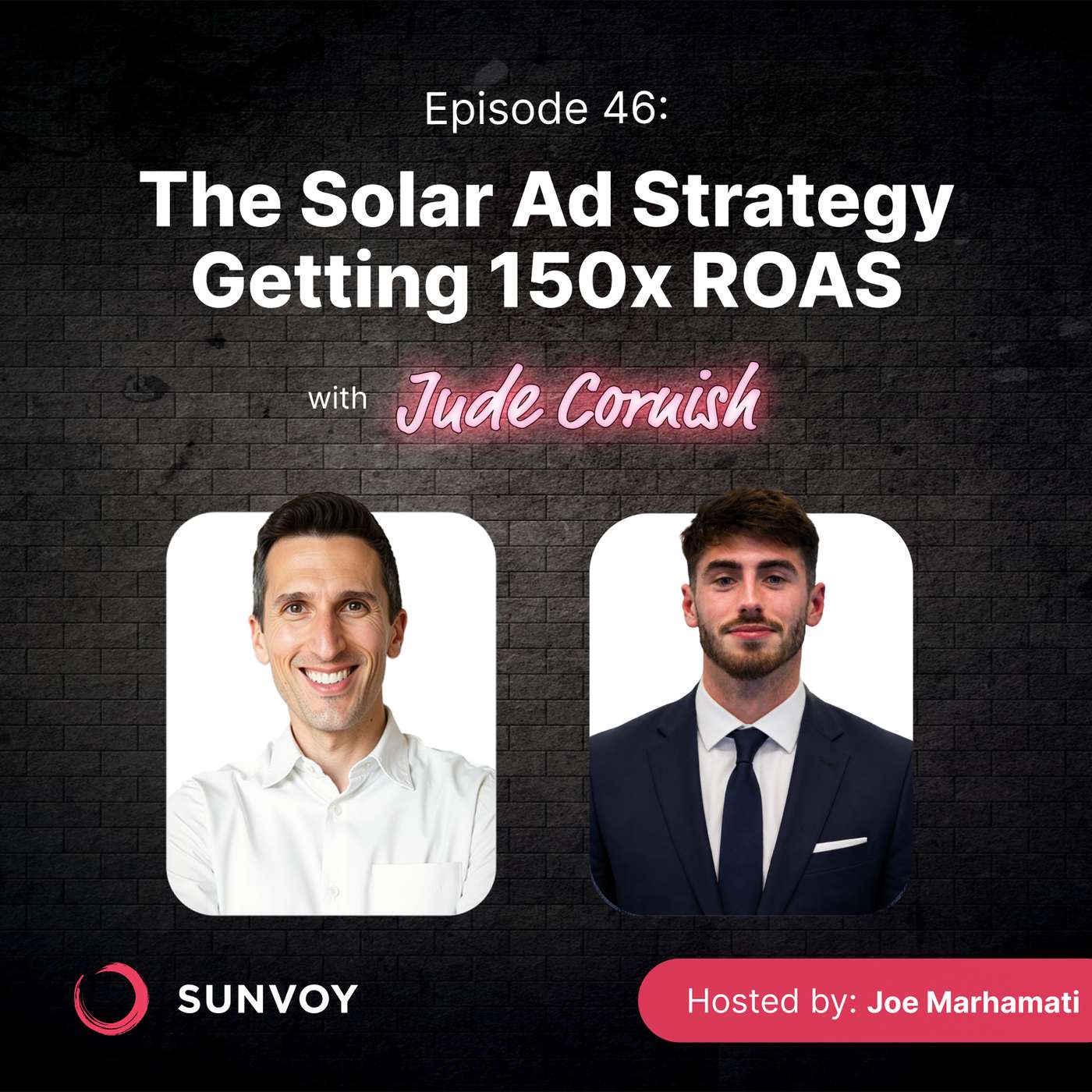
Alle Episoden ansehenEP 46
The Solar Ad Strategy Getting 150x ROAS
Über diese Episode
Most solar ads look the same... cheap panels, big discounts, and “free solar” hooks that make serious homeowners roll their eyes. In this episode, Joe sits down with Jude Cornish from Solar on Steroids to talk about a better way to market solar: show the actual work, explain the install, and let quality be the offer. Jude breaks down how his team used iPhone-shot site videos, honest education, and bold messaging like “looking for cheap solar, go find someone else” to help local installers stand out, lower CAC, and compete against the big sales orgs without pretending to be one.
Transcript
Joe Marhamati (00:00)Welcome everyone to today's edition of What Solar Installers Need to Know. My name is Joe Marhamati, and I'm happy to have Jude Cornish on the show today. Jude, how are you?
Jude Cornish (00:10)Very well, thank you. Thanks so much for having me on, Joe. Real pleasure.
Joe Marhamati (00:12)Pleasure is all mine. And you know what? I really love Solar on Steroids. It's one of the best names for a marketing agency I've ever heard. And it makes it very clear what you're working on. Tell us a little bit about your background, how you got into the solar industry, and what you're up to there at Solar on Steroids.
Jude Cornish (00:27)Yeah, 100%. So essentially it's a myself, Jude and Joe, my business partner's company. We started the company in July 2024, or just a little bit sooner before we incorporated. And both of us had done various freelance stuff before. And so I was a freelance web designer, Joe was freelance running advertisements, primarily Facebook ads. And we decided to essentially, you know, the classic is the riches are in the niches, right? And if you ⁓ jack of all trades, you're a master of none, all of those kinds of lines, right? So we said, okay,
let's just figure out how to have one type of business really well. And so lo and behold, it was solar. And just mainly because we already had some solar clients that we were already working with. And we found that we were just getting great results for them because in general, the marketing that a lot of solar companies are deploying is quite outdated compared to, know, e-commerce, SaaS, et cetera, et cetera. So decided on solar and the name came up just a random shower thought, suppose, but I proposed it to my parents, Joe.
And they were not best pleased. They said, no, I was going to take you seriously. All of this kind of thing. but we pressed on anyway, because after all is a marketing company. And right now, you know, we've grown from working with essentially kind of one or two residential installers a couple of years ago to 53 solar installers in the UK. And, we're now expanding into the USA market, which is how we were introduced, actually in how we met. So, yeah, super exciting times.
Joe Marhamati (01:39)Yeah, absolutely. I'll tell you my background with Facebook ads running a solar installation business. I was never really able to crack the code. And I talked to a lot of other solar installers in the US that, you know, they've tried it for years and they just don't see the ROI from other revenue referral marketing buckets. So where do you feel like you've cracked the code? If you're working with 50 plus installers in the UK, I'm guessing you're seeing some great ROI. So what's innovative about your approach?
Jude Cornish (01:48)Mm.
100%. I mean, we've got some installers that are seeing over 150 times return on ad spend. So they give us a dollar and we give them a home over 150 back, right? And the main reason for that, I think is that we weren't afraid to completely buck the trend on what everyone else was doing. Everyone else seemed to be running discount ads, package price ads, free solar bait and switch kind of advertising angles. And it was a real shame because you know yourself, installers work really hard.
We know that much and the quality of most installers work is exceptional and the attention and care to detail that they put in is exceptional. And we almost felt that that was going to waste with people basically, you know, mocking something up on Canva with a picture of a panel with a, you know, off of Google images and putting a price on it. Right. Or alternatively saying free solar. And then there's tiny texts beneath it that says, if you buy three enormous batteries, you get two panels for free. All of this kind of bait and switch angles.
So we said, okay, fine. If the installers are doing such great work and if solar works so well, if the value proposition is actually so strong, which we believe it is, in many different fields, both financially, but also environmentally, cetera, energy independence, then why don't we just show that? Why don't we just help installers show that? And so what we did, we got our iPhones out, went over to all the installation sites and said, Simon from Rudge Energy, talk me through the system. What have you installed, right?
And Simon took it away. And obviously our installers aren't trained actors. So they needed a little bit of coaching guidance through that on how to actually make it a high performing ad. But we realized that actually when someone just gets on site and goes, Hey, I mean, yeah, we put 14 panels up there. It's 5.4 kilowatt peak. And we've got Tesla Powerwall 3 on the side as well. And would they just talk through what they've done and even down to intricacies of the DC run and how well that's been installed and the consideration of using a white conduit against the white render wall.
All of this kind of thing, consumers actually love it. And especially the type of consumers that want to pay a little bit extra for quality, they engage so much better with these kinds of ads. So I remember distinctly the big moment we realized we'd kind of cracked something was when we ran an ad for a company called Kimble Solar that said, it literally opened with looking for cheap solar, go find someone else. And at that moment, we just knew that everything everyone else was doing
worked for some portion of the market, you know, worked for a demographic, but there was this entire demographic of the market that was being completely underserved, that cared more about quality than they did about price. And that actually just wanted someone that was going to look after them and the integrity of their roof. Right. So I think that was kind of how we started. And at first, don't get me wrong, we, were stumbling through it. We were making mistake after mistake. Right. But over time, you start to figure out what's working, especially when you're managing multiple accounts. And at first we actually paid for the Antiband as well,
which helps you figure out what works pretty quick. But that was essentially how we learned. There was no magic, magic pill or secret hack within the Facebook ads account. It was literally just show us your work. And that was it.
Joe Marhamati (04:54)Well, I love that story, you know, and it's funny, you sent me that landing page to show me some of your work and I was hooked by this idea of looking for cheap solar, look elsewhere because that's kind of the antithesis of what people, especially in the solar industry, normally associate with Facebook ads. And I wasn't even anticipating that the client that would be using that ad was a Sunvoy installer,
because normally I think of Facebook ads as kind of being more on the sales org side of the solar industry, which is not generally our audience. And so that's why I was so eager to have you on the show, because if you're able to build that bridge between the side of the industry that's using Facebook ads and the side of the industry that's vertically integrated, employee-owned businesses, quality-based long tenure businesses,
Jude Cornish (05:15)Yes.
Joe Marhamati (05:38)That's a big deal because you can potentially dramatically reduce the cost of acquisition for these companies by using honest, truthful ads that promote quality products. So why do you think this sector of the market has been so underserved?
Jude Cornish (05:52)I think it's to that point exactly. It's the majority of people that are running Facebook ads, especially in the US where I appreciate there's a big difference between typical sales orgs and integrated installers, vertically integrated installers. think that most of them don't have the stuff to show that we typically show on the ads. You know, you can't have a sales org that goes over and says, this is John, I've owned the business for 25 years. I've been installing solar since it came out. And this is one of my installs that I've done because they haven't done an install and
Sure, you can run Facebook ads profitably for those sales orgs, but actually we find that some of our local performers get better results than some national ones because they're able to utilize angles that obviously we recommend to them that the nationals can't even touch. They don't have the same personability. They don't have the same authenticity. They don't have the same track record. They don't have the same trust that these local installers have because the local installers can actually show off their work and take pride in it. And that's what we realized pretty early on. It's the
If you can give local installers the platform and with video ads, I think you can, like, I mean, at first, you know, there's not really a barrier to entry. We turned up with iPhones to do filming, right? And you just show them that actually people do care about the quality of your work. Then all of a sudden they've got this, this kind of weapon in their arsenal that the big sales roles can't even touch. And if they did, it would feel really inauthentic of them because it's obvious that they're not actually doing the installs. It's obvious they're not doing the aftercare. So I think that was the big
thing for us, it's actually, you know, helping the whole thing about marketing is playing to your strengths, your, your USPs. And I think that no one had really helped local installers, especially in the solar industry to actually play to their strengths is the long and short.
Joe Marhamati (07:26)And so what about LinkedIn ads? I saw you did maybe a little bit of work with LinkedIn and actually I've got a friend in the industry in Virginia that's been doing LinkedIn content and I think ads as well for a solar installation business for over a decade and his business has grown tremendously. So I think it's kind of potentially an underserved area for B2C. Where do you see LinkedIn coming in for this market?
Jude Cornish (07:29)Mm.
Yeah, definitely. We have quite a few installers that are repurposing all of the ads that we primarily create for Facebook and Instagram and actually posting them on LinkedIn. And what you find is that you get a whole new audience on there that are people, know, they're kind of scrolling through their LinkedIn. They're seeing loads of like work related things, some really boring kind of B2B ads. And then all of a sudden they're hit with Fraser who's going, Hey, check out this 16 kilowatt system I just installed down your road. And it's like, Whoa, okay, hang on. I'm awake. You know, maybe I should be working, but I'm awake and I'm watching.
⁓ So I do think that LinkedIn can work. think it can also work incredibly well for commercial. And I think that if you can get people in the door with commercial, the value proposition is just so strong. ⁓ I don't know too much about in in the US but in the UK, the paybacks are like two to three years. So if you can get someone in the door through any of these means, I think that, and especially with AI coming along as well, doing kind of like an estimate on what someone might be able to save just to show them the value, not to design a system, but to show them the value. I think that.
Essentially, yes, every platform can be utilized. now, next week we're launching our first TikTok ads campaign. And there's a whole kind of stereotypical view on that platform that it's just very young people, just kids, right? But there's only so many times that a parent will open their kids' TikTok on the browser before they download the app and all of a sudden they're hooked. So I think it's just about catering your message to each platform and getting it out there. Just get your work out there.
Joe Marhamati (09:12)And so if you were like a CMO for a solar installer right now and you had to build the buckets, the marketing buckets, obviously it's not all going into paid ads. Where do you recommend that a solar installer in the UK and, you know, or in the US kind of build their marketing spend out? Have you thought about that?
Jude Cornish (09:16)Yeah.
Yeah, definitely. ⁓ I would suggest a different answer based on the size of the installer. If the installer is below four to eight installations a month, I would suggest anything to be hyper local. I forget who said it, but someone said a great quote where they said, do things that don't scale, right? Because that's where your advantage can be. So local events, sponsor, you know, local charities, go to events, get your name out there. You know, maybe even open a showroom, a small store
that in a local market will convert better than almost any digital advertising. And it will encourage a huge volume of referrals, people that trust you because you're operating in their local area. I think the problem with that is that as soon as you get to eight installs a month, then you're trying to find something that's a bit more scalable and that you can put budget behind and get a very consistent output from it, but also scale that up consistently. There's only so many events that you can kind of go to. So I think once you're beyond eight installations a month, that's where stuff like Facebook ads,
really comes into its own because I mean, we've done it 10, 15 times now taking a business that's doing eight installations a month and just doubling it in a matter of two to three months. Facebook is a platform that allows you to do that very consistently. And the great thing about it is you can tune up the budget and you can tune down the budget. So we've got a lot of installers right now, especially with the what's going on externally with global events, they're actually decreasing their advertising budgets because they're too busy.
But the beauty of it is those ads are still running and when hopefully global events kind of change, they'll be able to ramp those budgets back up and be able to continue scaling. So I think that's what I would say. And then I think as soon as you surpass kind of 40 to 50 installations a month, that's where you start looking at a real multi-channel approach where you're kind of dipping your toes into Google, Bing, SEO, YouTube, Meta, everything you can to, because each platform is going to kind of support one another as you grow.
Joe Marhamati (11:14)And do you think that as you grow, it makes sense to focus more on paid ads or to kind of split the spin between inbound website events, sponsoring and paid ads? How do you think about that?
Jude Cornish (11:27)Yeah, I think paid ads by nature is one of the most expensive acquisition channels that you can do. Um, you know, as, as good as it is, and as fast as it can get you results and as much as it can scale, if you turn off your, you know, if you stop paying Facebook, say 10,000 a month, you stop getting leads. That's it, right? You know, you're renting that space. Um, And obviously that's our primary channel, but at the same time, we still recommend to all of our installers when they get beyond a certain level, start to diversify,
you should be investing in SEO, You should be investing in, you know, other marketing flyer drops, things like that. You should be investing in partnerships because really relying on one channel, whatever channel it may be, you know, if you, if you exclusively rely on SEO, that's a bad idea too, cause you're kind of at the mercy of Google, right? So I think it's more about diversification as you grow. But I think that, I mean, we've seen installers that have gone to they've, you know, five, six their business and
over half of that has come from Facebook. unless you're a real high scale, I think Facebook is probably one of the big levers you can pull just mainly because it's got the biggest audience you can target.
Joe Marhamati (12:28)And so what do you think is the thing that homeowners without solar have a light bulb moment and learn from these ads? Is it the savings? Is it, the solar panels actually look pretty good, or this is a local company? What's the one thing that they didn't know about solar that you think they learned from these ads? It's kind of like puts the light bulb over their head.
Jude Cornish (12:45)Such a good question. I struggled to put it down to one thing. I think a huge part is our ads put a lot of work into overcoming horror stories and misconceptions. think especially in the US, now that I'm speaking to more installers, there is such a fear around the solar salesman and around the process going to pot and around someone owning your roof and all sorts of legal stuff happening.
I think that actually education is, the huge driver. And as soon as you can kind of bring someone around to the idea that yes, there are people that have had bad experiences in solo and we're getting into the heat pump market now. That's even worse. and yes, there are those experiences, but actually this is how you avoid them. This is why that happened. This is, you know, what kind of installer might, might end up doing something like that. And this is how you can avoid it. I think that's when the light bulb goes off because all of a sudden they're, you know,
all of their feed has just been hitting them hard with free solar by now by one panel get to free data. And as soon as you come in and say, I'm not offering anything. I just want to educate you and actually help you see what is possible. I think that's when the light bulb goes off. And that's why our ads convert so so well, not just our ads, but any ads that are educational rather than just a straight offer. Because people are so much more trusting when they come off of that, that kind of messaging as opposed to just a hard offer.
Joe Marhamati (14:02)All right, Jude, I got to ask you, there's an urban legend out there that you spent 18,000 pounds of your own money on a client's ad spend. Is it true? And what was your thinking that went into that?
Jude Cornish (14:07)Yeah.
Yeah. Yeah, a hundred percent. So it's, uh, I'll explain it. It was technically Joanne dies funds. Um, So not that that makes it any better, but we essentially, when we got started, we recognized, look, we haven't got results for anyone yet. So what business do we have charging people for it? If we can't confidently say that we're going to get your results, then we can't walk away profitable out of that. So we said, okay, fine. Let's just get paid when you close deals and when leads progress through your pipeline and we'll cover the ad spend.
And installers, remember to this day, I did a talk at solar and storage live in London, in the UK, and they looked at me like I was mad. And it was funny because I did the presentation and I had a queue of about 15 people lined up ready to ask me questions. I actually like book in for a discovery call. We booked 26 discovery calls from that talk. And I remember speaking to a coach I've got called David Jacob afterwards. And he said, I was like, David, the talk went so well, you wouldn't believe it. And he said, well, yeah, because you just told people you're to give them free money.
I was like, yeah, okay, fair enough. That makes sense. But it was, it was great because what it meant was we took all the risk. We took all of the kind of jurisdiction and we were actually able to experiment at such a faster degree than anyone else. Because when it's our money and we're putting all of the investment into the ad account, quite frankly, the client just says crack on. Whereas if it's their funds, you take far less risk because you're like, Oh, I don't know if that's quite going to work. What are they going to say? I'm going to ask you to get approval on that, that spend for that ad.
You know, maybe that's what that was a bit left field. Whereas we came in and we said, right, here we go. We've got our own cash. Let's buy by some degree. Let's burn it. Let's figure out what is actually going to work and let's run some ads that are a bit left field. And over at the start, trust me, we were making no money. These tool has worked closing the ads were terrible. The leads were terrible. Everything was rubbish. But then over time you start to learn what's working and you'd learn really quick because there's only so much money that two 23 year olds have to deploy onto these ads. Right, and
by probably two, three months in, we were starting to get pretty insane results whereby clients were saying, we've never seen anything like this. I remember Mark Brown from infinite energy. he said to me, the leads have got a different look in their eyes. It's weird. It's almost like what are you guys doing? You, hypnotizing them. And we basically got to a point where we like, this is amazing. Great. Everyone's so happy. They're getting these results, but we then ran into a new problem where all of them said, can you spend more,
put more money into the ads. And we said, no, no, we can't, we can't, we can't afford it as it is. And so what happened was around December, 2024, we decided to basically, we got the results. had the case studies. We moved everyone onto a more traditional setup where they covered the ad spend and we got paid on commission. So it was kind of that shared mutual winning, mutual risk. And from there, that was when we really scaled hard, went from six clients
that December all the way up to 42 in one year. And that was mainly because we'd done the proof, we already put our own money into figuring out what worked and then it was just a case of rolling it out. So yeah, the tale is true. And yeah, I still I don't think I've recovered from the stress of that to be honest with you.
Joe Marhamati (17:07)Well, that's how we know that you're a true believer and that you really believe in growing this industry. So I love that story. So I know you're going into the U.S. market. Tell me, what have you learned so far about the U.S. market? What's your strategy to get into the market? And tell us a little bit about this offer that you mentioned to me last time for the first 10 installers in the U.S. Is that right?
Jude Cornish (17:26)100%, yeah, so we're essentially trying to do the US as similar to how we did the UK as possible. So we're flying out on April 19th. We're gonna be in the US for about three weeks. We've had installers sign up from New Jersey, New York, Connecticut, Florida, California. So we're gonna do a lot of traveling. Unfortunately, we were darting around the US. And what I've learned so far is that,
we kind of had a whim whereby we decided to enter the US market at almost a weird time where from the outside in it looks like, know, with the changes that happen with the big, beautiful bill with rebates, actually the market is almost retracting in a lot of areas and any other marketing agency would almost run for the hills because that by default means it's harder to get results, right? But what we're seeing is actually the exact same thing happened in 2015 in the UK where the feed-in tariff, which was our equivalent got removed by the government. The market retracted 80% and
that's actually when installers need the most help to showcase why they're different and what they can do for consumers. Right. So coming in, ⁓ the offer is that we're flying out and we'll actually do the whole backend on a commission only. The installer pays the ad spend, but we only get paid when they actually close deals as a percentage of the gross sale value. It's going to be intense. And to be honest with you, the logistics is proven to be the hardest part, the sales, you know,
encouraging installers to consider this new way of marketing is pretty hard, but also logistics, trying to figure out how we're going to balance all of these different filming days is going to be tough. But what I'm seeing is exactly the same as what I saw when I started in the UK market, whereby there's just a massive industry that is underserved by the current players, at least from a very specific Facebook advertising perspective, I would say.
Joe Marhamati (19:03)I love it. You know, I think you're possibly the first person I've met who's really hyper-focused on Facebook ads and promoting quality companies, honest messaging, and really getting the stories out there of solar homeowners to entice other people who maybe don't know anything about solar, have had the horror stories. And I just have so much respect for that. And you're really doing God's work. Where can people find you if they want to learn more?
Jude Cornish (19:28)100%. Thank you so much. And likewise with Sunvoy, honestly, we've had great feedback from Kimble Solar or a client in the UK. Um, and I think that that is going to take the UK by storm once it really gets, gets going. So fantastic there. Um, where can people find us? I am a bit of a LinkedIn addict. Uh, so definitely check us out on LinkedIn, Jude Cornish and Joe Garbutt on LinkedIn. Um, but also solaronsteriods.com. We've got 40 plus video testimonials on there. We're very keen on just being super open about what we do because
we're strong believers in ideas aren't worth too much. It's all about execution. So actually if someone's just getting started, if they are below four installations a month, but they want to try Facebook ads themselves, we've got 140 long format videos that they could use to, at least get the ball rolling and try the platform. Um, so definitely go to our website, solaronsteriods.com. And then if you are interested in actually when we're already out to you, try and, try and just get a call booked in as soon as possible. And we'll try and squeeze you in.
Joe Marhamati (20:19)Love it. Jude, good luck on your trip in the US. I hope you're able to help some of my friends out here with their Facebook ads, reducing their cost of acquisition. And thank you for taking the time to join us today. I really appreciate it.
Jude Cornish (20:27)Yes.
No, thank you so, much for having me on. I really, really appreciate it, Joe. Thank you.
Joe Marhamati (20:33)Thanks everybody for listening. This has been What Solar Installers Need to Know. We'll see you next time!