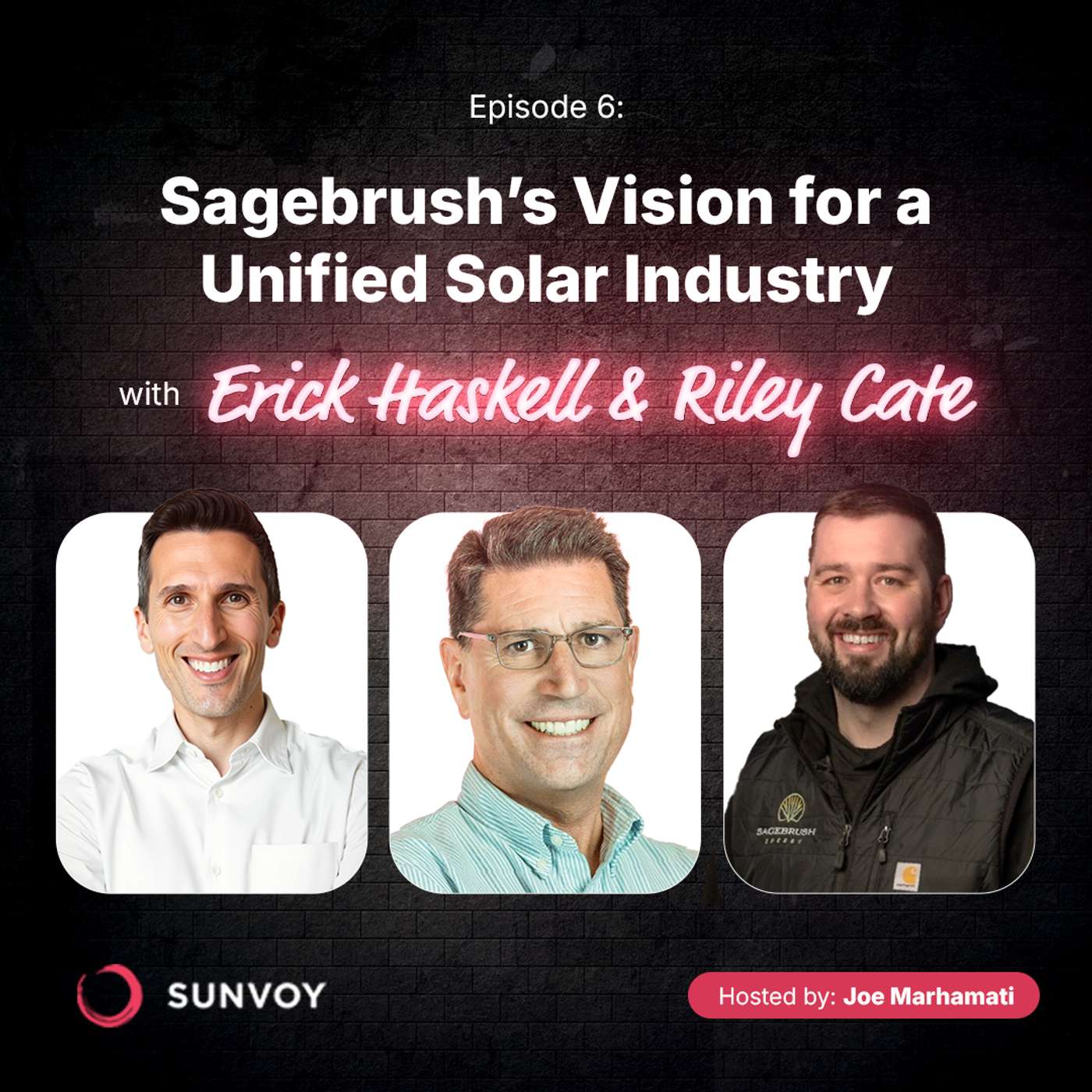
Alle Episoden ansehenEP 6
Sagebrush’s Vision for a Unified Solar Industry
Über diese Episode
Riley Cate and Eric Haskell ditched their corporate gigs to start SageBrush Energy—and in this episode, they share what it’s really like to build a solar company rooted in trust, community, and quality installs. From navigating policy shifts in Nevada to launching their own financing arm (SageBrush Financial), they break down the real challenges local installers face and why diverse financing is non-negotiable.
Transcript
Speaker 1: I will say that our business is stronger than it has ever been.
Speaker 2: The success of growth and where I see companies growing consistently really is your people.
Speaker 3: I mean, the story is not does it make power? Because they all make power. The story is what does it power?
Speaker 2: This is what solar installers need to know with your host Herve Billie and Joe Mahamati.
Speaker 4: Hi there. It's Herve and Joe in what solar installers need to know, where we interview solar CEOs and experts on how they run their business on the solar cluster. We ask their private revenue numbers. We give actionable advice and learn about trade secrets so you can run and grow your solar business. Joe and I built a solar company from 0 to 12,000,000 sales and got successfully acquired.
If you'd like to do the same or do better, go to sunboy dot com slash blog to get actionable behind the scenes lessons on running and growing your solar business. And now without further ado, let's jump right into the next episode.
Speaker 3: Hi, everybody. My name is Joe Marcamadi. I'm one of the cofounders of SunBoy, and welcome to the What Solar Installers Need to Know podcast. Today, I'm here with Riley Cate and Eric Haskell, the cofounders of Sagebrush Energy. Welcome, guys.
Speaker 1: Morning, Joe.
Speaker 2: Hey, Joe. Thanks for having us.
Speaker 3: Thanks for being on the show. I'm gonna give a little bit of background about how we know each other. This is one of my favorite stories since, starting SunVoy about, I'm just gonna say, six, eight months ago, Eric sent me an email. And like you guys and probably everybody listening, I get a lot of spam emails, so much so that I think I can spot them without reading a single word and delete them now. And so this was an interesting email from Eric.
And And I was like, I think that an actual person wrote this email. And it was something like, I'm a Fortune five hundred a a former Fortune five hundred executive. I've worked all over the world, and I wanna start a solar company. Would you talk to me? And I was like, I think a real person wrote this email.
I'm gonna respond to this email. And it was the beginning of a budding friendship and partnership, and Eric and Riley and I have spent countless hours working to help them launch a premium solar installation business, a vertically integrated solar installation business in Northern Nevada. And I've had so much fun in that journey. And I'm really excited for this conversation because Riley brings a wealth of experience from the solar industry and and Tesla and SolarCity and Eric, from his experience in years of corporate America. And so I would love for you guys to tell in your own words why you're starting a solar company, how you got into this, and some of your early lessons.
Let's start with the story. And and, Eric, how you came from corporate America into starting a solar company?
Speaker 1: Yeah. Happy to, Joe. Thanks. As you mentioned, I had a long corporate career working internationally largely with big consumer brands. Worked for Adidas, for Under Armour, Allbirds, big well known brands.
And I got to the point in my career where I wanted to do a lot less travel, settle down a little bit. I've always had a a deep passion for clean energy, the environment, and I wanted to do something in the space, but frankly, wasn't terribly well suited. I didn't have a lot of experience or background. I had nothing more a passion, really. But I figured that at least residential solar would be something I've spent my career selling to consumers, not residential solar, but at the end of the day, you know, selling consumer products.
So I decided to really focus on residential solar. Fortunately, I got introduced to Riley through our wives. As you mentioned, Riley's got a deep background in residential solar with some of the big names that you mentioned. And we started down this road of building a company. And one of the things I got a little bit disillusioned the deeper I got into it was some of the things, frankly, that were happening to consumers.
And it turns out that Riley experienced the same disillusion working for these big companies who sometimes are using overly aggressive tactics, perhaps misleading tactics with consumers. So we set about from the very beginning, as you mentioned, to set up a premium solar installer focused on putting the consumer first, educating consumers, doing right by consumers. You mentioned vertically integrated. We own our sales install team. We own everything about the experience with with consumers.
So that was really the genesis of it was doing right by consumers and addressing what both Riley and I feel are some of the the drawbacks what's happening in residential solar right now.
Speaker 3: Love that. And and, Riley, please share your experience too, bringing the the wealth of solar knowledge into the business to help it grow sustainably from the ground up.
Speaker 2: Yeah. Absolutely. Hope that my my wealth of solar knowledge is not being oversold. As you mentioned, I've spent well over the last decade, working for some of the largest national residential solar companies in the country. So SolarCity, which then became Tesla, and and ultimately Sunrun, that was where I spent the last several years for my my corporate solar life.
And I ultimately started in sales, moved up to to managing a team regionally, and then above that, and found myself in a learning and development capacity. So I oversaw and helped to co write a lot of the consultation guides, a lot of the onboarding for sales training in the residential space for these large, large national organizations. And while I firmly believe that good people are hired in, the right materials, the right methods are taught upfront, when you have a major national organization, you tend to, have behaviors that are are communicated at the top and expectations set at the top. But as it dwindles down to the bottom and and folks are chasing a commission check or chasing a quota and having to really, really narrow these pieces in in a certain market, ultimately, you wind up sacrificing customer experience in a in a pretty painful way a lot of the time. Had actually just decided I was I was gonna be stepping away from the industry after well over a decade just because I felt that it was just going in the wrong direction.
Consumers weren't being taken care of in the right way. And, ultimately, when Eric approached me and wanted to to see or explore doing this in Northern Nevada, it may have taken a a little bit of convincing, but after a a couple of great calls Eric is a salesperson for sure he sold me. After a couple of great calls, we just decided that there's there would be nothing more special than being able to do this, do it the right way and in our own backyard. And having worked for multiple companies over the last decade, I I I had this realization that there was not a real friend or family member that I'd ever actually sold or pushed or tried to convince to move forward in the solar space with any of these companies because the experience couldn't be guaranteed. Unless I made extra phone calls to get the right consultant, make sure the right crew was there, I couldn't guarantee what type of an experience they would have and what that experience would look like, not just going through the sales and installation process, but more importantly, what it looks like a year from now or five years from now, and when they need something with that system or they wanna add something to that system.
And they they don't have that same person to to go back to because more than likely, the original group they worked with to get installed is no longer working at that company any longer. Long winded way to say it was all just based off of us wanting to do the right thing the right way and take care of our our family, our friends, and our community.
Speaker 3: It is so heartbreaking to hear what you just said and for me to know how true it is that you can work in the solar industry and feel this anxiety when somebody asks you about going solar. Isn't that strange? I I was actually I was interviewed by EnergySage a couple days ago, and they were asking me the same question I'm about to ask you, which is why are all these national big box installers going out of business? What does it say about the industry, and what does it mean for what comes next in in the next five years? What do you think, Bradley?
Speaker 2: You know, it's a great question, Joe, and I I wish that I had a magic answer, that my answer was the the absolute right one. But I think a lot of people are trying to figure that out and trying to solve it. If I had to really peel back the layers and give my opinion around why it's happening and what's happening and kind of the turning that we're seeing in the industry and consumers standing up for themselves, legislation being passed in in many states, Nevada included, that are making things a little bit more difficult on the installer to have these these potentially negative practices and better for the consumer. But I think that it boils down to not ill intent. I think that every one of these companies going back to when these programs first started, when you look at, you know, the lease or the PPA being launched by SolarCity or Sunrun back in, you know, the late early thousands, the intentions were good.
But over time, what started to happen was expansion became the biggest goal of anything. And how many new territories and how many new markets can we get and how can we continue to drive profits? At the same time, the curve for the homeowner on on the cost of going solar, especially with a third party on profit, which is what all the national players are putting forward about 90% of the time, was not only heavily incentivized through commissions for these groups, but the rates that homeowners are paying were not based off the cost of solar whatsoever. Whatsoever. It was more in line with what the utility companies have been doing.
And we know utility rates are gonna go up, but there became a moment where companies started prioritizing profit over progress for the industry. And I think that that is what is leading to some of these national retailers starting to have to fold and starting to see things push back because rather than, you know, progressing the industry, doing the right thing for the homeowner everywhere that they possibly can, taking care of them at a local and a regional level, It's more so which utilities can we chase, which ones are we guaranteed to have battery attachment in. You know, if the utility in this in x state went up 8% last year, well, then our rates better go up seven and a half, as opposed to just chasing a great consumer experience with a product that can benefit them in the end. Go ahead, Eric. Please.
Speaker 1: I can add a couple other things, Joe, from my perspective. Number one is I just think it's primarily these big national companies who are driving the sales tactics that are are really ruining the reputation of our industry. So all of this door knocking nonsense that's happening are driven by these national players. And I I hope that gets eradicated from our industry. As Riley mentioned, we've got some laws here in Nevada that is really dampening that activity.
So first of all, I just think at the end of the day, nobody wants to be sold anything at their home. They don't want people knocking on their door. So it's the national players who are pushing that. And, again, we need to eradicate that. The other thing I'd add is I fundamentally don't believe that solar installation, sales and installation is meant to be a national business.
I believe it's meant to be a local community business. At the end of the day, we trust people to do this. Our home at the end of the day. Right? People punching holes in our our roof.
We want these people to be in our communities. So as you start to expand out of your home market, whereas a lot of times when businesses expand geographically, you hope that your costs go down because you're getting larger scale. I think what actually happens with these big national players, because they're getting out of their community, they can't rely on referrals. The cost of acquisition actually goes up. So I don't even believe the underlying economics of getting scale in solar works.
I think these businesses are meant to be local, regional, community businesses where you're selling to your neighbors, and those neighbors make referrals to others. So I fundamentally don't even really believe in the national model for for solar installation.
Speaker 3: Came into that. It's funny. I remember in my days of of running a business, I would always hear this phrase, the long tail. And because I was the long tail, I would wonder what does that mean? Oh, it's because 80% of the sales are coming from these top 10 big box installers that are blitzing these neighborhoods and ripping off granny, and us, the We Local installers, are the long tail.
Well, seems like now, the long tail is just becoming the tail, which is all of the local regional installers that are doing good work that have been around for twenty years. I talked to an installer yesterday that's been around for forty nine years, and these are the companies that are scaling and doing good work every day. Tell us about the legislation that passed in Nevada, why it matters, and why there was a solar executive, as you taught me last week, standing next to the governor signing that legislation, why did it originate, you think, in Nevada?
Speaker 2: Essentially, SB two ninety three passed went into effect in 2024, and it did a few things. The first was that it required that in order to market, sell, or install solar, every employee has to be a w two employee for the company. So you can't hire a third party sales organization to come in and do those blitzes that you're referring to, Joe. I mean, you can't send a team from Chicago, Illinois that has had a ton of success and then drop them in a rural market in the middle of Nevada and say, go knock every door and and, you know, see see what happens and see what we can turn out. So all of those pieces are gone, and that's caused a few companies that were local and regional throughout the state that did rely on these third party lead generation and and closer setter models to have to look at their business again and kind of revamp and figure out how are we gonna strategize and move forward now.
Some are figuring it out. There's still a few that are are trying to to cheat the system and skirt it somehow, which is unfortunate, but it's getting better. So eliminating the ten ninety nine rules, going to all w two for sales, I think, was a a first huge step in this bill. The second piece was that it requires said company who has all of their employees' w two to have a a Nevada state contractor's license. That's not a very easy thing to obtain.
As Eric and I can attest to, it's it's hard to get for the right reasons. They want to make sure that you have the experienced staff, that you've got the knowledge and the ability to run a business effectively and efficiently. And, ultimately, you're paying into a restitution fund as a Nevada state contractor that is utilized more often than not for solar projects in the state when a customer feels they were abandoned, the work wasn't done right, and the installer goes out of business. And so you've got a lot of new new areas where it's just making the the solar community within the state much tighter, but also putting much more responsibility on the company, much less responsibility on the consumer to hopefully sit down with the right consultant, wish that they got their door knocked by somebody that knows who they're talking about. They had an install crew from a reputable company that wasn't just subcontracted.
And so, still in the early phases, but a lot of progress is being made, and more and more legislation is moving forward. And the great thing is, to your point, that the majority of this bill was actually brought and sponsored by a local company here in Nevada as well. And so now we're looking to to continue to work with these companies that are wanting to progress the industry forward in the right way. Because, again, Joe, to your point of the long tail, when those blitzes happen, people come in and get door knocked or or in whatever fashion they they find these groups. The scary part is not just the homeowners that that said yes to it and had a bad experience, but got installed and and where they might be stuck in or stuck now.
The worst part is the folks that didn't say yes or that wound up canceling their agreement, which across the industry with these big boxes, and that happens upwards of 50% of the time. Somebody signs up, signs a proposal, and then gets cold feet because there was no explanation that happened. And so they ultimately cancel. No harm, no foul. Right?
Except for the fact that we now know that that consumer is likely not going to meet with any other solar company or do any other research into what might be right for them for at least a year, two, three years before they feel comfortable or they have a friend or family member in their network that decided to move forward with a different company that they felt very good about. And so it cripples the industry not just on the bad experience once an installation fits, if it wasn't done reputably, but more so almost on the consumers that have explored this and now are gonna wait years before they'll explore it again.
Speaker 3: You know, it's funny. I had a podcast episode a couple days ago, and and I was talking to a developer, utility scale developer about if you were the king of the solar industry for a day, what would you change? What would you do? And we were talking about permitting and interconnection reform. But now that I'm talking about this with you guys, and I think about all the reputational damage that has occurred in the solar industry from these big box installers doing this kind of work, and all of the bad press that's followed on from it, I actually have so much admiration for what was done in Nevada, and I hope it's copied in every single state in this country because the biggest risk to the industry, I think, is actually reputational, not whether a solar installation takes six months.
But okay. Assuming that that's our our number
Speaker 2: one I couldn't agree more. And, Joe, I I I do. I'd be remiss if I didn't pause and say that, well, yes, the $10.99 sales, the door knocking blitzes, those pieces largely have come from the big box, if you will, retailers for this. But there is also several small, you know, chuck in a truck, type solar installers that were guilty of this as well, and they just saw a way to make a quick buck in the industry and went out and did the wrong thing. So it happened somewhat on on both sides of the spectrum.
I don't wanna put all the blame into one area. But you're right. Across the board, it was reputational. And so what this bill has done is kind of taken both elements out of that. You can't just blitz from a national standpoint and send the team in to, you know, come in and knock every door.
You also remove all of the guys that just, you know, thought maybe I'll sell five, six, 10 systems, make a quick buck, and then bounce out of the state.
Speaker 1: So I I I will say, though, Joe sorry. Go ahead. Go ahead, Joe.
Speaker 3: I was just gonna I I this is my favorite story of the last few years. A friend of mine said he got door knocked in the DC area, and it was from a company that had a a local presence. And I thought that's strange. I didn't think that company did door knocking. That's really weird.
And then I asked my friend who runs the company, and he said, that's not actually my company. A company from the West Coast came to the neighborhood, changed their name to the name of our company, and started, you're familiar with this, absolutely blew my mind. The creativity of the level of fraud Oh my. Or has been going on in this whole industry.
Speaker 2: It it continues to happen. One of the more common things is you'll get somebody that says that they work with the net metering company. Doesn't exist. Or that, hey. We're out there, and we partnered with the utility.
I've even seen door knockers put on orange or yellow construction vests, wear a hard hat, say, hey. We're out in the area. I'm just setting appointments because we're working with so and so. Anybody that approaches you in that fashion is already just trying to undercut any value that they can provide, and they're looking to chase a commission check. So when you have that scenario, homeowners end up in a very bad position.
They're hopefully trusting of their utility company in some ways knowing that they're keeping the lights on most of the time. So when somebody says, hey. I'm here with the utility or I'm here with the state, it's just a it's a bad, bad, bad, bad.
Speaker 3: I agree. Eric, I cut you off.
Speaker 2: Go ahead.
Speaker 1: I was just gonna make a point that I do think and this is not necessarily a popular view in the in the industry, but I I think the industry is in a bit of denial. Right? It's very common to say, oh, there's just a few bad apples. And it's more than that, to be honest. I'm has said multiple times, there's orchards out there.
And frankly, the orchards are these big companies. I would say, I think by and large, the regional companies who are out there doing great work, they're not engaging in this activity. But when these big national players consume such a large percentage of the work being done, it may not be a large percentage of the number of companies, but the volume of installs and marketing going on, it represents a a, you know, a big problem. And I think we need to be honest as an industry and call this out rather than sort of say, yeah. It's just a few a few bad apples, because frankly, it's not.
Speaker 3: So this is a perfect segue for you all to tell us about the values of Sagebrush Energy. Tell me about how you came up with the name and the logo and the aesthetic, and, also what values do you hold, and and what do you the brands represent in the industry and then within Nevada?
Speaker 1: I'll start, then I'll let Riley add on. So, obviously, sagebrush is is it's the state plant, the state flower in Nevada. We've mentioned multiple times that we're a local community company. We don't have ambitions to expand beyond our community. So we felt very comfortable coming up with a name and a brand that's literally rooted in Nevada, specifically in Northern Nevada.
So that's sort of where the name comes from. It's really a reference to the heritage of the state, the beauty of the state of Nevada. In terms of the values, we've hit on it a lot already. Trust is critical. We spend a lot of time building trust.
We don't have aggressive sales tactics. To date, literally a 100% of our work has been through referrals, word-of-mouth. We've done very little marketing. That whole idea of building trust, building relationships, you know, not using these aggressive tactics have been important. And then at the end of the day, obviously, doing extremely high quality work so that when we've put the system on the roof of our consumers, they're happy with the outcome.
They've had a great experience. It's a high quality install. Install. And so really building that trust up front, building the relationship, maintaining that relationship, and then delivering an excellent an excellent system. Riley, you wanna add on to that?
Speaker 2: Yeah. I think, obviously, I will I will double down on trust 100% of the time and what we're trying to to convey there. Again, I'm a I'm a Nevada native, born and raised. My parents are Nevada native. So, I've been here for multiple generations, and it's just really, really important that we give this community a company that they can trust.
And we do have a a few other, very reputable folks within the region as well that we're doing great work. We just wanted to be a part of that. And so the the other two points that I will hit on is one of the pieces around building trust is that we wanna make sure that these are long term experiences with our customers. We all know that solar is generally not a short term purchase. It's either financed or it's contracted out for ten, twenty, twenty five, thirty years.
But oftentimes, most companies look at, hey. I sold that homeowner solar. Got a commission check cut. We got it installed. That's one more roof.
We're done. And over time, that consumer has no one to go back to, and all of a sudden, they want an EV charger. They wanna start looking at storage if storage wasn't an option for them to begin with. They're they're interested in a heat pump or, you know, smart thermostats and all of these different areas. And so, Joe, that's where you and SunVoy really came in, and we're so appreciative for that.
It's helping us to build a relationship with our customer that's not just today, that doesn't end in installation or PTO, but they've got someone to go back to. And then the the last piece that I'll plug in, and this was a big one for me, maybe a relatively unpopular opinion in the industry depending on whether you're falling in the kind of the big box world or the regional world, is we wanted to have all financial products available to our customers. I think we've all seen regional companies that, you know, maybe don't have the ability to offer a TPO product to third party owned solar lease or PPA. And because they've never had the ability or because it's so foreign to them, they kinda trash them. You'll see it on regional companies' websites sometimes of just saying, like, before you ever sign this, talk to us.
And it's really because they only have a loan product or a cash product to offer. On the inverse, you get the big boxes that are heavily incentivizing their TPO product and wanting to move forward with TPO. And so they're they're slamming the loan offers that, are are being competitive competitively bid from the regional companies. And so you get this clash that at the end of the day, both parties are guilty of the same thing, which is trying to persuade a consumer into a product that they feel is best, not that is necessarily best for the consumer. And so I'm a big fan of a very consultative process to identify and help the consumer ultimately make that choice as to why they wanted to go with a third party owned.
There's a number of reasons why that might make sense or why a cash purchase or a a loan at x term is better for their situation. So, it's a good segue into some other topics that Eric and I can dive into, but that was a big one is we wanted to be a regional player that offers all potential financing solutions that are available within the industry and then over time, maybe create a couple unique ones of our own.
Speaker 3: Wow. That's another perfect segue. You know, if somebody had asked me, should I run a solar installation business and another solar related business at the same time? I would have said, absolutely not, because I've done that, and it is really hard. But because it's not me anymore and it's you guys, I'm totally fine with it.
So tell us about Sagebrush Financial, how that started, why the hell you'd wanna start two businesses at the same time. And also, just ripping on what you said, Riley, I know a lot of solar businesses that are very skeptical of TPO products. Why do you think that is, and what are you hoping to do to change that?
Speaker 2: Yeah. I'll I'll take that part first, Eric, and then I'll let you dive into kind of the the genesis of of Sagebrush Financial. Joe, I I think it falls to two pieces. I think one is culturally, it it kind of has become a thing as I've as gotten further and further into this regional, world of solar. I think that you almost associate TPO with those big box national companies, and you and you wanna be different.
And so culturally, it's like, no. We're staying away from that. That's bad. I also think there's just more so a lack of understanding and a lack lack of availability to be able to offer those products. And for far too long, if you wanted to offer a TPO product, generally, your only option was to now work with one of those national big box retailers and become a channel or a an affiliate partner of theirs and sell their agreements.
And so, of course, most reputable regional companies would wanna stay away from that situation and keep themselves separated. So I think it's it's lack of availability, lack of exposure to it, having always done something a certain way and always had a product that works and and you feel good and your customers are happy, so you feel like you're doing everything right. What we wanna bring to the table is the ability to offer all of that in a way that still fits and meets your values as an installer. So that being said, I'll I'll hand it over to Eric on kind of where things went and how how we got this this other sister company started.
Speaker 1: Yeah. Sagebrush Financial really was born out of us feeling that there weren't good options and, frankly, a bit of frustration for what was there. So when we set up Sagebrush Energy and we started to look for financing financing options for our companies, On the loan side, frankly, there were a lot of products out there that we just didn't want to offer to our consumers. I won't name names, but we all know that there's products out there that are predatory, frankly, and and unfair to consumers. So I did I had zero desire to to work on the loan side with with those companies.
We ultimately ended up finding a good partner on the loan side in Climate First Bank down in Florida, we built a great relationship with them. They've got a great product that's fair to consumers. None of these exorbitant dealer fees and things like that. On the TPO side, though, we we really couldn't find anything in the market that either gelled with the values of our company or frankly the ones that have good products. We were a brand new company and had the door slammed on our face a few times, which if I'm honest, was a bit a bit frustrating.
So ultimately, in one of those frustrating moments, said to Riley, and Joe, this is the moment you're referring to, which sometimes I wonder about whether it was a great idea. But when we said we're just gonna set this up ourselves, we're I literally said we're gonna start a bank. Hence, Sagebrush Financial was born, and we've created what I think are some really neat products. And it was initially just to provide leases and PPAs to our customers here in Nevada for Sagebrush Energy. We funded it internally.
We created the products. And it was important to us to create features in the products that addressed what we felt were shortcomings of existing products. So we have a guarantee in our leases and PPAs that consumers will never pay more as part of their lease or PPA than they would have paid to the utility. As you know, there's some of these products have hefty escalators, and it's technically possible. And it does happen where consumers actually get upside down on their their solar.
They're paying more for their solar than they would pay to the utility. So we have explicit guarantees that'll never happen to consumers. We actually, for a lease product, allow consumers to own the product at the end. Once they've made their lease payments, they own the the system, which is, again, unique feature that we've we've created. We've put a bunch of features in that make it really easy to sell your home because you hear some people talking about these TPO products being an impediment to selling the home.
So we've sort of stripped all of those away. We don't. The buyer of the home doesn't need a credit check. There's no fees. We make it really easy for the system and the agreement to transfer to the new buyer.
So we've put a lot of features in the the product that we're really proud of. Once we did that, again, we were proud of the product, and we've subsequently started offering it to other quality installers around the the country. So, what started is sort of a project just internally for our own Sagebrush customers, whereas we feel really strongly we don't have ambitions to extend that business geographically, we did feel strongly that we could make this great lease available to installers who shared our our values in other parts of the country. So, again, thus was born Sagebrush Financial, and we're now in the process of offering these loan and p p or sorry, the the lease and PPA products to other installers.
Speaker 3: Well, the show is called what solar installers need to know, guys. So speak directly to solar installers right now and tell them what you know, who you're looking for, who you wanna work with, what types of installers, what kind of parameters, how long they've been in business, volume, anything that they might wanna know because I'm guessing that you just raised some eyebrows.
Speaker 1: Riley, you wanna take that one?
Speaker 2: Yeah. I'm happy to. I think first and foremost, we don't we don't wanna close the door on anyone. Eric Eric mentioned a a frustrating experience, having having the door closed on us a few times as we were trying to get this going. I'm gonna I'm gonna call it humbling.
You know, we're sitting here going, how do we not qualify? We we've got all the experience in the world to do this. And so I I think we don't want to immediately have anyone feel that they couldn't reach out to us. Obviously, Obviously, we do plan on being very, very thorough in who we onboard. And so we want the best of the best.
We want regional installers that are reputable, have been in business for, a long time, happy, satisfied customers. Or if they're just starting up, we still wanna look through and and make sure values align. And, again, their their whole piece or their their whole vision needs to align with ours in terms of building trust with customers, wanting to create long term relationships over time. But, ultimately, it's the installers that are looking for maybe another just financial product in general to be able to offer. As things continue to change within the industry, cost of goods are in flux and, you know, there's a lot happening, you do sometimes start to see these cyclical spins of where people gravitate away from loans and and lean more towards a third party on product.
And so and if you're starting to see that in your market, reach out and let's have a conversation about it. But, ultimately, we want installers that want to be able to offer their customers every choice available. We don't want installers that are going to pay their reps more for selling a product over this product, incentivize them to press a homeowner in any any any certain direction. The way that we view this is when you sit down with a homeowner, you should be able to say, hey. Based off the questions that I've asked you, the responses you've had, the conversation and dialogue that we put together over the last thirty, forty five minutes, an hour, here's my recommendations on what I think would be a great product for you, but what do you think?
And let the homeowner kind of decide where they wanna go and what they wanna do and make it very consultative. And, ultimately, if you are one of these regional installers that has historically only had a loan or a cash product, We wanna give you something to be able to compare apples to apples with with these big box guys that are in your backyard as well. And, we wanna offer a better product than they can offer on the TPO side. It doesn't mean that you have to move the customer to TPO, but if you firmly believe a loan is best for them, but they're sitting there with a proposal from two other TPO markets, we want you to have one that you can put up against it and say, you'd be crazy not to move forward with this one if if if that's the route that you're you're wanting to pick.
Speaker 1: Joe, one other thing that I'll add, and I this is something that Riley taught me early on when we were talking about this from all his years in the industry, which is that we know that generally default rates are low with these products. But when they do happen, they largely happen because installs went wrong. The way the industry is focused is on consumer level FICO scores and things like that. We're the firm belief that that's actually not the primary driver. The reasons that people default is because they had a bad experience with the installation.
They're angry, and they don't pay. At the end of the day, if people own their homes, they need energy in the home. They're gonna pay their lease or PPA. So this gets back to our focus on choosing high quality installers because we know if a quality install and a good experience happens, the consumer is gonna pay default rates are gonna be low independent of what their underlying FICO score could be. So, it sort of reinforces we're not looking necessarily at years of experience, but the quality of what these installers are doing with consumers.
Speaker 2: And I'll just add one more point to that, Eric. You made me made me think of this. But, again, we don't we don't wanna say if if you live in this state or if you've only been in business for this long, you don't qualify. We want you to reach out. We wanna have a conversation and see.
Obviously, we can't be everywhere all at once. We wanna be very thoughtful in who we bring on and how this product does expand. However, that that being said, we also intend to and and do have a very robust onboarding program for these installers as well. So it's not just a thing of we like you. We think you're in a good market, and your Google review scores are great, so we'll turn it on for you.
We wanna come out. We're gonna train the product. We're gonna work with your reps, with your employees. We will shadow consultations in your market as you're discussing this product because, again, while it may be a a white labeled product for for that particular installer in that region, at the end of the day, we wanna make sure that if we're out there spreading a new product and trying to fundamentally reset the solar industry back to where it has been and where it should be to continue to progress forward, we need to make sure that we do our due diligence across the board and that you as a regional installer are prepared and able to sell this at the the same standards that that we're doing with our customers at Sage Fresh Energy here in Nevada.
Speaker 3: Just kudos to you guys for seeing a gap in the market and filling it and doing it in your first six months. It took me eight years to find that gap in the market before we started SunVoy. And it's also a lesson for the installers that are listening. If there's something in your business that you're doing really well that you think you can provide value to other installers, and they're very well may be. I talk to installers all the time.
They design their own CRM. They design their own carport. Whether it's hardware or software or services or consulting or financing, if there's something that you're doing really well in your business that you think you can sell to other solar businesses, that can be very high impact in this industry. So kudos to you guys. I wish that I had had Sagebrush Financial.
When I was a solar installer, I would have signed up. That's it's super cool. Okay. Let's go back to day one. I got to see you guys go through this journey of starting a solar company, and it was reminding me of what it was like when Urbain and I did it.
So we did it in Virginia, 2,000 miles away. But take us through what that was like, and how did the reality of actually starting a solar company, the bureaucracy, the red tape, the good, the bad, the ugly, and the and the totally boring compared to what you thought it was gonna be like?
Speaker 1: Well, I'll start, Joe, and then let let Riley tack on. It it was a hard process. Riley touched on it a little bit earlier, but everything took longer than we thought, and we did jump through all the bureaucratic hurdles. But what helped me a lot is we reminded ourselves constantly when we we'd be in the frustrating moments where we got pushed off, a decision was waiting, we had to submit more paperwork. At the end of the day, because of the laws that Riley walked through, they've made it as really challenging.
You've gotta be a high quality company to get licensed and do business here. And so we had to remind ourselves frequently and calm ourselves down that this is for a reason. It shouldn't be easy to go through this process because we want good companies doing good work. So oftentimes, in the frustrating moments, helped to remind ourselves that now that we're on the other side, we're quite proud to have gotten through it and frankly grateful that these controls are in place to, you know, protect consumers and prevent fly by night companies from coming in and doing wrong by consumers. So like I said, definitely frustrations, but we try to always be understanding of why those frustrations existed and try to be patient to get through the process.
Speaker 2: Yeah. Eric, that was you summed it up perfectly. I would say that if I look back on the last six months to a year, definitely a lot of frustrating moments, but also a lot of very exciting moments. And more than once, Eric and I found ourselves putting the cart before the horse multiple times where, you know, we hit some milestone or something would clear, our brand would come back or, you know, our website was was close to development or, you know, you name it. We get really excited and then think that we were this close to to crossing the finish line and being done only to to find out, oh, wait.
Nope. You still have to wait two weeks for this and another it'll be about a month for this. So very, very much peaks and valleys, highs and lows. But all in all, it's been it's been a great experience. However, it's not for the faint of heart.
We've been spinning multiple plates, and, you know, one thing is always contingent on another thing happening. And in order for that thing to happen, you need to circle back on this thing that you already thought was done. So it's been a lot of a lot of long days, late nights. And, ultimately, though, to Eric's point, we we just continue to refresh back and realign with our values and the reason we started this and what we're trying to accomplish, and it's pretty easy to keep pressing forward. Every day, we build more and more momentum behind our brand and what we're trying to accomplish.
The more we've networked and attended conferences and and gone out and spoken with other installers, suppliers, developer, distributors, manufacturers, it's just a very, very exciting time for Sagebrush right now as people are really starting to get behind our vision and what we're wanting to accomplish.
Speaker 3: Well, and speaking of building a company from the ground up oh, sorry, Eric. Gotta lag.
Speaker 1: I was just gonna add one more thing, Joe. Sorry. As Ben, you've sort of gone through this with us and you you know this story, but I think it would be interesting for other installers. When I was first getting into this, I've got a good friend who runs a solar company out east in Vermont, and he told me right up front, if you're gonna go down this road, you really need to understand the policy environment in your jurisdiction. And I fortunately, I listened very carefully to him because we went through some wild proposals from a policy standpoint.
So we were very close to launching Sagebrush in the middle of last year when our local utility came with a proposal to triple the basic service charge. It was essentially a solar killer proposal. They were proposing to make the basic service charge in Northern Nevada the highest in the country, and they were promising to lower volumetric rates at the same time. So it was very clearly a proposal meant to make the economics of solar hard to to do. So Riley and I literally had to put it on pause because had this proposal gone through, we were struggling to find a way to get the math to work.
And we were so we were literally on hold. And this took about a half year to get resolved. It finally got resolved in the fall of last year. Thankfully, our public utility commission here in Nevada rejected the proposal by our utility, and then we we started back down the road we were on. But it was an interesting reminder.
We still, to this day, stay very close to the policy environment, whether that's of your local utility or your state legislature or whatever that is. We stay very involved in all those, and I I would encourage all existing and and, you know, installers to heed the advice that I was given early on to really be close to the policy environment where you're doing business.
Speaker 3: Oh, can
Speaker 2: I I would just add add to that too? Don't be afraid to reach out, not just to other solar companies and peers that you know are advocating, but this is something that coming from the the larger companies, we just kind of we're generally, always involved in the policy component. And I think a lot of regional folks can find that intimidating to dive in and ask questions, but don't be afraid to reach out to a senator, reach out to a state representative. They'll take your meetings. They'll take your phone calls.
They will absolutely walk you through and and hear your stories. So don't allow that to be a gating factor. If you see something wrong or if you think something could be done better or city or county or state, make it known, and and oftentimes big things will happen.
Speaker 3: I'll I'll second that. You know, we actually had a government affairs person in our business. You know, we were relatively small local business, because there are so many regulations that need input from solar installers. And sometimes you feel like a thing is a business standard, but they actually want to have your input on what's working and what's not working, whether it's getting licenses or getting permits or getting interconnections. So that's great advice.
Riley, I've gotta ask you, on the IT front, since you really built the stack, the IT stack at Sagebrush, and this is so relevant to solar installers. This is a real what solar installers need to know question. How did you think about building that tech stack? What did you learn in going through that process? And tell us, what did you build?
What what does it look like?
Speaker 2: Yeah. I I'm happy to dive into this. This was definitely a daunting process. And, again, my background having come from companies where your tech stack is developed in house. You have software engineers.
You're developing everything and providing input across all the way through. It's all localized. And so I was fortunate enough at at all three of of my last solar companies that I'd worked for to be in a position to be very close to what was done on the proposal tools, what our CRM looked like, the way that that was functionally taught and trained, and what made it easiest for reps, for installers, for for you name it. And so when we were tasked with building it, part of my ignorance was like, oh, we'll just go find a company that already has all this stuff in place, and we'll just we'll use that. We'll go.
That is not the case. And what we found was, obviously, we wanted to build a system that was scalable. We all know, and I'm sure many of the the installers here listening probably maybe still are operating off of this method, but probably started with, like, an Excel spreadsheet of maintain and keeping track of all your customers and your leads or, like, a very rudimentary CRM, and you're building out Google contacts and doing all of these things. And right off the bat, both Eric and I knowing from our our backgrounds and and larger companies, we wanted something that was sustainable, that was built for the long term, that we didn't have to retool two years from now or three years from now and and have that become an issue. And so we started with identifying a a CRM.
We we went with HubSpot. Ultimately, in looking at designing HubSpot, we did find Sun CRM, which we are have been extremely happy with that onboarding process. We're almost entirely complete because of a couple of last minute pieces that I threw in. But Sun CRM really helped us from that perspective to create our own solar flow, build the build out HubSpot to be built for us, for our business based off of feedback that I had on how we want our customers to move through a pipeline from lead generation all the way through to post PTO and additional products later. As you move past the CRM, though, and you start getting into proposal tools, and you start getting into monitoring, and you start getting into, you know, all of these different nuances, your agreement portal, how you're gonna sign docs, all of that, what I started to realize in doing research on just about every company that's out there is most of them carry about 60 to 80% of everything that you need.
There's not really one company out there that has the entire package. There's some, but it's not great. They've they've got areas that they're really, really good at and then areas they have the capability for, but it's not really what they're meant to be be utilized for. And so, thankfully, Eric agreed with me that we needed to kind of piecemeal it together in some ways and find who's the best at each of these individual segments, who's got the best lead capture and lead generation form that we can follow on our website, who's got the best proposal that's the most customizable for us that we can remove any of these static graphs or graphs that we just don't align with or agree to. So who's got that that we can put in place?
Then it's who's got the best monitoring and application? And so there's SunVoy comes into play. And so over time, I don't wanna list off every one of the many for the the providers right now, but we ended up building what I think is one of, if not the best, you know, proposal and consumer experience standpoint that also is entirely functional for our business at scale by finding all of the best of each one of them. And while we may not use 100 of the services that they offer, we feel that it was worthwhile to be able to get what they offer and do very, very well built into our tech stack. So, again, pretty long winded answer.
I'm happy to provide more detail and dive into the specifics of how this got built. Eric's seen this giant chart that I've created around how this flows to here and what this needs to look like and what this is gonna take care of versus that. But we're in a good spot now because, again, we just didn't wanna settle for good enough and say we'll fix that later. We wanted to start with something that we can be proud of, that our customers can be proud of, and ultimately that our business can function on.
Speaker 3: It's so important. I mean, it's one of the most foundational pieces when starting a solar company. We we've just got a few minutes left, and I really wanna ask you this question that we sort sort of hinted at in the beginning. If you were king of the solar industry for a day, aside from the sales stuff since we sort of touched on that, what would you change? I wanna start with Eric because he's a little bit newer to solar industry, and then I actually wanna hear, Riley, your take as well.
You could change that.
Speaker 1: Happy to, Joe. And it's it's the the timing's interesting. We're just coming off the NAVSTEP conferences. Happened to be in our backyard here in in Reno. So we've just finished a week of spending time with everybody in the industry, and so a lot of this stuff happened.
It won't surprise you to know from everything we've said to this point that my answer is very much around the consumer. If I were king for a day, I would eliminate all of these things that frankly have sullied the reputation of what should be the best industry on Earth. It's an amazing industry. We're generating electricity from the sun. And the fact that that has been tainted by a group of people who are taking advantage of consumers frustrates me, and it saddens me.
And it it it's been sort of the driving force for everything we're doing. So it did give me comfort being in NAVSET for the last week and but there are a lot of great people. There's no shortage of people who share this concern and they they want these changes to happen. But in my king for a day moment, it would definitely be eradicating these unfortunate practices that are tainting the reputation of our our industry with consumers.
Speaker 3: I
Speaker 2: don't I don't know if I I could have a a more articulate response that than than what Eric just put put forward. So I would say if I was king for a day, everyone would probably install SunVoy. And and I'm just kidding. Everyone? That sounds like a lot of work.
I I Half of everyone. Yeah. No. I really do think, though, if I was king, and I'm not sure how I'd accomplish it, I would just wanna bring more consistency to the industry across the board. Consistency in quality of work, consistency in pricing, consistency in products being put forward, consistency in regulations so that, you know, a homeowner who just happens to live on a different side of a river or a a county line doesn't have a wildly different experience than the homeowner across the street whose kids go to school with their kids.
Like, it's just it's crazy how how much this can differentiate area to area. And then the last piece would be everyone should continue to focus more on storage. I think that we I would almost given the reputation that the term solar has has, and to Eric's point on on how that's been built and how it's been there, one of our focuses really is on what storage can do for a customer and leading with storage in every way that we can. And solar is just the fuel for storage, but it it has so many more potentials and capabilities. So I think the sooner we could get more of the regional folks to to really pivot that notion and change their product set, I think we'll be in a better space in the industry long term.
Speaker 3: Yeah. I'll tell you one of my most formative experiences in the industry was going to the Gigafactory also in your backyard, seeing a factory that literally curves with the curvature of the earth because it's so big, and just being so inspired by, what's happening now and what's coming in energy storage. It's growing by leaps and bounds. The price is going down. We've got one minute left, guys.
This is the plug portion. If your uncle lives in Reno, how does how does uncle Kenny find Sagebrush Energy? Where where do the consumers find you guys?
Speaker 1: So easiest way is sagebrush energy dot com. Go to the website and check us out there. If installers are interested in learning more about Sagebrush Financial, there's also a website for that, which is sagebrush-financial.com. So check that out. For those of you who wanna reach out to us, Ryle and I are both active on LinkedIn.
There are separate LinkedIn pages for Sagebrush Energy, for Sagebrush Financial. We love hearing from people. So through any of those means, feel free to reach out.
Speaker 3: Well, I really appreciate you guys taking the time out. I wish I had another hour because I have, like, 20 more questions to ask you guys. But unfortunately, I don't, so you have to come back on. But I just wanna say to to the folks listening, you know, if you do have family or friends in the Northern Nevada area, I don't spend a lot of time with people who don't share my values. These guys share my values.
They share the values of SunVoy. They share the values of what I think the solar industry needs. It's been a pleasure to get to know you guys, and I know your business is gonna do extraordinarily well. And and thank you for taking the time to be on podcast.
Speaker 1: Thanks for having us, Joe. Really appreciate it.
Speaker 3: Great. Thank you for everybody for listening. This is SunBoy's edition of what solar installers need to know. We'll see you next time. Thanks, guys.
Speaker 4: If you'd like to do the same or do better, go to sunvoy.com/blog and get actionable behind the scenes lessons on running and growing your solar business.