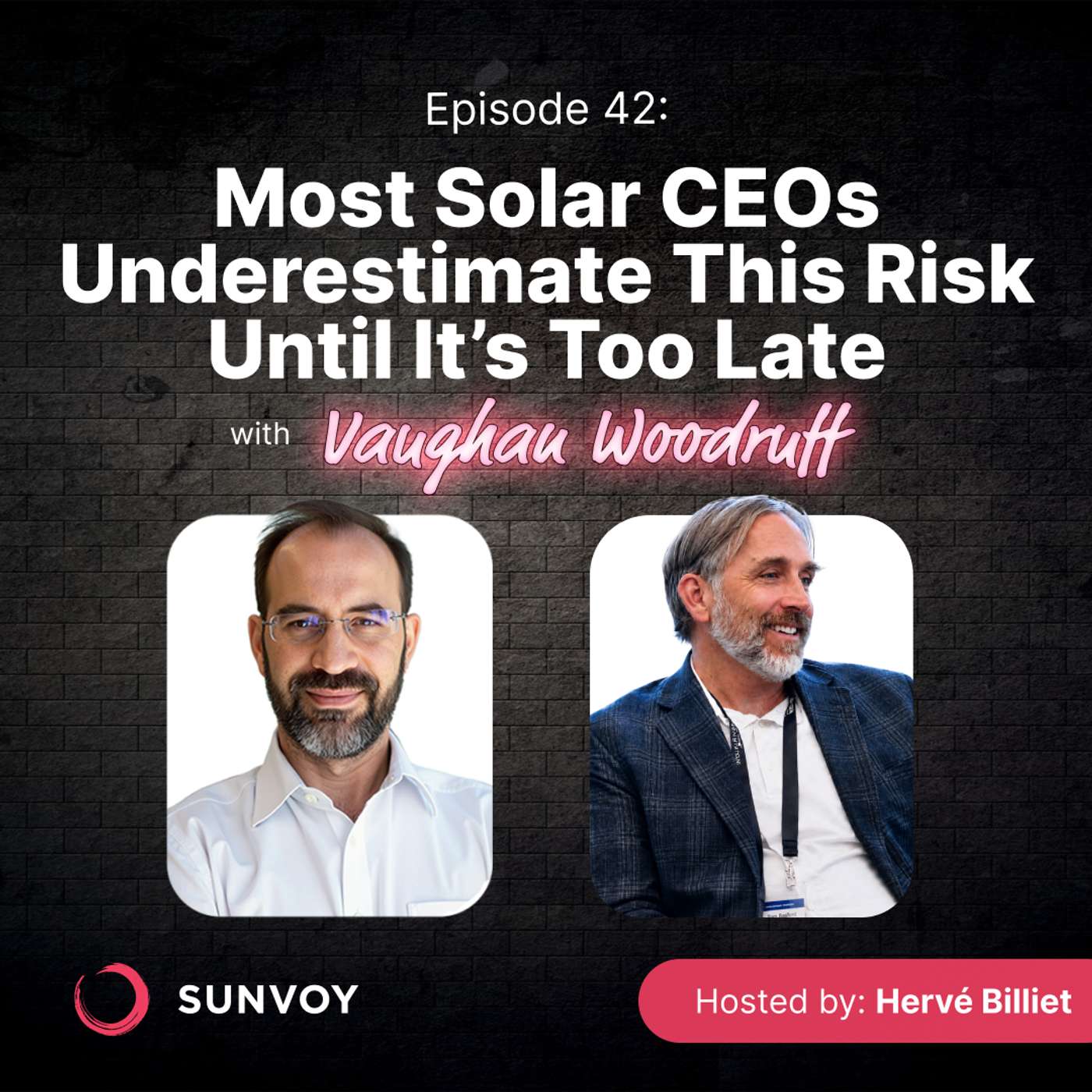
Alle Episoden ansehenEP 42
Most Solar CEOs Underestimate This Risk Until It’s Too Late
Über diese Episode
Interconnection is one of those things most solar companies don’t think about...until it becomes the thing slowing down the entire business. In this episode, Hervé sits down with Vaughan Woodruff to unpack the messy reality behind utility approvals, permitting bottlenecks, and why “people and process” issues are often bigger than the technical ones. They get into utility relationships, workforce development, community solar growing pains, and how outdated interconnection rules are colliding with modern tech like batteries, VPPs, and smart inverters. If you’ve ever had a project stuck in limbo because of utility red tape, this conversation will feel very familiar.
Transcript
Herve Billiet (00:01.138)
Welcome everybody to another episode of What Solar Installers Need to Know, where I invite Vaughan Woodruff. Hi Vaughan, how are doing?
Vaughan Woodruff (00:10.05)
Hey everybody, I'm doing great. How are you doing today?
Herve Billiet (00:12.206)
I'm doing great. First time that we record two podcasts on the same day. So we're going to hang out the volume for 2026. So tell us more about, Von, what you are currently doing. Maybe let's start there, but then also let's take a little trip through memory lane and speak about like the early days of Solar, how you got started, how you involved with the different institutions within the Solar industry, IREC and...
revision and everything in between. So, what do you currently do?
Vaughan Woodruff (00:45.838)
Yeah, great, Herve. Thanks again for having me. I'm the principal of Equinox DG, so it's a small one-person consulting business. We're focused really on solving the people and process issues with DER, distributed energy resource interconnection. It can be a really complicated process. A lot of people get turned away from it because it's technical, it's bureaucratic. 80% of the issues are people and process issues. So we're really digging in and helping to support
solar company owners, utility regulators, know, clean energy nonprofits in the space, well as utilities where they're willing to help solve those people and process issues. And I got here, you know, I did not go to school to work on interconnection regulation policy. My background, I'm actually a civil engineer, in my, in my undergrad. And then I was a teacher, ended up going back to grad school, for teaching after being
an engineer for a little bit and realizing it wasn't my thing in the way that I was doing it. And solar cross at like a perfect time, like that technical background plus the people background, I ended up getting into solar water heating roughly 18, 19 years ago. And for those who've been in it long enough know that was as much a teaching exercise as it was a technical exercise, right? It was about building markets. It was about the public who maybe knew a little bit,
but needed to know more to feel that trust because they may have been the first person in their lives that was actually going to buy one of these systems and wanted to feel really good about it, make sure that the people that they were working with were folks that they could trust because they knew they were going to get a hard time at the next dinner party. Someone saying, what the hell did you put that stuff on your roof for? And so I got into this when it was solar heating, when it was basically a HVAC technology. PV was happening a little bit at that time,
but it was mostly in select markets. The prices hadn't been at a place where folks could just buy it off the shelf, almost like we do today. And I ended up moving, that was in Montana. I'm originally from Maine where I am now and about 15 years ago, I moved back to Maine right as the housing crisis was going on. We moved back home, and I brought the business with me and ended up within a year,
Vaughan Woodruff (03:11.448)
started growing the business. was getting to a place where it was about time to hire, you know, that first threshold of hiring an employee, which was like, man, this is going to be complicated. I'm going to put it off. I'll keep working my tail off. And, know, eventually though, it was clear, need to bring some folks on board. And right at that time, a local community college just 15 miles down the road from me had been awarded this big department of energy grant for helping to integrate solar training into
trades programs around the Northeast, around New England and New York. And I hemmed in hot. mean, Looking back at it now, I can't believe that I was hesitant about it, but I had been moving in this direction. of, right, I've got this business. I didn't have any grand schemes of like growing this big multimillion dollar business. It was mostly, I'm living in rural Maine. This is something I can do and I like to do, and there aren't any other opportunities right here for me to do it.
And so just kind of leaned in not knowing what would happen. And so, during that time, I was basically, you know, working with plumbing and heating instructors, electrical instructors, building trades instructors, and helping them understand solar heating technology at that time, so that they could then, you know, convey it to their kids. And the big idea was like, at some point, clean energy is going to be a mainstream technology and everybody
in such and such a trade is going to need to know the things. The same thing was happening for PV at that time. And it was happening with an institution out in New York, Hudson Valley Community College that was doing the solar PV side of that instruction for the same region. And so that was a perfect, yeah.
Herve Billiet (04:54.568)
And so, I'd to interrupt, the idea was that every trade, if you do roofing, if you do plumbing, if you're in an electrical shop, that everybody's gonna add solar products, solar department is gonna be part of every company.
Vaughan Woodruff (05:07.822)
That's right. And this was a national program. Solar Energy International was part of it. Florida Solar Energy Center was part of it. Interstate Renewable Energy Council, which we'll talk about, I'm sure, in this conversation, was administering the whole program. And that was the piece that jumped me in. I I had known of SEI and FSEC for quite some time. I was like, how many times do I have the opportunity to work alongside these folks? And yeah.
It was ahead of the curve, right? Like this was the classic teaching people for jobs that don't yet exist, right? Like we would put this in, we would talk with community colleges, we'd talk with like vocate, you know, high school vocational instructors. They would learn this stuff. And there was a lot of grant money to help them kind of work that into their programs. You know, but at that time we hadn't seen the job growth that we would see, you know, in the coming years that would really drive
that demand because these are emerging markets in lots of places around the country. Obviously, there were some developed ones at that time, but this was really about how do we spread this across the whole country.
Herve Billiet (06:14.152)
So it work force development kind of, I've seen over the years, it's never in balance. Either you have a high demand, you don't find the people, then workforce development is kind of being ramped up. I remember like a few years ago, they were calling me, can you please hire? It was like, well, we're in a slowdown actually. At one point, like Ipsun was like, kind of like slowing down. So I cannot hire people that you just train. I don't need them right now. So it's always out of balance. I work for the development, it be pretty hard.
Vaughan Woodruff (06:43.062)
It is, you I've, I've sat on both sides of it. I'm now the chair of the, of the state workforce board here in Maine. So I see like the bureaucratic side of it as well. And, it's, it takes a while to get those programs out. There's a lot of public funding that may go into it. I mean, I remember when I was at revision energy, we had a, a state organization that essentially wrote our program into an RFP reached out to us ahead of time, just to say, Hey, we think this would be a great opportunity for you. then say,
the name outright, but it was, you know, this kind of program doing this kind of stuff in these kinds of states. We couldn't even go after the money because like you said, I mean, there were, there were some issues related to licensure ratios that it just made it really difficult for us to ramp it up in a way that was really gonna, you know, be in line with what, what that program was trying to achieve. It's really hard to do. And this is a big part of my life has been like market side
versus regulation side, right? And the two different pieces that those work at.
Herve Billiet (07:43.836)
Well, why don't we speak about interconnection? Because I think you have a similar situation there between policy and what happens in the real world and how does everybody in between. So tell us more about how, why is there even a need to begin with? What's what's the problem statement?
Vaughan Woodruff (08:02.069)
Yeah, the problem statement is essentially we have these systems or facilities, you they use a bunch of different names that want to be able to access the grid, right, to be able to operate in parallel with them. And the utilities are charged with providing a safe and reliable grid at affordable costs. Right. And in order to be able to do that, they need to be able to understand what is being proposed to connect and what kind of impact that will have on the system.
Stuff I focus on is distributed energy resources, just like a lot of your companies. We're not talking at transmission level. There are some similar processes, but the projects that we're looking at are not those utility scale projects where you need to do a deep engineering study for every single one and look at various factors to figure out how will it impact safety and reliability. so interconnection regulation is really about how do you streamline it to avoid those studies when you don't need them?
Herve Billiet (09:02.152)
Mm-hmm.
Vaughan Woodruff (09:02.234)
And so, yeah, that's been a big part about it. And when I was first in business, I took it for granted. mean, we started as solar water heating. I didn't have to worry about it. These are essentially islanded systems. They were heating water in the house, right? But when we got into working in the electrical trades, because of that pivot that took place once the price of PV dropped, and then heat pumps here in Maine, Maine's been a leader in heat pump deployment.
We really ended up pivoting to becoming an electrical contractor, renewable energy, obviously. And once you start doing that, unless you're doing off-grid, that's when interconnection happens. And like a lot, I'm sure like a lot of your listeners, when I first did it, it's like, okay, here's the utility. We're going to interconnect to this utility. They send me the forms. I fill out the forms. I put them in. I wait sometimes the right amount of time, maybe a little bit longer than I like to.
But eventually they say, okay, and it's good to go. Cause we were largely, you know, early on, like a lot of contractors working on Rezzi projects, maybe some small commercial projects that were essentially akin to Rezzi projects. And that's what it was like until 2019. was around that time had been leading the state industry trade group for a number of years. And so we were having a lot of issues related to net metering or energy billing, which, you know, on the policy front is
Herve Billiet (10:09.064)
Hmm.
Vaughan Woodruff (10:25.71)
always front and center for lots of states and lots of companies, especially during that time. And in 2019, after a pretty contentious gubernatorial administration who was actively outspoken, I mean, I would go on conservative talk radio to kind of push back on some of the messaging that was happening out of the Blaine House, which is where the governor's residence here is in Maine. We ended up getting a new governor that ran on clean energy.
and opened up a lot of the kind of arbitrary restrictions, the clean energy we had seen in the state and the pendulum swung. so up to that point, Interconnection again, it was filling out an application and sending it in. After that date, it was not that anymore. We saw a big expansion to community solar here, which put, you know, the utilities were seeing volumes in sizes of projects they hadn't seen before. And so that, you know,
As happens, right, that leaks right down into the business owners lapse as we start to see projects that maybe require more utility study or in some cases projects that were basically being told, you're not going to be able to connect this unless you're going to pay for a significant upgrade that we know your project probably can't afford.
Herve Billiet (11:45.192)
So once you have that in main, now that you work on interconnection, like you advise, you said usually about people and process. So you do these across the entire US or specific states?
Vaughan Woodruff (11:59.182)
That's correct. Yeah. My experience started in the Northeast and then in 2024, I joined the Interstate Renewable Energy Council's regulatory program. was the VP of regulatory reform there. And IREC is an organization that if your listeners don't know about, they should because it's been, it's served as a foundation for a lot of the stuff in the weeds, workforce development, permitting, and especially interconnection. prior to that, net energy billing or net metering.
but I had always leaned on Iraq when we would have a utility that would do something that seemed pretty outlandish. I would reach out to Iraq and say, we're kind of seeing this thing. This doesn't seem like, sorry, is this, is this something you've seen before? Am I just, you know, am I, are my expectations off? And we got a lot of them that were like, yeah, we've seen that before. No, it's not normal. Here are some ways to fix it. And so, yeah, I've been working nationally on this for the last.
couple of years and my consultancy looks at this across the entire country.
Herve Billiet (13:04.466)
All right. You mentioned people and process. So that's usually the core, but explain to me the people part in an interconnection request. Where the people are coming into play.
Vaughan Woodruff (13:16.706)
Yeah, I mean, the people are everywhere. For folks that are running a business, if you haven't thought about all the touch points and accountabilities for interconnection within your company, like the processes that you have within your company are probably not going to be durable for the long term, especially if you see market swings where, you know, the more solar, the more energy storage that we get on the grid, the more challenging this gets, right? So there's people in process there.
Right? Like, what are the conversation? Well, let's just start. We're acquiring customers. How are we thinking about where we're acquiring customers? Are we marketing out to the entire service carrier of the business, or do we know that there are constraints? And how do we know that there are constraints? What's being communicated to prospective customers in terms of the interconnection process? Is this an expectation that's being set that this is just fundamentally a
you know, box checking affair in which they're going to get an approval and it happens behind the scenes where they're not, you know, really a part of the process, but the company takes over for it. Or is it, is it going to be different than that? Are there going to be a lot of back and forth and communications? Might there be utility communications that maybe are a little bit confusing for somebody who just wants solar panels on their roof. Right. And then, and there, that's all the internal, what, what do the, what do the processes look like? How are we
preparing our staff to do this well, whether it's talking with customers, but then moving on to the utilities because utilities have served us well by being pretty stable, right? Having very fundamental conservative processes that aren't set to scale. They're set to operate on a fairly fixed, you know, expected volume, expected work volume. That's obviously changing. We're seeing a lot of low growth. We're seeing a lot of demand for
Herve Billiet (14:54.92)
Mm-hmm.
Vaughan Woodruff (15:10.35)
for DERs, that is where a lot of this stuff runs into a brick wall. We have a market that's moving very fast, technology is changing very quickly, and then you run into a utility that might as well be five or six separate businesses that share the same name. They have one group that's focused on billing, one that's on metering, one that's on planning, one that's on integrating DG, and they don't necessarily talk to each other in the way that we might expect.
That's where a lot of people in process happens. And then finally, which is some of the hardest is if that, if that just becomes a log jam, um, you know, applications are being put in and they're not being, uh, approved of the timelines are taking way too long or utilities coming back and saying, yeah, Herve, we're going to have to put in a 50,000 upgrade, $50,000 upgrade for that $25,000 PV system that you pitched. Um, then it gets into another
people in process, which is regulation. Because one of the things that we have here, right, we're not working with a free market business with the utility. We're looking at a, right, usually an investor-owned regulated monopoly. And the only way that those processes improve in lots of cases are if those utilities are being regulated in a way so that they're doing the things that are in the public interest. And so that
Herve Billiet (16:11.752)
Mm-hmm.
Vaughan Woodruff (16:37.974)
That in itself is another, I I unfortunately had to learn about this the hard way, right? There are not classes for learning about this stuff. We're trying to work on that right now with HeatSpring, but it's a lot of trial and error and learning on the role, know, learning as you go, learning as problems come up and how do you solve those problems? And, you know, my undergrads in engineering, my grads in education, I will say,
As a solar business owner, I probably leaned on that education degree way, way more than I did the engineering degree, especially as it comes to interconnection.
Herve Billiet (17:13.756)
Yeah. I want go back to the, when you said people, like having your staff, how they mentioned interconnection. think, you we went from like, you can sell anywhere, anytime. We were at places in DC where circuits were getting full. So you sell there, very likely you receive like, no, cannot interconnect. And so you just wasted your time and effort. So I think that's maybe a lesson learned also from other countries that the more sort of getting involved, you cannot just...
talk about a connection that's like, part of the points that check the box, think, and that's the hard part. The sales process, when you want a homeowner to just put their signature on that document, you also need to set them up for success that if they sign, they know that interconnection may be taking longer or even places in Virginia, we receive pushback from the utility, like can't do it. And so it became more and more the case that an interconnection is not a
just to check the box, that was part of it. And then also Sunvoy, we now have a way to have e-signatures so that when a project hits a sort of milestone, documents get sent out automatically. Because it is a cost if you have project managers to keep track of, oh, we need to fill out these interconnections and...
Maybe I shouldn't say these a lot, but it did happen that we say like the odd utility, bad utility, they didn't connect quickly. And then utility responds like, never send us a signed document. like, oops, you right. It did happen more than once. So it's like, yeah, we should just automate that part.
Vaughan Woodruff (18:48.792)
Totally.
Vaughan Woodruff (18:56.086)
You're not alone. this is, this is a P I mean, whenever I talk with companies and ask them about their interconnection issues and hear, hear what they are. The next thing I asked is like, all right, talk to me through how you're understanding this. And you know, for some it was, we have five people that are touching this process and it was actually an internal communication issue in terms of what was going. No one was tracking. Like when did the application get submitted? Well, the utility has a certain number of days before they're supposed to.
Herve Billiet (19:16.124)
Mm-hmm.
Vaughan Woodruff (19:25.166)
A verify that they received it and it was complete. And then after that to review it. Right. And if, if that stuff's not tracked when things become problems, then all of a sudden it's like trying to, you're starting from zero at the time that the problem happened, as opposed to looking back and saying, here are the trends, right? We, we have started to see these approval processes. They're increasing and increasing in the amount of time that utility is taking to do them. And so, yeah, there, there, there's so much data that
I will say once the problems came, I was like, that would have been a good one for us to have. Right.
Herve Billiet (19:59.176)
Thank
And if you have these at a certain level, imagine then scaling having more demands. Just magnifies any power you may have in that process to a level that just everything becomes bottleneck.
Vaughan Woodruff (20:13.74)
Right. it, you know, one of the things about this is solving an internal process issue as hard as it can be. Cause transition management can be really in change management can be really difficult. The fastest place it's going to move is within your business, right? The utility is probably not going to move nearly as fast as you will. And it's going to take like creative problem solving to find the lever and the incentive for them to do it. If their process is broken.
And then if it can't be reached through that, it then goes to regulation, which can take years. mean, you can have, I've been in several States where it's like the problem existed. It was clear it needed to be resolved. And it takes two to three years to go through, you know, inquiries with the public utilities commission, then to a rulemaking and then all the deliberations in the back and forth that take place.
You want to solve the problem in the places where it's quickest to resolve and be very proactive to avoid getting into the place where you're dealing with it when it's like code red and it ends up maybe having to go all the way to a public utilities commission because going there means you're solving problems from three or four years ago, which as you know is a really, really hard place to be as a business.
Herve Billiet (21:32.744)
Yeah, it's not an efficient way. But maybe let's speak about that worst case scenario. If you go to other rulemaking and all of that, three, four years later, has a problem then been resolved? Or you just go back to more investigations and just have you seen other problems that are still not resolved many years later after all that rulemaking and policies put in place and in the end nothing changes?
Vaughan Woodruff (21:57.222)
Or yeah, I mean, it can be a variety of things, right? Interconnection has been an easy thing for regulators to procrastinate on. It's technical. The parties that are coming to the table, which are typically industry and utilities, largely don't see eye to eye. And so the regulators are put in the position of essentially being a referee on technical issues and they
are largely staffed by lawyers, not by engineers. so it can be, and there's a concern, right? If we change, I'm here, you know, if I'm a commissioner, I may be hearing that if I change it here to deal with this problem, it's also connected to all of these other things, right? So for instance, if I'm solving issue related to community solar, even though we're not talking about rooftop, it could have big impacts on interconnection
Herve Billiet (22:43.026)
Mm-hmm.
Vaughan Woodruff (22:49.152)
impacts for rooftop systems and vice versa. yeah, its regulators take time and it's easy to procrastinate these things. Massachusetts is a great example. They've been talking about energy storage provisions there for six years at this point and are finally getting to a point to pass and update the utility tariffs there. But yeah, this is a really, it's a really hard thing. We have
37 states and territories in the US who have chosen to regulate their utilities on this topic, and none of them are the same. I keep thinking about this. I mean, you're an electrician, Herve, right? Like, can you imagine if the electrical code was different in 37 states, and then 13 didn't have one, and then, you know, the only thing that we see as it relates to electrical code is, you know, somebody might be on the 2023 and somebody might be on the 2020, right?
We know there are some changes that happen and some can be substantive. And if they're too much of a problem, an electrical board will maybe put in a fix before they adopt the next version of the code. But for interconnection, which is fundamentally, electrical code is electrical safety in someone's home, someone's premises. Interconnection's electrical safety is just that interface between the premises and the rest of the grid.
The physics is the same in Maine as it is in California, as it is in Maryland, you know. But for some reason, we have attempted to solve it in so many different ways. And it doesn't make any sense and this needs to shift.
Herve Billiet (24:27.272)
Do you see a future where they kind of start aligning?
Vaughan Woodruff (24:32.3)
Well, interestingly, Delaware, man, I've been talking a lot about Delaware lately for a little state. It's a pretty instructive example. Delaware was late to adopt interconnection procedures. So back about 20 years ago, the federal government made it very clear through the Energy Act to say, states, this is your responsibility. It's your responsibility to regulate interconnecting solar, small wind at that time, and now batteries to the grid.
And Delaware took some time, I actually passed a law in Delaware saying that they need to have interconnection procedures and they needed to be aligned with the model interconnection procedures of IREC, the Interstate Renewable Energy Council. And it took them a while, but finally in 2011, they did. And they, at that time, there was every year there used to be this report called Freeing the Grid that would grade every state's net metering and interconnection policies. Delaware got an A. They were the glowing example.
And they did nothing from regulatory perspective. And then in 2021, they launched a community solar program and said, we're importing energy from all over the place. We don't have much generation here in Delaware. Let's do it through community solar. And so in 2021, they passed a bill to get community solar on the books. And as of October, 2025, they had one four megawatt project that got installed under that program.
Cause they were operating their rules in 2011 were actually the based on the original IREC model from 2005. So they have like 20 year old rules that they never updated. No one was doing community solar 20 years ago, right? Like there weren't timelines saying like, Oh, when you do a system impact study, you have to do it within this period of time. The utilities in Delaware were actually complying with the rules that were on the books. And so.
Herve Billiet (26:09.558)
Mm.
Herve Billiet (26:29.511)
You
Vaughan Woodruff (26:30.702)
There's actually a bill, the session that's gone in to say, we'll see whether it passes or not, but that basically would require the public service commission to update their model interconnection, to update their interconnection procedures each time that IREC updates their model. And so that gets it more towards that like national electrical code cycle type approach. So watching that really carefully talking with parties in Delaware about that, because I do think
Herve Billiet (26:49.436)
Yeah.
Vaughan Woodruff (27:00.066)
We have to get to a proactive standpoint. Like how we dealt with interconnection nationally is reactive. A problem comes up, let's look at it. Let's talk about it for a really long time. Let's eventually change the rules. It takes years into your, you know, to the point we've been talking about, like once you solve the problem, three or four more acute problems have probably arisen during that time that now need to be addressed. And so that becomes a really challenging set of circumstances.
Herve Billiet (27:29.896)
Yeah. And none of those issues are actually very simple either. It's not, there was a reason why it does take a bit of a time, but, at the same time, I'd like to ask you if there is one change in interconnection policy that would have an outside impact nationwide. Is this something you have in mind?
Vaughan Woodruff (27:48.364)
Yeah, I think it's getting to the point where it's just an expectation that interconnection rules are updated on a regular cadence and that they're aligned with some sort of common threat because right now you have states, can't even, don't interconnection procedures and rules don't resemble one another. And so what ends up happening is then it further exacerbates this idea of each state needing to then
kind of think that they're coming up with their own solution to the problem instead of saying like, you know, let's just say you're Maryland and you look over the border and say, well, New Jersey just updated theirs. Ours were very similar to this. These are the things that they tweaked. Let's take a look at it here and then tweak it accordingly. It's really not how it happens. And commissions are just, they're very understaffed, right? Like they are so out resourced by utilities. And so
I mean, that's another place that we need to look at is making sure that we're funding those regulators. Because at the end of the day, in the world that I've lived in with utility regulation, the adage is utilities don't serve their customers, they serve their regulators. And across the country, it's really hard for regulators to come in and tell utilities, you need to do it this way. Cause if they don't have engineers and the utility says, well, this is going to impact safety and reliability. That is the line.
Herve Billiet (29:16.253)
Yep.
Vaughan Woodruff (29:18.06)
Right? Like that is the line that even if a utility is just like, I don't want to change my practices. It would be too much if they can find something that's safety and reliability. It probably can allow them to continue to do the things the way that they want to do them.
Herve Billiet (29:33.5)
Yeah, I was in DC. We had many meetings. It took a lot of my time as CEO to be in all those policy meetings. I'm an engineer by trade, reading long documents. not my forte. I know it take a great pleasure out of it, but we had to do it. At the time, residential was limited to 100% of past utility bills. That's how much you could install for SOAR. Now in May we're at 200%.
Vaughan Woodruff (29:41.645)
Hmm.
Herve Billiet (30:01.736)
I remember being on a very large table. The city representative commissioner was on one side. Utility was in front of us. it's like, At some point, after all those hours of conversations, like, why don't we go do the same as in Maryland and go to 200? And on the spot, I had the idea, like, why don't we just go to 200 over five years time? That leaves you some room to adjust over five years in utility. Because they use that, oh, it's at risk.
it's a risk of safety. so that's kind of a nuclear option, right? As soon as you tell it says that conversation is over. So, but I was able to come up with the idea to like, let's change the rules over five years, periods, 20% each year in addition. So even if it's a stretch every year you have, you can adjust a little bit to it. It's not a rule. We are five years later. So,
utility was able to work with that. But I remember, as soon as they say it's a risk for the grid, then that stops our conversation. And to their point, mean, if it is indeed a risk that would destabilize the grid, then they are in their right to push back. then I'm not managing an utility company, so it's easy for me to say it's not a risk.
Vaughan Woodruff (31:28.59)
For sure, 100%. And I think you're hitting the nail right on the head, Herve, as it relates to getting back to the people in process conversation here, which is being good at listening and hearing what the utility pressures are. Number one, help you build stronger relationships with the utility. But number two, also give you the opportunity to find those solutions that may be mutually advantageous outside of the eye of the regulator to start with so that
they can become, you you can come with collaboration to the table with solutions. And I always found when I was running a business early on, you know, I was on the phone as the business owner talking with the utilities when things came up and the person Nate at central Maine power, who I talked with at that time, he continued to move his way up the chain. And, you know, we would always be checking, you know, I would call you checking up on kids. We'd be seeing how
out each other's lives are doing. still do it today. Like if we end up running into each other at conference on the phone. And that's where like this opportunity for injecting empathy into your business model with a utility has huge opportunity for returns because I will never say I have, and I've dealt with this stuff a lot, the full understanding of what it takes to be a utility that's managing all the things that a utility manages.
I understand the interconnection side of things, but that is just a tip of the iceberg for what the utility is responsible for. And so there's a huge opportunity just in human relationships here, right? To have those meetings. And I found that some of the quickest opportunity to change things in a positive manner for my business also changed things in a positive manner for the utility. And we didn't both understand that until we sat down and we talked about the details.
And as I mentioned before, a utility is a bunch of different business units. whoever's at the, when someone comes and tells me, Hey, I was at this proceeding and the utility said this. I'm like, who for the utility said this? Was it their regulatory attorney? Have they talked to their engineers? Have they talked to the metering department? Things along those lines. And, know, usually I'll hear something and it's like,
Vaughan Woodruff (33:48.888)
probably the metering department wouldn't say that. Let me call the person in the metering department that I know and let's chat it through and make sure that the lines of communication are actually working on both sides of the equation.
Herve Billiet (34:00.104)
Interesting. So that's why in a very technical environment full of rules and regulation, in the end, the people is still an important factor.
Vaughan Woodruff (34:10.508)
Yeah. I mean, the utility for a bunch of us is a black box, right? We put some information in and some things come out. There are ways to learn about the black box and the easiest way to do it because every utility is a little bit different is by building strong relationships. I mean, I've been called from down in that area in Maryland. I got contacted by a national nonprofit who said, Hey, we had a customer reach out to us who
the utility basically said, no, you can't put in your rooftop system. We have no idea what to do. And so I was like, well, let's, let's see what this looks like. And started digging in, talked with the installer who had basically moved on, which makes sense because it's way cheaper for customer acquisition costs than it is to deal with a utility regulator. Right. But they didn't even have a contact in the utility besides the general,
you know, catch all email address that goes to the utility. And if you're a company right now that does not have somebody you can at the utility, if you deal with a singular utility or a couple, if you don't have someone that you can pick up the phone and contact and have a strong relationship with, you're behind the game at this point, right? Like that's a really critical aspect. It's part of the business model.
Herve Billiet (35:28.294)
Well, talking about risk, mean, utilities are in the business of mitigating their risk and make sure the grid is stable. But as a solar company, you need to mitigate risk. New policies can come your way and things like that, but not having a counterpart at utilities that you can actually call, that is part of risk mitigation, I think, as a solar business. I remember one of our utilities we worked with,
changed their interconnection procedure website. Little did we know that all the path, all the active interconnections at that time, everything got deleted. It's just the oops, it's gone. It's like, wait, we didn't know you would just literally just delete everything. Now for all the resi, it's annoying, but manageable. Just fill everything out again, just redo it and submit, it's fine.
But we had one 500, 560 ish kilowatt system in middle of DC. That already, we already had approval to interconnect. And well, that was gone. So we had to re-approve and then it got denied. It's like, we got in, we got into connection. We we, we already installed it. It's like, no, and then they come up with some crazy number or like 50, 60, thousand dollars extra or something like,
Vaughan Woodruff (36:50.648)
Mm-hmm
Herve Billiet (36:56.296)
we'll be stuck. It's already on the roof. So that was an interesting situation where in the end, after all the processes and procedures and rules and everything, it came down to me knowing the right people. One phone call and like Lily Teminus later, Paul was solved and that is Lily people.
Vaughan Woodruff (36:58.094)
Mm-hmm.
Vaughan Woodruff (37:11.054)
Mm-hmm.
Herve Billiet (37:19.752)
Maybe this is a good way to end this podcast about risk mitigation for a Solar company. Like know your vendors, know your partners. Utilities, I would expand it to distributors, right? Something can go wrong with distributors. Know your competitors too. Not every competitor is like a mean competitor, which is very friendly competitors out there. So get to know them. so yeah, Mitigate your risk as a business for a time.
Vaughan Woodruff (37:44.844)
Yeah. And if I could throw one more thing in there, you've been talking about DC a lot and it would be hard in early 2026 to get on a podcast about solar and not talk about the expiration of the tax credits. But DC has done something outstanding. you know, While I was at IREC, one of the folks on our team had been working in DC quite a bit. And I would hear from folks a bunch like, what do we spend in time in DC for? And it's such a small market. It's like, well,
they have utilities that are neighboring states that serve, you know, are the same family of utilities that serve DC. And what happens in small places is that strong examples can happen that can be replicated elsewhere. And I'm not sure if you saw this, but in late 2025, the public service commission in DC, issued an order that was amazing. And, you know, we had pushed hard for this.
And it's something that business owners really need to take into account. Cause a lot of times we've been looking at, all right, started construction deadlines in July, how are we going to meet those? There's FEOC stuff. The place and service requirements at the end of these projects, people are going to start paying more attention to them as the end of 2027 starts to roll around. Right. And some of these projects are going to require utility upgrades.
This was the thing as a business, a solar business owner that just, I felt like my brain exploded the day I was like, wait a second. My customer's federal tax credit eligibility is dependent upon the utility. Like, and I'm the intermediary and it's dependent upon me as an intermediary here too. Like this is nuts. But you know, there are going to be what ended up happening in DC and some of the things that we pushed for were having.
What they launched, we hadn't imagined it this way, and it's really great, is called the Temporary Conditional Interconnection Program. They told PEPCO, the utility there, that they can staff up for the demand that's going to happen. So they gave them the leverage to do that. They also required that they have a conditional authority to operate, which means that they're issuing paperwork that satisfies the place and service requirements of the federal tax credit.
Vaughan Woodruff (40:01.906)
even if the utility hasn't done their upgrades yet. So let's say, you know, let's say it's a 200 KW project and only 50 KW of it can happen in the near term before the utility puts in an upgrade. This requires the utility to actually have a standardized way to say, we're going to authorize you for the 50 KW. You complete your construction. We get it online at the timeline that we can. And then when the upgrade happens, it can be fully powered up. And this is going to be big.
stuff moving forward because the closer we get to the end of 27, I think more folks are going to recognize like, geez, I'm either negotiating these as a one-off with the utility or this isn't going to be an avenue that's available to me and regulatory processes take time. So right now, if folks have relationships with regulators in their state and are trying to figure out how to deal with this, that DC Public Service Commission order is something that every time I have a chance,
that we're talking with a commission on anything. It's like, have you seen what they've done in DC? Have you seen what they've done in DC? Because it's really instructive for ways to resolve the near term issues that we're having. And I really think this ticking clock becomes an opportunity because as we talked about earlier, interconnection has been something that's easy to procrastinate. We can't procrastinate it now. Tax credit wise, and then with all the capacity and energy affordability issues that we have, there are very few states that have good,
interconnection procedures for batteries for energy storage. And if folks want to be able to leverage those and they're going to start pouring them into utility frameworks that aren't set up to do it well, this is going to be problematic. yeah, We've got a short term ticking clock. I think that can help drive some long-term change. And we're looking forward to seeing how we can do that.
Herve Billiet (41:51.24)
And I think the hardware becomes also more complex, right? In the past, I mean, you could now throttle inverters more easily. You could redirect import-export limits. You could push it all into a battery to defect the gridless. So those interconnection agreements, I don't think, I mean, it's like how much are you going to put on the grid? It's like a field. That's it. It's not a formula or like depending on the settings of inverters and batteries and how they interact and depending on the weather, like
it's so much more complex than in the past. So I wonder how those forms are going to evolve over time. They will have to evolve because if you ask for a simple PV to be interconnected, that is just not the same as a PV with a battery that is so much smarter than before that can do virtual power plants and so much more interacted to the grid that a simple interconnection application is just, yeah, it's old school. It's just not the reality anymore.
Vaughan Woodruff (42:50.062)
Yeah, I mean, the vision that's there is that these hosting capacity maps that we think of as prospecting tools in the near term actually are approval tools in some areas like California. They actually use the results in the hosting capacity map for approval for small projects. And as it relates to flexible interconnection, there's an increasing number of these maps that are showing when constraints happen,
so that the inverter, the facility export can be scheduled so that it avoids exporting at times of major grid constraint. And this gets to the point, like it needs to be way more sophisticated. We're living in this information age that can make it happen. It's just a matter of how do we evolve regulation at the pace that technology demands and that humans in our communities demand. It's a hard one,
but definitely one worth solving. And there are lots of ways companies can get involved in doing that.
Herve Billiet (43:47.944)
It's been a real pleasure. Thank you for being on the What Solar Installers Need To Know podcast.
Vaughan Woodruff (43:52.706)
Yeah, same here, everybody. Thanks for getting this out.
Herve Billiet (43:55.388)
Thank you.